Application Of Blunt Bevel Dispensing Needles In Automatic Glue Machine Micro-Dispensing
Nov 12, 2026
1. Pain Points of Micro-Dispensing on Automatic Glue Equipment
Automatic glue machines for electronics, medical devices and optical assemblies require stable micro dot or micro line dispensing. Traditional sharp dispensing needles easily produce rubber debris if they are used to draw glue from stoppered containers, and the sharp edge causes glue tailing during cutoff. Ordinary blunt needles with flat tips have large flow resistance and poor flow consistency under low-volume micro dispensing. Particle impurities in glue will block tiny channels, leading to missing dots and dot size deviation. Many automatic glue machines use separate aspiration and dispensing needles, which increases fluid transfer links and contamination risk. When the glue contains crystal precipitates or filler particles, inline filtration is required, but external filter accessories bring extra dead volume and bubble generation. Standard fixed-size needles cannot adapt to special micro dispensing trajectories and compact valve structures. Without optimized bevel transition, the glue meniscus at the tip is unstable, causing dripping during head movement. ISO13485 medical electronic production also requires consumable traceability and particulate control, which generic industrial needles cannot satisfy.
2. Working Principle of High Precise Metal Dispensing Needle For Automatic Glue Machine
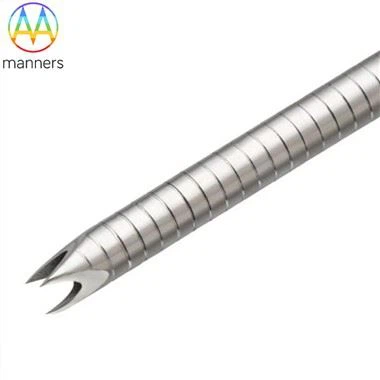
This stainless steel needle is designed for direct connection with dispensing syringes, integrating liquid aspiration and dispensing into one component. The 30–50° specially treated blunt bevel reduces coring when piercing glue container stoppers, cutting particle sources at the beginning. The optional built-in <5 μm hub filter intercepts filler particles, crystals and rubber fragments before glue enters the syringe and dispensing valve. The polished inner bore stabilizes fluid flow for micro dispensing. The moderate bevel angle creates a smooth outlet transition, helping glue break cleanly at cutoff and reducing wire drawing. The stainless steel body maintains rigidity under repeated pressure cycles on automatic glue machines. Inner diameter ranges from 0.1 mm to 0.8 mm, and custom inner diameter, tip length and hub interface can be produced from 2D/3D drawings or samples. The bevel geometry balances low flow resistance and anti-coring performance. The filter membrane only blocks solid particles without affecting the rheological behavior of adhesive, so the original dispensing recipe can be retained after switching.
3. Classification for Automatic Glue Dispensing Scenarios
By filtration function, blunt filter needles are selected for filled glue, crystal-prone glue and medical electronic adhesives; non-filter blunt bevel needles are for pure, particle-free glue formulations. By inner diameter, ultra-micro 0.1–0.3 mm is for picoliter-level micro dot marking and tiny component bonding; 0.3–0.6 mm is the mainstream for SMT, medical device assembly and general automatic glue dispensing; 0.6–0.8 mm is for higher-flow sealant and bead dispensing. By bevel tuning, 30–40° bevel versions are for delicate rubber stoppers and low-viscosity glue; 40–50° bevel versions are preferred for high-speed dispensing cycles and faster glue aspiration. By customization, standard stock needles fit common luer valves, while custom needles adjust hub, tip length and bevel angle to match proprietary automatic glue machine end effectors. ISO13485 certified options are available for medical electronic production. Packaging can be standard cartons or customer-specified cleanroom packaging.
4. Practical Operation Guide for Automatic Glue Machine Dispensing
First, select filter or non-filter type according to glue composition. Filled epoxy, conductive paste and crystal-prone glue need blunt filter needles. Second, select inner diameter matching the target dot size and filler particle size. The maximum filler particle must be smaller than the filter pore size and much smaller than the inner bore. Third, assemble the needle tightly with dispensing syringes before installing on the glue machine. Perform dry vacuum test to confirm no air leakage. Fourth, set dispensing parameters: avoid excessive pressure, which may rupture the filter membrane and cause tip deformation. Tune dispensing pressure, time and vacuum retraction to eliminate tailing and dripping. Fifth, tip height control: keep the gap between tip and substrate stable to ensure clean glue break. The blunt bevel outlet changes the meniscus behavior slightly, so fine-tune the gap after needle replacement. Sixth, scheduled replacement: filter needles must be replaced once flow rate drops obviously. For long continuous runs, schedule periodic dot inspection to catch drift caused by slow filter clogging. Seventh, cleaning protocol: flush the channel with compatible solvent after each shift for non-filter blunt needles. Filter needles for particle-rich glue are disposable on production lines.
5. Practical Experience from Automated Glue Dispensing Lines
Many dispensing technicians previously separated aspiration needles and dispensing needles, which doubled contamination risk. Using this integrated blunt filter needle simplifies the workflow and reduces particle introduction. A common error is applying the same pressure parameter for filter and non-filter needles. Filter needles have inherent flow resistance, so the dispensing recipe needs slight pressure adjustment. Operators also found that 40–50° bevel blunt tips provide cleaner cutoff than flat blunt needles, especially for medium-viscosity epoxy. When customizing needles for compact dispensing valves, the hub length is often overlooked, leading to mechanical interference during robot movement. In medical electronic batches, auditors will check whether filter needles are used for glue drawn from stoppered vials. Some factories only focus on dot precision while ignoring particulate records. When tailing occurs after switching to blunt bevel needles, the usual solution is adjusting vacuum retraction rather than changing to sharp needles.
6. Conclusion and Value Sublimation
High precise metal dispensing needles for automatic glue machines integrate anti-coring aspiration and micro dispensing functions. The 30–50° blunt bevel reduces stopper debris, and the optional hub filter intercepts particles in adhesives. It simplifies the fluid preparation workflow for automatic glue equipment and stabilizes micro dot quality. Drawing and sample customization adapts to different valve and robot structures. ISO13485 certification meets medical electronic regulatory requirements. It is not only a simple fluid outlet but a process control component that links glue preparation and final dispensing quality.
7. Industry Suggestions and Outlook
Automatic glue dispensing is moving toward smaller dots and higher speed. Equipment integrators should reserve standard luer interfaces for blunt filter needles in new machine designs. Process teams can build a glue-needle matching library by viscosity, filler size and target dot volume. Future optimization directions include low-adhesion bevel surface treatment to reduce glue residue and high-flow thin-film filter membranes with lower pressure loss. Suppliers can provide flow testing services for custom needle samples to shorten recipe validation cycles.