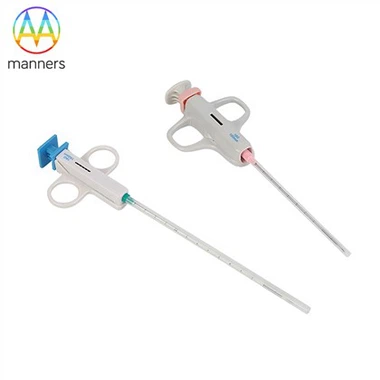
Full Gauge Specification System Of Brachytherapy Needle Manufacturers
Aug 07, 2026
1. Industry Pain Points In clinical cancer brachytherapy, many medical institutions lack standardized gauge selection standards, resulting in random matching of needle specifications and tumor lesions. Blind use of thick-gauge needles for superficial delicate tumors causes excessive surgical trauma, large wounds and slow postoperative recovery. Improper use of thin-gauge needles for deep and sclerotic tumors leads to insufficient needle body rigidity, easy bending and deformation during puncture, resulting in channel deviation and failed seed implantation. The lack of full-gradient specifications and customized sizes makes it impossible to adapt to personalized tumor depth, tissue hardness and lesion size, restricting the popularization of precise minimally invasive brachytherapy.
2. Working Principle The gauge specification of Mick-type brachytherapy needles determines the needle body diameter, mechanical rigidity, puncture stability and minimally invasive level. The G value is inversely proportional to the needle thickness: smaller G value means thicker needle body, higher compression resistance and bending resistance, suitable for high-resistance hard tissue and deep lesion puncture; larger G value means finer needle body, smaller trauma and higher operational flexibility, suitable for superficial, small and sensitive area tumor surgery. Professional brachytherapy needle manufacturers rely on precise pipe machining technology to ensure stable mechanical properties of each specification, realizing scientific matching of needle performance and clinical lesion scenarios.
3. Product Classification The full series covers 8G, 11G, 13G, 14G, 15G, 16G, 18G and 20G standard specifications, divided into three functional categories. Heavy-duty thick needles (8G/11G) feature ultra-high rigidity and deformation resistance, suitable for bone tumors, sclerotic malignant tumors and deep abdominal tumor puncture. Universal standard needles (13G/14G) balance rigidity and minimal invasion, covering most common solid tumors such as lung cancer, liver cancer and breast cancer. Fine minimally invasive needles (15G–20G) are ultra-fine and low-trauma, specially applied for brain tumors, cervical tumors and superficial micro-tumor high-precision implantation.
4. Practical Operation Standards Formulate specification matching schemes based on preoperative CT/MRI tumor assessment and tissue hardness detection. Hard deep malignant tumors select 8G/11G heavy-duty brachytherapy needles to ensure puncture stability. Conventional intermediate tumors adopt 13G/14G universal needles to balance safety and efficiency. Superficial sensitive lesions choose 15G–20G fine needles to reduce surgical trauma. For special irregular lesions, apply manufacturer customized non-standard sizes to realize one-to-one scenario matching.
5. Industry Application Experience The full-gradient gauge system of professional brachytherapy needle manufacturers completely solves the industry pain point of model mismatch. Standardized classified selection effectively avoids needle body deformation and excessive trauma problems, significantly improving the one-time puncture success rate and surgical safety. Customized size services make up for the limitations of standard specifications, perfectly adapting to special complex tumor surgical paths, and greatly improving the overall adaptability of brachytherapy instruments in individualized cancer treatment.
6. Summary Single specification and blind selection are key factors restricting the precision and safety of cancer brachytherapy. Brachytherapy needle manufacturers build a complete full-gauge product system covering heavy-duty, universal and minimally invasive types, matching all conventional clinical tumor scenarios. Combined with personalized customized size capabilities, the system realizes full-scene adaptive coverage, effectively standardizing clinical selection procedures and improving the refined treatment level of tumor interstitial brachytherapy.
7. Future Prospect In the future, manufacturers will further refine the gauge gradient and develop variable-diameter adaptive brachytherapy needles adapting to multi-layer tissue resistance. Combined with artificial intelligence tumor lesion analysis system, intelligent specification automatic matching function will be realized, further standardizing clinical operation and promoting the high-precision and intelligent development of cancer brachytherapy technology.