From Single Hole To Multiple Grooves: How AVF Needle Manufacturers Use Customized Innovation To Solve Dialysis Clinical Challenges
May 30, 2026
As the vascular conditions of dialysis patients become more complex, standardized AVF needles have failed to meet clinical needs. Manufacturers need to adopt customized designs to develop differentiated products specifically for special patient groups. They should optimize the entire process, including the needle tip shape, flow channel structure, and material selection, to address clinical challenges such as difficult puncture, insufficient blood flow, and vascular damage.
Special Needle Tip Design: Addressing Complex Vascular Access Issues
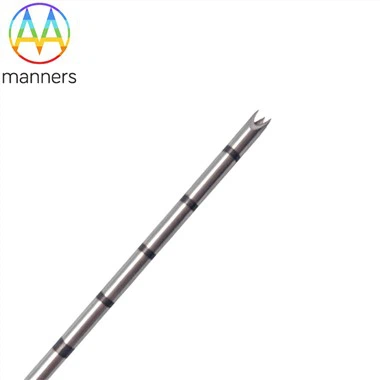
For patients with tortuous or calcified blood vessels, the manufacturer has developed angled needle tips (15° - 45°) to reduce the puncture force by increasing the contact area. For children or those with thin blood vessels, conical needle tips (with a tip diameter of 0.8mm) have been designed to reduce the risk of vessel wall tearing. Manners Technology customized a titanium alloy-coated needle tip for an elderly patient with severe vascular calcification. By utilizing the wear resistance of titanium, the service life was extended, and the surface micro-arc oxidation treatment enhanced the anti-thrombosis performance, increasing the patient's puncture success rate from 60% to 95%.
Multi-Groove Flow Channels: Improving Hemodynamics
The traditional single-hole AVF needle is prone to blood flow turbulence and vortex, which leads to red blood cell damage and coagulation. The manufacturer uses five-axis laser cutting to create 2-4 spiral grooves on the side of the needle body, forming a laminar flow field. For example, a double-groove needle customized for a patient with a hypercoagulable state has a groove width of 0.12mm and a depth of 0.06mm, which increases the blood flow speed by 25% and reduces the occurrence of coagulation events during dialysis from 2 times per week to 0 times. Finite element analysis shows that the groove structure can optimize the wall shear force from 15 dyn/cm² to 25 dyn/cm², which not only promotes the arrangement of endothelial cells but also inhibits platelet aggregation.
Material Customization: Meeting the Needs of Special Groups
For patients allergic to nickel, the manufacturer applies surface nitriding treatment to 316L stainless steel, forming a titanium nitride ceramic layer. This not only maintains the strength of the stainless steel but also prevents the release of nickel ions. For patients requiring long-term intravenous catheters, a degradable magnesium alloy coating needle has been developed. It gradually degrades in the body, avoiding vascular stenosis after needle removal. These innovations need to undergo accelerated aging tests (70℃/2 weeks to simulate 1 year) and biological safety evaluations to ensure the safety of long-term implantation.
Clinical Collaborative Innovation Model
Leading manufacturers have established a rapid response mechanism for clinical needs and have collaborated with dialysis centers to carry out a closed-loop innovation process of "problem - solution - verification." For instance, in response to the issue raised by nurses that "the needle body is prone to sliding," Manners Technology designed anti-slip textures on the needle holder, increasing the friction force by 40%; for the pain point of "difficult exhaust," they developed side-hole exhaust needles, reducing the exhaust time from 3 minutes to 30 seconds. This collaborative innovation has compressed the product iteration cycle from 18 months to 6 months.
Conclusion
The customized design of AVF needles is a direct reflection of the manufacturer's clinical insight. It requires converting patient needs into manufacturable engineering solutions. Only through continuous innovation and iteration can we provide safer and more efficient access tools for dialysis patients, truly realizing the "patient-centered" medical value.