From Cholangiography To Precision Puncture: The Origin And Evolution Of The Chiba Needle And Its Revolutionary Role in Interventional Radiology
Apr 18, 2026
From Cholangiography to Precision Puncture: The Origin and Evolution of the Chiba Needle and Its Revolutionary Role in Interventional Radiology
Core Product Terms: Chiba Needle, Percutaneous Transhepatic Cholangiography (PTC) Needle
Representative Manufacturers: Cook Medical, TSK Laboratory (Japan), Dr. Japan
The Chiba Needle, an indispensable precision instrument in interventional radiology, oncology, and urology, derives its name from Chiba University in Japan. Its birth was not the result of a deliberate quest for a new device, but rather a solution born from a pressing clinical challenge, eventually evolving into the cornerstone of modern percutaneous puncture techniques.
I. Origins: Innovation Driven by High-Risk Complications
Prior to the 1960s, Percutaneous Transhepatic Cholangiography (PTC) was a high-risk procedure. Physicians used relatively thick, stiff needles to puncture tiny intrahepatic bile ducts for diagnosing obstructive jaundice. However, this approach frequently led to severe complications, including bile leakage, peritonitis, and massive hemorrhage, severely limiting its clinical application.
A turning point came at Chiba University. Led by Professor Kunio Okuda and his team, they designed and popularized the use of a thinner, more flexible puncture needle. The core design philosophy centered on "thinness" and "flexibility": with an outer diameter typically less than 1 mm (e.g., 22–23G) and a thin-walled structure, the needle offered exceptional pliability. The narrow gauge significantly reduced the risk of damaging liver parenchyma and blood vessels, while the needle's flexibility allowed it to bend upon encountering resistance rather than forcing its way through, thereby drastically improving safety. This innovation transformed PTC from a hazardous examination into a safe, routine diagnostic method, rapidly gaining acceptance worldwide.
II. Design Essence and Nomenclature
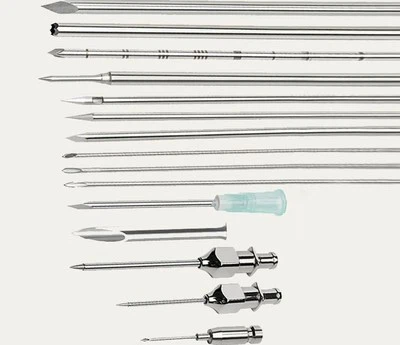
The classic Chiba Needle features several iconic characteristics: a sharp tip with a long bevel for smooth penetration; centimeter markings along the shaft for precise depth control under image guidance; and a transparent hub or luer-lock connector for easy attachment to syringes for aspiration or injection. Its essence lies in "fine-needle aspiration" (FNA), utilizing negative pressure to collect suspended cell clusters for cytological analysis.
Consequently, "Chiba Needle" evolved from a university-specific innovation into a generic term for a class of slender, flexible needles used for diagnostic puncture, aspiration, or establishing initial access tracts under imaging guidance (such as ultrasound, CT, or fluoroscopy).
III. Explosive Expansion of Applications
The success of the Chiba Needle was not confined to cholangiography. Its safety, precision, and minimally invasive nature quickly led to its expansion into nearly all percutaneous interventional fields, becoming a "master key" for interventional radiologists:
Tissue Biopsy: Used for fine-needle aspiration (FNA) of solid organs such as the liver, kidney, pancreas, lungs, and thyroid, providing cytological evidence for tumor diagnosis.
Percutaneous Nephrostomy: A critical tool for placing the initial guidewire to establish access for percutaneous nephrolithotomy or drainage of obstructed kidneys.
Fluid Drainage: Employed for puncturing and draining abscesses, cysts, or pleural/peritoneal effusions.
Vascular and Ductal Access: Used in complex vascular interventions or non-vascular luminal interventions (e.g., biliary, gastrointestinal) for initial puncture.
Early manufacturers like Cook Medical and Japan's TSK Laboratory standardized the production and promoted the global distribution of Chiba Needles. Cook Medical, in particular, established it as a standard tool in introductory interventional radiology training.
IV. Evolution and Modernization
While the core principle remains unchanged, the Chiba Needle continues to evolve to meet higher clinical demands:
Enhanced Ultrasound Visibility: The addition of echogenic coatings or dimpled surfaces on the tip or shaft makes the needle easier to identify and track under ultrasound imaging, improving the accuracy of ultrasound-guided punctures.
Material and Process Upgrades: Utilizing higher-grade 316L stainless steel and employing processes like electropolishing ensure a smooth inner lumen free of burrs, reducing tissue trauma and facilitating guidewire passage.
Specialized Designs: Derivatives such as the spinal anesthesia-specific Chiba needle feature unique tip designs that auto-seal the dural puncture site after insertion, minimizing cerebrospinal fluid leakage.
V. Conclusion: A Medical Legend Named After a University
The story of the Chiba Needle is a quintessential example of "clinical need-driven innovation." Starting from solving a specific clinical dilemma (PTC safety) and leveraging its superior design philosophy, it ultimately became a foundational tool for the entire field of minimally invasive intervention. Today, when physicians manipulate a slender Chiba Needle on an imaging screen to precisely reach a target, they are continuing the legacy of that great innovation from Chiba University over half a century ago. It is more than just a product; it represents a medical philosophy dedicated to pursuing safety, precision, and minimal invasion.