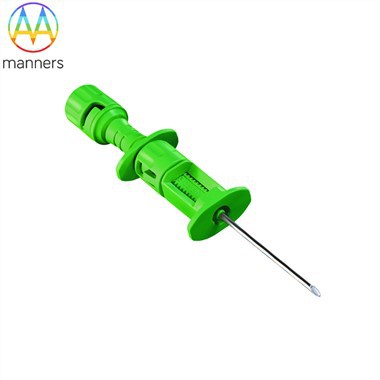
Focusing On Ultra-Precision Machining And Surface Integrity—Micron-Level Care: Creating A Zero-Trauma Passage With Super-Interior Laparoscopic Trocars
May 22, 2026
Official Announcement of Results:
We proudly introduce a precision manufacturing system for laparoscopic trocars based on the concept of "full-process generative machining." This system integrates precision CNC cutting, multi-axis linkage grinding, magnetorheological polishing, and specialized electrolytic polishing technologies, achieving mirror-level surface finish (Ra < 0.2 μm) and exceptional geometric accuracy on both inner and outer surfaces-particularly the critical internal working channel. This ensures surgical instruments pass through the trocar with "zero friction," minimizing microtrauma to surrounding tissues around the puncture site and redefining the very definition of "invasive" within minimally invasive surgery.
R&D Background Pain Points:
The sleeve serves as the "critical passageway" through which instruments enter and exit body cavities. Microscopic tool marks, burrs, and material micro-tears left by conventional machining methods-such as ordinary turning and drilling-represent a "rough truth" hidden beneath the smooth surface. These defects lead to multiple issues: first, increased frictional resistance during repeated instrument passage affects tactile feedback and precision, accelerates wear of instrument seals, and causes air leakage; second, rough surfaces are more prone to adhering blood, proteins, and tissue debris, forming biofilms that become potential breeding grounds for postoperative infections and are difficult to thoroughly clean and disinfect; third, during insertion and removal, microscopic irregularities may act like "fine sandpaper," scraping tissues and exacerbating inflammatory responses. Clinical demand for "ultra-smooth, non-invasive" internal lumens is growing increasingly urgent.
Core Technology Innovation:
Our technological core lies in disrupting the traditional segmented approach of "forming first, then polishing," and pioneering a generative process chain where machining equals finishing.
Precision CNC Machining: Utilizing a Swiss-type lathe with natural diamond tools, the outer diameter, conical surface, inner bore, and side holes of the sleeve are precisely turned and drilled in a single setup, ensuring shape errors and concentricity are controlled at the micrometer level from the outset.
Multi-Axis Grinding: For critical internal surfaces, micro-grinding with CNC spiral grinding using miniature abrasives effectively removes lathe tool marks, reducing surface roughness from above Ra 1.6 μm to below Ra 0.4 μm.
Magnetorheological Polishing: For complex internal cavities (such as those with side holes or valve seat structures), magnetorheological polishing technology is applied. Under magnetic field influence, the magnetic fluid containing nano-abrasives forms a flexible "polishing ribbon" that conforms adaptively to any complex contour, eliminating microscopic imperfections from prior processes without blind spots.
Specialized Electrolytic Polishing: Finally, precision electrolytic polishing is performed using an optimized electrolyte formulation and process parameters tailored for medical-grade stainless steel and titanium alloys. This step goes beyond simple brightening by selectively dissolving a few microns of the surface layer, leveling micro-irregularities and relieving stress concentrations, resulting in a mirror-finished surface with Ra < 0.2 μm and a more stable passive film.
Mechanism of Action:
The core mechanism of "zero trauma" lies in minimizing the surface friction coefficient and biological adhesion potential. The ultra-precision processed surface features an extremely low arithmetic average roughness (Ra value), indicating minimal height variation between micro-level peaks and valleys. When surgical instruments such as graspers or scissors pass over it, although the contact area is large, the actual contact points are continuous and smooth, allowing shear forces to be evenly distributed and significantly reducing friction. Simultaneously, the nearly perfect surface minimizes microcracks and "adhesion nests" caused by plastic deformation. In terms of biocompatibility, the exceptionally smooth surface greatly reduces non-specific adhesion of platelets and proteins, lowering the risks of thrombosis and infection, thereby achieving a unified physical and biological "low-trauma" effect.
Efficacy Verification:
Tribological testing shows that the dynamic friction coefficient between our sheath and standard instrument sealing valves is over 40% lower than that of conventional products. In durability tests simulating 100,000 instrument insertions, no visible wear marks were observed on the inner cavity, and airtightness was maintained. Bacterial adhesion experiments using Staphylococcus aureus and Escherichia coli demonstrated that, under identical conditions, bacterial adhesion on our ultra-smooth surface decreased by more than 60%. Histopathological analysis from animal studies revealed significantly reduced inflammatory cell infiltration and fibrosis around the tissue tract when using our product compared to conventional sheaths. Clinicians reported smoother and more precise instrument handling, particularly noticeable during delicate dissection and rapid suturing.
R&D Strategy and Philosophy:
Our philosophy is: "The essence of minimally invasive surgery lies in respecting every micrometer of tissue." We believe that the true strength of a trocar-the quality of its internal cavity-is far more important than its appearance. Our R&D strategy focuses on pushing the limits of manufacturing precision, treating "surface integrity" as the lifeline of our products. We invest heavily in state-of-the-art production processes, aiming not just to "make it," but to "make it perfect," ensuring that every interaction between instrument and human tissue is as gentle as a whispering breeze-practicing patient care with meticulous attention to the finest details.
Future Outlook:
We will continue to explore next-generation surface engineering. Our research focuses on developing "glaze-like" inorganic coatings that combine superlubricity with antibacterial properties, as well as investigating femtosecond laser-based fabrication of micro- and nanostructures to create specific biomimetic topologies on surfaces. These structures not only further reduce friction but also actively guide cell behavior, promoting wound healing. Our vision is to transform the inner lumen of laparoscopic trocars into a "smart interface"-one that not only enables seamless instrument transmission but also proactively protects tissues, pushing the concept of "minimally invasive" surgery toward a new frontier of "non-invasive" perception.