The R&D Philosophy Of PTC Needle Manufacturers
May 23, 2026
In the field of medical devices, material selection and product design directly define the performance boundaries of instruments. For percutaneous transhepatic cholangiography (PTC) needles, the application of material science and design innovation embody manufacturers' core competitiveness. From the perspectives of material engineering and industrial design, this paper deeply explores how PTC needle manufacturers enhance product performance in complex biliary interventions through material innovation and design optimisation.
Precision Engineering of Metallic Materials: Balancing Strength and Flexibility
The shaft material of PTC needles must satisfy multiple contradictory requirements simultaneously: sufficient rigidity to penetrate the hepatic capsule and parenchyma, appropriate flexibility to accommodate respiratory movement, and excellent fatigue resistance to withstand repeated use. Modern manufacturers achieve these goals through refined control of material science and heat‑treatment processes.
Micro‑regulation of Stainless Steel
The superior performance of medical‑grade 316L stainless steel stems from precise control of its chemical composition and microstructure:
Low carbon content (≤ 0.03 %): Prevents intergranular corrosion and ensures long‑term implantation safety
Molybdenum addition (2–3 %): Enhances pitting corrosion resistance against bile erosion
Grain size control (ASTM Grade 8‑10): Balances strength and toughness
Through cold working and appropriate heat treatment, manufacturers precisely regulate the mechanical properties of needle shafts:
Mild cold working (10–20 % deformation): Raises yield strength to 800–1000 MPa while maintaining good ductility
Solution treatment (quenching at 1050 °C): Eliminates processing stress and restores corrosion resistance
Stabilising annealing (850–950 °C): Prevents sensitisation and ensures consistent performance in welded zones
Super‑Elastic Application of Nitinol
For complex cases requiring curved puncture, nitinol delivers a revolutionary solution. This shape‑memory alloy exhibits super‑elasticity at body temperature, tolerating 8 % strain without fracture - eight times that of conventional stainless steel.
Manufacturers adjust phase‑transition temperatures by precisely controlling alloy composition and heat‑treatment processes:
Af temperature setting: Austenite finish temperature set at 30–35 °C to ensure full super‑elasticity at body temperature
Thermomechanical training: "Memorises" straight or pre‑curved shapes within the alloy via specialised processes
Surface passivation: Forms a titanium oxide layer to improve corrosion resistance and biocompatibility
Innovative Application of Polymer Materials: From Auxiliary to Functional Components
Polymer components in PTC needles have evolved from simple structural parts into functional modules.
Evolution of Hub Materials
1st‑generation: Conventional ABS plastic, prone to cracking with limited sterilisation cycles
2nd‑generation: Polycarbonate (PC), featuring good transparency and high strength
3rd‑generation: Polyetheretherketone (PEEK), resistant to high‑temperature and high‑pressure sterilisation with excellent biological stability
4th‑generation: Medical‑grade TPU, offering high flexibility and comfortable tactile feel
Functional Coating Technology
Polymer coatings on needle shafts have evolved from basic lubrication to multi‑functional integration.
Hydrophilic Coating Technology
Material systems: Polyvinylpyrrolidone (PVP), polyethylene glycol (PEG), polyvinyl alcohol (PVA)
Mechanism: Forms a hydrated layer upon water absorption, reducing friction coefficient from 0.5 to 0.05
Durability improvement: Cross‑linking technology raises friction‑resistant cycles from 10 to over 50
Antibacterial Coating Technology
Silver‑ion coating: Slow release of silver nanoparticles for broad‑spectrum antibacterial effects
Chlorhexidine coating: Cationic surfactant that disrupts bacterial cell membranes
Quaternary ammonium salt coating: Permanent antibacterial surface with no release of bactericides
Drug‑Eluting Coatings
Antiproliferative drugs: Paclitaxel and sirolimus coatings to inhibit biliary stricture
Anti‑infective drugs: Vancomycin and gentamicin coatings to prevent puncture‑track infection
Anticoagulant drugs: Heparin coating to reduce thrombosis
Structural Design Innovation: Integration of Fluid Dynamics and Ergonomics
PTC needle design must comprehensively consider fluid dynamics, mechanical performance and operational convenience.
Optimisation of Lumen Fluid Dynamics
In biliary interventions, fluid characteristics of contrast medium injection and bile drainage directly affect surgical outcomes. Manufacturers optimise lumen design via computational fluid dynamics (CFD) simulation.
Balance Between Inner Diameter and Flow Resistance
Basic principle: Per the Hagen‑Poiseuille law, flow rate Q is proportional to the fourth power of radius r and inversely proportional to length L
Design optimisation: Maximises inner diameter while ensuring rigidity. A typical 21G PTC needle with a 0.5 mm inner diameter delivers a contrast medium flow rate of 15 mL/min
Flow resistance control: Inner‑surface roughness Ra ≤ 0.1 μm, with specialised coatings reducing guidewire passage resistance to ≤ 0.2 N
Innovation in Side‑Hole Design
- For drainage catheters, side‑hole design directly impacts drainage efficiency and clogging risk:
- Spiral arrangement: Side holes arranged spirally to avoid weakening tube‑wall strength at the same cross‑section
- Large‑small hole combination: Proximal large holes (1.5 mm) ensure initial drainage, while distal small holes (0.8 mm) prevent tissue aspiration
- Anti‑clogging design: Smoothly transitioning side‑hole edges to reduce protein and cell adhesion
Needle‑Tip Geometry: The Science of Puncture Performance
Needle‑tip design lies at the core of PTC needle performance, optimised by manufacturers through biomechanical research.
Puncture Mechanics Research
- Tissue puncture process: Three phases of compression, cutting and separation
- Key parameters: Puncture force, tissue deformation, tissue injury
- Testing standards: Simulated materials such as gelatin, silicone and ex‑vivo porcine liver
Comparison of Needle‑Tip Types
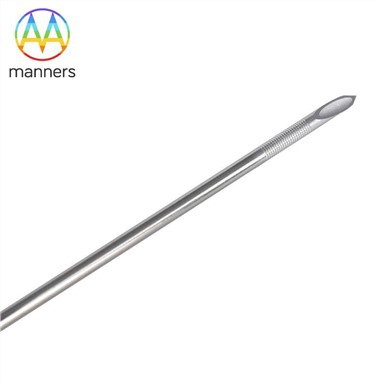
- Bevel‑tipped (Chiba needle): 15–30° bevel angleLow puncture force, moderate tissue injury, good directional controllabilitySuitable for most routine punctures
- Triangular‑pyramid‑tipped (Trocar needle): Three cutting edgesHigh puncture force, strong tissue separation capability, good directional stabilitySuitable for fibrotic tissue or repeated punctures
- Clover‑leaf‑tipped (Franseen needle): Three symmetrical cutting surfacesMinimal tissue compression, high‑quality biopsy samples, uniform puncture forceSuitable for tissue biopsy
Quantification of Needle‑Tip Sharpness
- Manufacturers evaluate needle‑tip performance via standardised testing:
- Puncture force test: Measures penetration force using standard test materials (e.g., polyurethane film)
- Cutting force test: Measures force required to cut simulated tissue
- Durability test: Sharpness retention rate after repeated punctures
Ergonomic Design: Optimising Surgeon Experience
Operational experience with PTC needles directly influences surgical efficiency and safety.
Hub Design
- Anti‑slip texture: Increases friction coefficient to prevent slipping with wet hands
- Colour coding: Distinct colours for different specifications for rapid identification
- Luer connector: Standardised design compatible with various syringes and connecting tubes
- Thumb rest: Ergonomically shaped for stable gripping
Visual‑Aid Design
- Depth markings: 1‑cm interval markers for precise puncture depth control
- Direction indicators: Hub markings aligned with the bevel direction of the needle tip
- Ultrasound enhancement: Special treatment at shaft markings for clear visibility under ultrasound
Innovation in Connection Systems
- Rotatable connection: Prevents accidental disconnection during operation
- Haemostatic valve: Prevents blood reflux and reduces contamination risks
- Quick‑connect design: One‑hand operable coupling
Testing and Validation: Guaranteeing Design Reliability
New designs must undergo rigorous testing and validation.
Mechanical Performance Tests
- Bending stiffness test: Measures shaft stiffness via the three‑point bending method
- Torsional strength test: Evaluates performance under torsional loads
- Fatigue test: Simulates respiratory movement to assess service life under repeated bending
- Puncture durability: Tests performance degradation through repeated puncture of simulated tissue
Fluid Performance Tests
- Flow rate test: Measures contrast medium flow under varying pressures
- Burst pressure test: Verifies the lumen's capacity to withstand injection pressure
- Leakage test: Validates the tightness of all connections
Pre‑Clinical Validation
- Animal experiments: Verifies safety and efficacy in porcine or ovine models
- Simulated‑use tests: Evaluates operational experience by experienced surgeons on simulators
- Usability tests: Observes learning curves for novice surgeons
Future Trends in Materials and Design
Materials and designs of PTC needles are evolving toward intelligence and multi‑functionality.
Smart Material Applications
- Shape‑memory polymers: Shape‑shifting at body temperature for self‑expansion
- Electroactive polymers: Rigidity adjustable by applied voltage for variable‑stiffness needles
- Hydrogel coatings: Expand upon tissue contact to fix needle position
Structural‑Functional Integration
- Multi‑lumen design: Main lumen for manipulation, secondary lumens for perfusion or drainage
- Integrated sensors: Pressure sensors for real‑time monitoring of tissue resistance
- Sustained‑release drug‑delivery systems: Drug‑loaded shafts for slow release of therapeutic agents
Personalised Customisation
- 3D‑printed manufacturing: Shaft shapes customised based on patient CT data
- Patient‑matched design: Shaft parameters optimised for special anatomical structures
- As PTC needle manufacturers, we deeply recognise that material and design innovation are the source of product competitiveness. Through in‑depth material research, precision engineering design and strict testing validation, we continuously push technical boundaries to provide clinicians with safer, more efficient and user‑friendly interventional tools. In the era of precision medicine, the integration of material science and industrial design will continue to drive innovation in PTC technology.