Engineering The Eye Glow
Nov 07, 2026
The Pain Point: Over-Treatment Burns
Some clinics use facial RF settings on the eye area, resulting in fat atrophy, indentation, and worse shadow. The pain point is iatrogenic aging: the treatment causes the very problem it was meant to solve. This is a particularly damaging outcome because it is visible, difficult to reverse, and directly linked to operator error. Patients who experience it often lose trust in the entire category, not just the clinic. Preventing over-treatment therefore protects both the individual patient and the industry's credibility. The problem is often invisible in training: a practitioner who is skilled with facial RF may assume that the same settings will work around the eye, not realizing that the thermal mass is far lower and the tissue far thinner. By the time the indentation appears, several weeks have passed and the patient has already lost confidence. The industry needs clearer education about energy budgets and about the difference between facial and periorbital protocols.
The Principle: Controlled Energy Budget
Under-eye tissue has low thermal mass, so energy must be tightly controlled. Gold-insulated needles localize energy and tip-only release avoids epidermal burn. Depth must remain conservative at 0.5 mm or less. Mechanically, smaller diameter lowers bending moment but raises stress concentration, so the needle must be straight within one degree to avoid micro-cracks in tissue. The concept of an energy budget is useful: each pulse spends a limited amount of thermal energy, and the operator must decide where to spend it. Spending too much in one area creates damage; spending too little produces no remodeling. Calibration and experience determine the right balance. It is also important to understand the difference between coagulation and contraction. Mild coagulation stimulates collagen remodeling, while excessive coagulation causes fat necrosis and volume loss. The eye zone is particularly vulnerable to the latter because the orbital fat pads are close to the surface and have limited regenerative capacity. A conservative protocol that prioritizes collagen stimulation over immediate tightening will produce better long-term results.
Device Categories: Insulated vs Non-Insulated
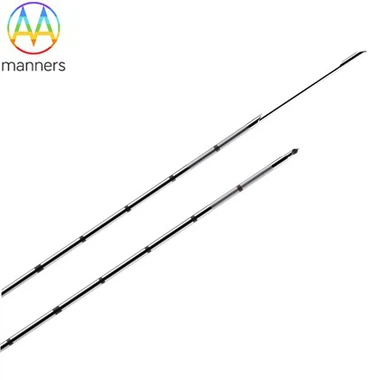
Insulated needles are safer for thin skin because energy is released only at the tip, sparing the epidermis and the dermal-epidermal junction. Non-insulated needles offer stronger remodeling but higher risk, and they should be reserved for thicker tissue such as the lateral cheek. Gold-plated insulated needles provide the best eye-zone profile, balancing safety and efficacy. Clinics should choose devices with adjustable energy and clear depth markings, and they should train staff on the specific eye-zone settings rather than assuming facial settings will transfer. It is also advisable to use devices with real-time impedance feedback, because tissue resistance changes as the needle passes through different layers. Without feedback, the operator is guessing, and guessing is unacceptable in the periorbital region. Maintenance and calibration records should be kept for every device, and any device that shows inconsistent energy output should be removed from service immediately.
Operation Guide: Energy Rules
Keep RF off at the medial canthus, where the tissue is thinnest and the angular vein is close to the surface. Use pulses of 50 ms or less near the lid. Perform a test spot and wait 15 minutes before continuing. Document settings for every session. If the patient reports heat beyond mild warmth, reduce energy immediately. These rules are simple but must be enforced consistently, because the eye zone leaves little margin for error. Before treatment, confirm that the patient has not used retinoids or acids on the area for at least five days. During treatment, keep the needle moving and avoid stacking pulses in the same spot. After treatment, apply a cooling mask and inspect the skin for any signs of blanching or excessive erythema. If these appear, stop and reassess. The goal is not to maximize energy but to deliver the minimum effective dose.
Field Experience: Documentation Saves Reputation
Before-and-after cross-polarized photos reveal vascular versus pigment change. Most "no effect" cases actually show vascular reduction; the patient simply did not see it in selfies. Standardized imaging protects both clinic and patient. It also provides evidence if a patient later claims the treatment caused harm. Documentation is therefore both a clinical tool and a risk-management tool. Experienced practitioners photograph under the same lighting, at the same angle, and at the same time of day for each visit. They also keep a written log of settings, serum, and patient feedback. When a patient expresses dissatisfaction, the clinic can review the record and identify whether the issue is technique, expectation, or biology. This systematic approach turns anecdote into evidence and allows the clinic to improve over time.
Summary: Less Is More Around the Eye
Precision beats power. The eye zone rewards restraint. Clinics that master conservative settings achieve better long-term results than those that chase immediate visible change. The principle applies to depth, energy, and session frequency alike. A patient who receives four gentle sessions will often look better than a patient who receives two aggressive ones, because the gentle approach allows collagen to mature without collateral damage. Restraint is not a compromise; it is the technically correct choice for thin, mobile, poorly vascularized tissue.
Outlook: Micro-Robotic Eye Heads
Robotic stamp arms with 0.05 mm depth tolerance will make eye treatments safer and more reproducible. This technology will reduce operator variability and allow more clinics to offer the treatment confidently. Coupled with real-time imaging and impedance feedback, robotic systems could adjust depth and energy automatically based on tissue response. The result would be a treatment that is both safer and more effective, and a category that is defined by engineering discipline rather than by individual skill alone.