Echogenic Needle For Nerve Block Training: Simulation And Competence
Nov 29, 2026
Regional anesthesia is taught at the needle tip. Textbooks describe planes, videos show expert hands, and mannequins display idealized anatomy, but the skill that matters is the ability to know, at every millimetre, where the point of a thin metal tube is sitting inside a living person. That skill cannot be acquired by watching. It has to be practised, and the quality of the practice depends on whether the trainee can see what they are doing. This is why the choice of needle inside a simulation programme matters as much as the curriculum around it.
Clinical Challenge: Learning on Patients Is Expensive
The traditional apprenticeship model asks patients to absorb the cost of training. Early attempts take longer, involve more passes, and produce more patchy blocks, which in an awake patient means discomfort and in a busy list means delay. Most departments accept this because there is no alternative, but the arithmetic is unkind: the learning curve is paid for by people who did not consent to be teaching material.
Simulation offers a partial solution, yet many programmes stop at the phantom. A trainee who has practised on a block of gel can find a target in a gel block, not a nerve behind fascia in a patient with a high body mass index. The gap between phantom competence and clinical competence is where confidence is created prematurely, and premature confidence is a recognised contributor to complications.
Working Principle: What Simulation Must Reproduce
A useful simulator reproduces three things: acoustic behaviour, mechanical resistance, and electrical response. Acoustic behaviour means the needle must appear as it does in tissue, including the change in visibility as the approach angle steepens. If the training needle has a strong echo at every angle, the trainee never learns to manage a lost tip, which is the single most important skill in clinical practice.
Mechanical resistance teaches force control. Tissue layers differ in how they yield, and the transition from skin to fat to fascia is information the hand uses to anticipate depth. Training models with realistic resistance develop the habit of advancing in small increments rather than pushing through, and that habit transfers directly to patients.
Electrical response completes the triad. Where stimulation is part of the protocol, the trainee must learn that a motor response is a distance estimate rather than a position, and that it can be misleading when insulation is damaged or the field is wet. Practising the interpretation of an ambiguous response is more valuable than practising a perfect one, because ambiguity is what clinical work supplies.
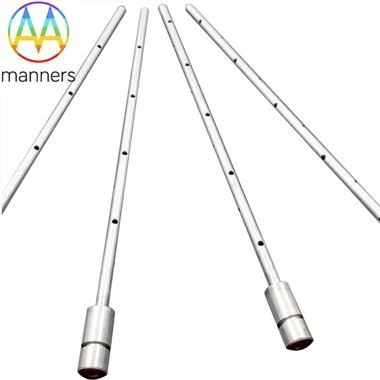
Cost is the fourth variable, and it cuts both ways. Sterile clinical stock used on a phantom is expensive and encourages careless handling, so programmes usually keep a dedicated training supply with the same specification but a different status. Whatever the arrangement, the device used for practice should behave like the device used in theatre: the same gauge range from 8G to 26G, the same stainless steel stiffness, and the same surface preparation, including electropolishing, laser marking, and the sterilization route the hospital actually uses. A training stock of Echogenic Needle For Nerve Block devices configured to mirror clinical kits, down to standard carton or client-specific packaging, removes the small unfamiliarities that otherwise appear at the first real procedure. It also makes assessment fair, because every trainee is judged on the instrument they will later be issued.
Product Classification and Specification Choices
Training programmes need devices that mirror clinical stock, not a separate economy line. If trainees learn on a needle with different echogenicity or stiffness from the one they will use in theatre, the transfer is partial and the first clinical attempts become a second learning curve. The practical approach is to specify one platform and use it in both settings.
|
Training Need |
Specification |
Why It Matters |
|
Phantom and gel models |
21G–22G, 50–100 mm, strong reflector pattern |
Matches routine clinical handling |
|
Steep-angle practice |
Laser-etched or machined echogenic surface |
Teaches tip recovery when visibility drops |
|
Stimulation workshops |
Insulated shaft, controlled active tip, 8G–26G range |
Accurate threshold interpretation |
|
Needle handling drills |
Standard carton, colour-coded hubs |
Familiarity before first patient |
|
Competence assessment |
Laser-marked depth graduations |
Objective measurement of depth control |
|
Procedure-specific modules |
Custom sizes on request |
Aligns model with local protocol |
The range available from 8G to 26G, with custom diameters and lengths produced on request, allows a programme to cover paediatric and superficial modules as well as deep plexus work without changing supplier. Medical-grade stainless steel construction ensures the mechanical feel is representative, electropolished lumens keep injection drills realistic, and options such as laser marking, sterilization processing, and client-specific packaging let a department configure training kits that match what staff will actually open in theatre.
Practical Technique: Structuring a Competence Pathway
Build the pathway in stages, with an explicit pass criterion at each. Stage one is device handling outside any model: loading the stylet, connecting the stimulator, identifying the bevel orientation by feel, and understanding the markings. Many complications begin with a trainee who has never looked closely at a needle.
Stage two is image interpretation on a phantom, where the objective is to identify the tip rather than the shaft. A simple exercise works well: the trainer advances the needle a few millimetres without announcing it, and the trainee must state which part of the bright line moved. Trainees who cannot perform this reliably are not ready for stage three, regardless of how many blocks they have watched.
Stage three introduces tissue-like models with layered resistance and simulated nerves, and requires the trainee to place the tip adjacent to the target, confirm with stimulation, and demonstrate spread. Stage four is supervised clinical practice with a defined number of observed procedures and a structured assessment of tip visibility, pass count, and injection technique. Each stage should be documented, because competence claims need evidence when a department is audited.
Troubleshooting Experience: Common Training Failures
The most frequent training error is chasing the needle. A trainee loses the tip, advances further hoping it reappears, and ends up navigating blind. Correcting this requires an explicit rule enforced during simulation: after two centimetres of invisible advancement, stop, withdraw, and re-orient. Rules learned under supervision persist under pressure; rules learned from a lecture do not.
The second is misreading stimulation. Trainees often treat any motor response as confirmation of correct position, when the relevant question is whether the threshold falls as the tip approaches and whether the response matches the expected nerve territory. Practising with a deliberately faulty cable or a wet field teaches the difference between a true and a false signal better than any explanation.
The third is overconfidence after phantom success. A trainee who has placed fifty needles in gel believes they have placed fifty needles in people. Supervisors should name this explicitly, and the assessment should include cases with difficult anatomy, since the skill being tested is adaptation rather than repetition. Recording which cases required rescue, and reviewing them together, turns individual near-misses into shared competence.
Procurement and Compliance: Equipping a Programme
Training budgets are usually small, so specification should emphasise durability per unit of realism. Reusable phantom models, a supply of 21G and 22G needles for handling drills, and a stimulator with visible current display cover most of the curriculum. Keep training stock separate from clinical stock but identical in specification, so there is no adjustment period at the first patient.
Compliance considerations are the same as for clinical supply: material certification, sterilization validation, and lot traceability. For devices used only in simulation, confirm with the supplier which documentation still applies and whether non-sterile variants are available, since using sterile clinical stock for phantom practice is wasteful and can encourage casual handling habits.
Documentation of training itself is a governance matter. Keep records of assessed competencies, the devices used, and the criteria applied, because accreditation bodies increasingly ask how competence was demonstrated rather than how many procedures were observed. A programme that can produce that record is in a stronger position when staffing or scope of practice is reviewed.
Conclusion: Competence Needs a Visible Tip
Training works when feedback is immediate and honest. A needle that shows its tip on the screen gives the trainee exactly that: a clear signal about where they are, followed by a clear consequence when they inject in the wrong place. A needle that disappears at awkward angles teaches nothing except the habit of guessing.
The practical implication for departments is to treat the training device as part of the curriculum. Match it to clinical stock, enforce rules about lost tips, teach stimulation interpretation as a probabilistic skill, and document assessment. Competence then becomes something demonstrated rather than assumed, which is the standard patients are entitled to expect.
Future Trends: Simulation, Data, and Credentialing
Simulation is becoming measurable. Force sensors in models, instrumented needles that log depth and trajectory, and AI-based assessment of recorded ultrasound clips allow a programme to score tip visibility and pass efficiency objectively rather than relying on supervisor impression. Once scoring exists, credentialing can reference it, revalidation can be tied to it, and a department can benchmark itself against peer units using the same recorded metrics.
Virtual and augmented reality platforms are moving from novelty to curriculum, particularly for rare approaches where clinical exposure is limited. These systems depend on device behaviour being reproducible, which favours needles with consistent echogenicity and controlled electrical characteristics. Alongside this, sustainability requirements will push programmes toward reusable models and reduced packaging, while single-use traceability and custom sizing become normal expectations rather than premium options.