Disposable Radiofrequency Needle Application In Chronic Pain Intervention
Oct 05, 2026
1. Industry Pain Points
Chronic nerve pain intervention is a high-frequency application scenario of radiofrequency technology, and traditional treatment equipment has many practical pain points. Reusable radiofrequency needles are prone to insulation damage after repeated use, resulting in scattered radiofrequency energy, unable to accurately target pain nerve points, leading to poor pain relief effect and easy recurrence. In addition, the rough surface of worn needles will cause excessive friction and tearing of nerve and muscle tissues during puncture, increasing postoperative pain and inflammation reaction of patients. The complex disinfection and maintenance process of reusable equipment not only increases the workload of medical staff, but also cannot completely eliminate cross-infection risks. Moreover, the single specification of traditional needles cannot adapt to different pain parts such as spine, joints and facial nerves, resulting in poor treatment pertinence and limiting the popularization of minimally invasive pain relief technology.
2. Pain Intervention Working Principle
The pain intervention mechanism of disposable radiofrequency needles is based on high-frequency ion vibration targeted thermal regulation. The equipment outputs 150,000 times per second high-frequency alternating current, which acts on the ion-rich tissue fluid around the pain nerve. Under high-frequency oscillation, tissue ions vibrate and collide rapidly to generate uniform biological heat. The disposable needle with complete insulation structure can accurately concentrate thermal energy on the lesion nerve area, adjust the nerve conduction function through controllable high temperature, block the transmission of pain signal from peripheral nerve to the central nervous system. Different from traditional destructive treatment, the precise thermal effect can selectively act on pain-transmitting nerve fibers without damaging normal sensory and motor nerves, realizing safe and long-term pain relief. At the same time, the one-time sterile design avoids inflammatory infection caused by equipment pollution, and reduces postoperative pain complications.
3. Pain Intervention Equipment Classification
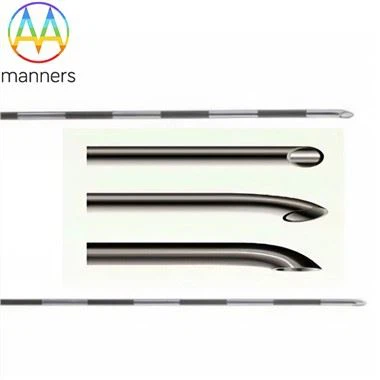
According to chronic pain types and intervention parts, disposable radiofrequency needles are divided into three categories. First, spinal pain special needles (8G-14G), with high rigidity and strong penetration, suitable for lumbar and cervical nerve root pain, intervertebral joint pain intervention, stable puncture and accurate positioning. Second, superficial nerve pain needles (18G-22G), with fine needle body and flexible operation, used for facial trigeminal neuralgia, postherpetic neuralgia and limb superficial nerve pain treatment, with minimal trauma. Third, joint pain customized needles, with special needle tip angle and insulation design, adapted to sacroiliac joint, knee joint and other deep joint pain intervention, which can accurately avoid joint synovium and blood vessels. All products adopt stainless steel sterile processing, with complete specifications and strong scene adaptability.
4. Clinical Intervention Operation Guidelines
Chronic pain intervention operations need to follow standardized minimally invasive processes. First, preoperative evaluation: confirm the patient's pain location, pain degree and lesion range, select the matching needle specification, and check product sterility and integrity. Second, positioning puncture: under ultrasound guidance, perform slow percutaneous puncture, adjust the needle tip to the pain nerve target point, and confirm the accurate position through electrical stimulation test. Third, thermal intervention treatment: turn on the radiofrequency host, set the safe treatment temperature and high-frequency vibration time, carry out targeted thermal regulation of the lesion nerve, block pain signal conduction. Fourth, postoperative care: withdraw the needle slowly after treatment, disinfect the puncture point, apply local hemostasis and bandaging, and observe the patient's vital signs and pain relief in real time. Used needles are uniformly disposed of as medical waste to avoid secondary pollution.
5. Practical Clinical Experience
Long-term clinical practice in pain departments proves that disposable radiofrequency needles have significant advantages in chronic pain intervention. The smooth polished needle body greatly reduces puncture trauma, and the postoperative local swelling and pain reaction of patients is significantly reduced compared with reusable needles. The stable insulation and energy output performance ensure accurate targeting of pain nerves, with a one-time pain relief effective rate of over 95% for common chronic pain, and a lower recurrence rate. For intractable pain such as trigeminal neuralgia and postherpetic neuralgia, customized special needles can adapt to complex anatomical structures, solving the problem of difficult positioning and poor treatment effect of traditional equipment. In addition, the one-time use mode saves equipment disinfection and maintenance time, improves the efficiency of clinical pain intervention, and reduces the operating cost of medical institutions.
6. Summary and Sublimation
Disposable radiofrequency needles effectively solve the problems of poor targeting, high trauma and high infection risk in traditional chronic pain intervention. Relying on precise high-frequency bio-thermal regulation principle, it realizes minimally invasive, safe and efficient treatment of various chronic nerve pain. Diversified classified products cover all common pain intervention scenarios, and standardized operation specifications ensure the stability and repeatability of treatment effects. The application of the product not only improves the clinical cure effect of chronic pain and reduces patient suffering, but also optimizes the medical service process of pain intervention, and promotes the standardized development of minimally invasive pain treatment industry.
7. Industry Prospect Suggestions
The industry should continue to optimize the structural design of pain-specific radiofrequency needles, develop flexible needle body materials to adapt to joint and deep tissue curved puncture, and improve positioning accuracy. Strengthen the research on thermal effect parameters matching different pain diseases, form targeted treatment parameter standards, and improve the pertinence of pain intervention. Accelerate the popularization of customized needle products for intractable pain, and enrich the product system for complex pain scenarios. At the same time, strengthen clinical promotion and technical training, improve the operational proficiency of medical staff, and further expand the application scope of disposable radiofrequency needles in chronic pain rehabilitation treatment.