Core Functions Of H₂O₂ Transfer Needles In Medical Low-Temperature Sterilization Systems
Jun 01, 2026
Within the low-temperature sterilization sector, hydrogen peroxide (H₂O₂) stands as the preferred sterilant for heat-sensitive medical devices thanks to its potent bactericidal, virucidal and sporicidal efficacy under low-temperature conditions. Manufactured by Manners Technology, the H₂O₂ transfer needle serves as a critical consumable inside such sterilization systems, whose performance directly governs the reliability, safety and cost efficiency of entire sterilization cycles.
Taking mainstream low-temperature hydrogen peroxide plasma sterilizers including the Sterrad® 100NX and NX series as examples, these units operate by vaporizing aqueous hydrogen peroxide inside an airtight sterilization chamber before subjecting vapor to plasma field decomposition into water vapor and oxygen to complete dry low-temperature sterilization. The indispensable initial step of the whole workflow lies in accurate, aseptic transfer of hydrogen peroxide solution at a fixed concentration (approximately 59% typically) from storage cartridges or bottles into the vaporizer installed within the sterilization chamber, a core interfacing task undertaken exclusively by the H₂O₂ transfer needle. The component pierces the rubber septum sealing the storage vessel to establish a hermetic delivery pathway and dispense calibrated liquid dosage over predefined durations. Any fluid leakage, inaccurate dosing or solution contamination mid-transfer risks aborted sterilization cycles and permanent damage to high-value sterilization hardware.
Material compatibility of the cannula body carries paramount importance. As a powerful strong oxidizer, hydrogen peroxide induces corrosive attack on most common metals. Manners Technology specifies Grade 303 and 304 stainless steel for proven outstanding corrosion resistance against high-concentration hydrogen peroxide environments. Particularly for fully hardened, tempered and electropolished surfaces, the homogeneous austenitic microstructure resists oxidative erosion from hydrogen peroxide and prevents metallic ion leaching that would contaminate the sterilant. Dissolved metal ions risk premature catalytic breakdown of hydrogen peroxide to compromise sterilization potency, alongside residual metallic deposits left on medical devices that pose potential hazards to patients. Accordingly, material test certificates and RoHS compliance documentation for transfer needles constitute mandatory paperwork during medical device procurement procedures.
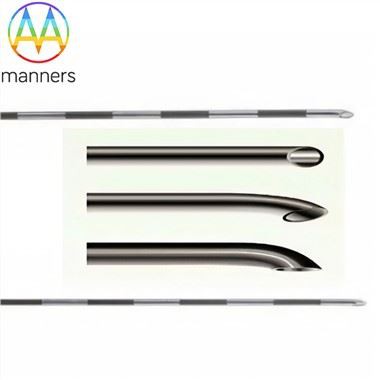
Precision-engineered geometry directly underpins consistent volumetric dosing. Sterilizer systems calculate dispensed hydrogen peroxide volume via closed-loop regulation of differential air pressure, dispensing duration and internal flow resistance, whereby the transfer needle's inner bore diameter, overall length and internal surface finish dominate flow resistance characteristics. Diameter tolerances controlled to ±0.01 mm with sliding headstock lathe machining deliver uniform flow resistance across individual needles, enabling identical fixed-volume H₂O₂ delivery for every sterilization cycle. The hexagonal hub design delivers robust anti-rotation locking to orient the beveled tip at optimal piercing angles, cutting down penetration resistance while aligning the central bore perfectly with supply tubing to eliminate turbulent flow and trapped air bubbles during fluid transfer.
From infection control perspectives, inherent cleanliness of the needle forms the primary barrier against cross-contamination. Electropolishing and ultrasonic cleaning implemented during production eliminate microscopic surface irregularities prone to biofilm formation. Further engineered as either single-use or limited-reuse configurations per model specifications and client contractual agreements, these design rules prevent residual buildup and microbial proliferation induced by repeated recycling. Inside busy hospital Central Sterile Supply Departments (CSSD), clinical technicians execute dozens of daily sterilization runs; reliable transfer needle performance therefore directly impacts operational throughput. Poorly engineered needles trigger piercing failure, fluid leakage or loose fitting connections that halt processing workflows and delay turnaround of surgical instruments.
From a broader industrial landscape, rising uptake of minimally invasive surgery and intricate reusable medical devices fuels growing reliance on low-temperature sterilization technologies. As an indispensable link within this technical ecosystem, iterative upgrades of H₂O₂ transfer needle design advance sterilization practices overall. New-generation needle variants engineered for higher-concentration hydrogen peroxide or viscous booster additives facilitate faster-cycle sterilization protocols. Ongoing manufacturer collaboration with leading sterilization equipment OEMs such as STERIS and Getinge mandates continuous product optimization to align with evolving international norms including the ISO 13485 medical device quality management standard and keep pace with successive equipment revisions. Though diminutive in physical size, the transfer needle functions as a cross-disciplinary hub bridging chemistry, material science, precision mechanical engineering and clinical infection control, occupying an irreplaceable position safeguarding modern healthcare safety.