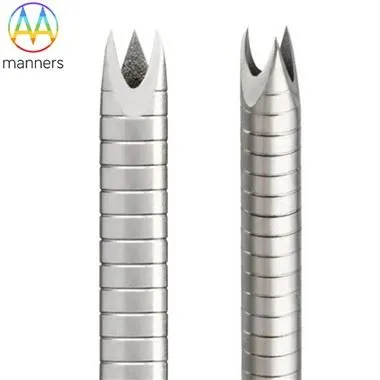
Coblation Electrodes For Inferior Turbinate Shrinkage
Nov 10, 2026
1. The Clinical Pain Point
Conventional heat-based nasal tools leave a heavy psychological footprint. Patients associate turbinate surgery with burning smell, charring, prolonged crusting, and painful recovery. Even when clinical results are acceptable, the patient experience often feels traumatic. Many people who would clearly benefit from turbinate reduction delay intervention for years because they fear "burning the nose."
From the surgeon's side, the bigger issue is control. Traditional electrocautery concentrates heat at the metal-tissue interface. Tip temperatures can approach 800°C, creating a wide thermal penumbra, carbonized tissue, and unpredictable collateral injury. In a structure as thin and vascular as the inferior turbinate, that lack of predictability is dangerous. Superficial burns cause crusting and synechiae; deep burns risk periosteal injury and bony exposure.
Another underappreciated problem is that many coblation wands on the market were originally designed for soft-tissue platforms outside the nose. They are too bulky, too stiff, or poorly balanced for the narrow nasal valve and the curved posterior turbinate. The instrument itself becomes the limiting factor.
2. Working Principle
Coblation is not "cutting with heat." It is low-temperature molecular dissociation mediated by ionized saline. The electrode operates in bipolar mode within a conductive fluid field. Radiofrequency energy accelerates sodium ions in normal saline, forming a constrained plasma cloud around the active tip. The plasma field breaks intermolecular bonds in tissue at 40–70°C, well below the threshold of carbonization.
Because energy is delivered through the plasma rather than through direct metal-to-tissue heating, the thermal spread is shallow-typically within 0.5 mm of the probe surface. The result is a precise submucosal channel with minimal damage to the overlying respiratory epithelium. Histologically, the treated zone undergoes coagulative change in the cavernous sinusoids, followed by controlled inflammation, fibroblast proliferation, and collagen contraction over 4–8 weeks.
Mechanically, the needle must sustain a stable plasma field without arcing. That requires a high-conductivity active tip, a precisely defined insulation window, and a shaft that resists saline corrosion. Tungsten or tungsten-alloy tips maintain arc stability; 316L stainless steel shafts provide structural stiffness and electropolish-friendly surfaces.
3. Device Classification
Reflex-style wands use a loop or angled active element. They are effective for bulk reduction but can be cumbersome in the anterior nose.
Hummingbird-style micro wands are slimmer, with finer tips better suited to turbinate heads and pediatric anatomy.
Needle-type plasma electrodes resemble RF turbinate needles but operate in plasma mode. They create discrete submucosal channels rather than broad surface effects, which aligns better with mucosal preservation.
Irrigated custom probes are the most adaptable. Shaft diameter can be reduced to ~1.5 mm, working length around 110–130 mm, tip angle and curvature defined by 2D/3D input. Laser-cut insulation windows control exactly where energy is released. Electropolishing ensures the shaft does not drag or tear mucosa during insertion.
4. Operational Guide
Saline infiltration of the submucosal plane is not optional. It separates tissue layers, sustains the plasma field, and cools adjacent structures. Without adequate irrigation, plasma collapses into resistive heating and the procedure reverts to cautery.
Under endoscopic view, the needle is introduced at the anterior turbinate and advanced parallel to the long axis. One to three channels per side are typical. Energy is applied in short passes of 8–12 seconds while the probe is slowly withdrawn. Activation every 6–8 mm creates overlapping lesions without overheating any single point.
Depth should stay submucosal, usually within 2 mm of the surface. Mucosal blanching, smoke, or resistance spikes mean the tip is too superficial. At the end of each channel, brief coagulation seals the entry point.
Postoperative care is straightforward: saline irrigation, nasal emollient, no forceful blowing for one week, and endoscopic review at two and six weeks.
5. Real-World Experience
Clinically, coblation feels different from hot RF. Patients report less intraoperative discomfort and less post-op pain. Crusting is lighter and resolves earlier-often within 2–3 weeks instead of 4–6. Rebound swelling peaks in the first week and then subsides.
Objectively, acoustic rhinometry and rhinomanometry show measurable reductions in nasal resistance by 6–12 weeks. Mucociliary studies show preserved ciliary beat frequency when the technique is submucosal.
The trade-off is lesion volume. Coblation treats a smaller radius per pass, so bulky turbinates may need more channels or a second session. Experienced operators plan geometry rather than power: more lines, lower energy, better symmetry.
6. Summary
Coblation electrodes turn turbinate reduction into a cold, controlled, mucosal-sparing procedure. The technology is not simply "RF with saline"-it is a different energy paradigm. When the needle geometry, irrigation, and depth control are correct, it offers one of the best comfort-to-efficacy ratios in modern ENT minimally invasive surgery.
7. Outlook
Future coblation needles will integrate micro-sensors for impedance, temperature, and flow rate. Irrigation, suction, and energy will be synchronized automatically. OEM customization will move from "choose a size" to "design a patient-specific access path," especially for revision cases and complex septal deviation.