Clinical Value Of 18G Biopsy Trocar Needles In Image-Guided Biopsy
Sep 30, 2026
1. Industry Clinical Pain Points
Traditional percutaneous biopsy procedures have long faced prominent clinical bottlenecks in imaging-guided lesion sampling. Conventional thick-gauge biopsy needles cause excessive tissue trauma, massive intraoperative bleeding and obvious postoperative scarring, seriously affecting patient recovery and cosmetic effect, especially limiting clinical application in breast minimally invasive biopsy. Ultra-thin small-gauge needles easily lead to insufficient sampling volume, incomplete lesion tissue acquisition and high false-negative pathological diagnosis rate, resulting in missed diagnosis and misdiagnosis of early lesions. Manual biopsy instruments have unstable puncture accuracy, prone to angle deviation and tissue displacement during sampling, and are greatly affected by artifact interference under ultrasound and stereotactic guidance. In addition, traditional biopsy tools have single structural design, poor adaptability to deep tiny lesions and complex tissue structures, frequent sampling failure and repeated puncture, which increases patient pain and clinical operation risks, restricting the standardized development of precise biopsy diagnosis.
2. Core Working Principle of 18G Biopsy Trocar Needles
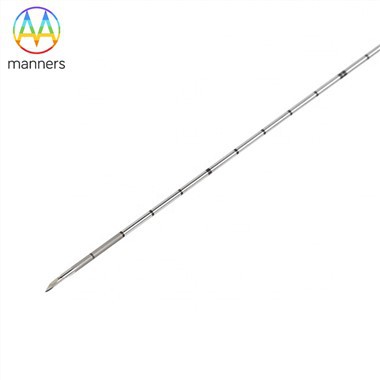
18G Biopsy Trocar Needles adopt optimized medium-gauge precision design, perfectly balancing sampling adequacy and minimally invasive clinical needs, and become the core equipment of modern ultrasound and stereotactic guided core-needle biopsy (CNB). Adopting integrated trocar puncture and sampling structure, the needle tip is processed by professional grinding and laser cutting technology to form ultra-sharp and precise cutting edge, which can penetrate skin and lesion tissues with low resistance, realizing regular and tiny puncture incisions. The scientific 18G caliber design ensures sufficient core tissue sampling volume at one time, completely solving the insufficient sampling defect of thin-gauge needles, while avoiding the excessive trauma of thick-gauge instruments. Made of high-quality medical stainless steel and processed by fine necking, swaging and electropolishing technology, the needle body has ultra-high smoothness and structural stability, effectively reducing tissue friction and artifact interference under imaging guidance, ensuring accurate in-place sampling and improving the authenticity and effectiveness of pathological samples.
3. Product Classification and Performance Characteristics
According to clinical operation mode and imaging adaptation scenarios, 18G biopsy trocar needles are divided into manual conventional biopsy type and automatic CNB adaptive type. The manual conventional type features flexible operation and strong controllability, suitable for routine superficial lesion biopsy and basic clinical sampling, with high cost performance and wide popularization value. The automatic CNB adaptive type matches the working mechanism of modern automatic core-needle biopsy devices, with precise structural size and stable popping sampling performance, specially designed for ultrasound and stereotactic guided precise biopsy of deep and tiny lesions. All products support full-size personalized customization according to customer 2D/3D drawings or samples, covering multi-gauge size expansion. Adopting laser marking and precision finishing technology, the products have clear scale identification and stable performance, and can adopt standard carton packaging or customized packaging according to procurement needs.
4. Standard Image-Guided Biopsy Operation Guidelines
Preoperative preparation: Select matching 18G biopsy trocar needles according to lesion depth, size and imaging guidance mode. Inspect needle tip sharpness, needle body smoothness and scale integrity to confirm no deformation or damage. Complete preoperative ultrasound or stereotactic positioning to mark the precise puncture path and lesion target area, and implement standardized local anesthesia to avoid target tissue blurring caused by excessive anesthetic infiltration. Intraoperative operation: Under real-time imaging monitoring, slowly penetrate the tissue along the preset path with uniform force, adjust the needle body angle accurately to avoid blood vessels and normal tissues. After the needle tip reaches the lesion target, complete core tissue sampling stably, avoid repeated needle movement to reduce artifact interference and tissue bleeding, and ensure complete and undamaged sample acquisition. Postoperative processing: After sampling, slowly extract the needle body, perform local hemostasis and sterile dressing, record operation information in detail, and send the core samples for standardized pathological detection and analysis.
5. Practical Clinical Application Experience
Long-term clinical practice of image-guided biopsy verifies that 18G Biopsy Trocar Needles have irreplaceable comprehensive advantages in minimally invasive sampling. Compared with thick-gauge needles, this product has smaller puncture trauma, lighter postoperative pain and no obvious scarring, with excellent cosmetic effect, which is highly suitable for breast and superficial soft tissue biopsy. Compared with thin-gauge sampling tools, the one-time sampling volume is sufficient and complete, effectively reducing the false-negative rate of pathological diagnosis and improving the accuracy of early lesion screening and diagnosis. Under ultrasound and stereotactic guidance, the smooth needle body and precise structural design greatly reduce imaging artifacts, ensuring clear intraoperative vision and accurate puncture positioning. The product has stable mechanical performance, low sampling failure rate and few postoperative complications, and is compatible with most automatic and manual CNB devices on the market. With flexible customized services and reliable processing quality, it has become the mainstream preferred instrument for clinical routine and precise biopsy operations.
6. Summary and Sublimation
18G Biopsy Trocar Needles effectively solve the industry pain points of unbalanced sampling effect and trauma degree, low diagnosis accuracy and poor imaging adaptability of traditional biopsy instruments. With scientific 18G medium-gauge design, precision processing technology and excellent image-guided adaptive performance, it realizes the organic combination of minimal surgical trauma and sufficient effective sampling. It standardizes the operation process of modern core-needle biopsy, improves the accuracy and safety of imaging-guided percutaneous biopsy diagnosis, provides reliable instrument support for early screening and precise diagnosis of breast and other tissue lesions, and promotes the standardized and minimally invasive development of clinical pathological biopsy technology.
7. Industry Prospect and Development Suggestions
With the continuous improvement of public early tumor screening awareness and the popularization of precise imaging diagnosis technology, the market demand for high-precision minimally invasive biopsy needles will continue to grow. It is suggested that medical device enterprises continuously optimize the needle tip cutting structure and imaging adaptive performance of 18G biopsy trocar needles, reduce artifact interference and further improve puncture precision. Enrich personalized customized specifications to adapt to special lesions such as deep tiny lesions and adjuvant lesions. The industry should unify the technical standards and operation specifications of image-guided biopsy needles, strengthen clinician standardized operation training. Medical institutions should comprehensively popularize high-precision 18G biopsy trocar needle sampling technology, improve the overall level of early lesion diagnosis, and promote the high-quality development of minimally invasive biopsy diagnosis industry.