Pot Life At The Needle Tip
Nov 13, 2026
Ask a supplier for pot life and the answer comes back in hours. Ask the line why the last twenty units of a batch look different from the first twenty and the answer is a shrug. The two numbers are not measuring the same thing. Pot life describes a mass of adhesive sitting in a pot, where most of the material is shielded from air. A needle tip holds a film a few tenths of a millimetre thick, exposed on three sides, warmed by a valve block above it, and asked to flow through a channel narrower than a hair. Its usable life is a fraction of the quoted figure, and it is the fraction that decides whether a shift runs clean.
Treating tip life as an unavoidable nuisance leads to compensating habits: more frequent purges, longer wipes, higher pressure to force through a thickening bead. Each of those masks the symptom while adding cost. The more useful approach is to understand what consumes the working window, to notice the failure before cure hides it, and then to design the cycle around the real clock rather than the catalogue one.
The Gap Between the Drum and the Exit
Where the Clock Actually Starts
Pot life begins when the two components meet, which for a static mixer is at the first element. Everything downstream shares that clock, including the mixer, the adapter, the needle and the deposit. A line mixing thirty shots an hour spends most of that hour with reactive material standing in the last thirty millimetres of the path. The relevant question is not how long the batch lasts, but how long the material in the tip can wait between shots.
Surface Area Is the Real Clock
Cure is a surface phenomenon before it becomes a bulk one. In a narrow bore, the ratio of wall area to volume is high, so a thin film reaches a different state far sooner than the same chemistry in a pot. Two epoxies with identical pot life can behave completely differently at the tip if one wets the wall and skins over while the other stays mobile. Wetting behaviour and filler content matter as much as the headline cure schedule.
Dead Volume Holds Yesterday's Material
Every transition from mixer to needle carries a cavity that the flow does not fully sweep. Material in that cavity ages in place and is released gradually, mixing a fraction of older adhesive into fresh shots. The result is a deposit that is chemically slightly different from what the drawing assumes, with cure gradients that only appear after oven inspection.
What Shortens Life at the Tip
Air, Light and Solvent Loss
The open exit is an evaporation surface. Low-viscosity grades lose solvent or a reactive diluent and thicken at the very edge, which is precisely where shear is highest in the next shot. Some formulations skin over through contact with air, others through exposure to light. A cap that closes the tip between cycles does more for consistency than most recipe changes, and it costs far less than scrap.
Heat From the Valve
Valve bodies sit close to heated platens, preheat stations and lamps. A needle attached below a warm block runs several degrees above ambient, and cure rate roughly doubles for every ten degrees in many epoxies. Sealing the adapter with a thermal break, or simply measuring the needle temperature with a contact probe, often explains a drift that no amount of pressure tuning will fix.
Shear History and Filler Settling
Each shot shears the material in the bore. Filled epoxy that thins under shear recovers slowly, so a rapid sequence of shots can keep the tip in a low-viscosity state, while a pause lets it rebuild and settle. Settling is permanent in the sense that no pressure change restores the original distribution; once filler concentrates at the exit, deposits become lean in the resin that carries them.
Reading the Symptoms Before Cure
Stringing and Tailing
A thread that stretches rather than breaks is the earliest reliable signal that the material at the exit has changed. It may be solvent loss, partial advance of cure or a filler-rich skin. The distinction matters because the remedies differ: capping addresses the first, cycle time the second, and a wider exit or a purge addresses the third.
Weight Drift Across a Pause
Weigh ten shots, wait five minutes, weigh ten more. If the second set trends lower, the path is holding material that no longer flows freely; if it trends higher, aged material is being pushed out first. This simple test separates an ageing problem from a valve problem in under ten minutes and needs no instrumentation beyond a balance.
When Purging Masks the Problem
A line that purges before every shot can hide a badly matched needle for months, at the cost of adhesive and cycle time. The waste becomes normal and stops being questioned. Every purge habit deserves a number: grams per shift, seconds per cycle, and what the process would look like if the tip could simply hold its state for the interval between shots.
Designing the Cycle Around Tip Life
Purge, Wipe, Cap or Chill
Purge is the blunt instrument: it removes aged material by discarding it. Wiping removes only what protrudes, leaving the bore unchanged. Capping isolates the exit from air and light with almost no material cost, and chilling the needle slows reaction without altering chemistry. In practice the cheapest sequence is usually cap between short pauses, purge after long ones, and wipe only as a housekeeping step rather than a control measure.
Needle Geometry That Buys Minutes
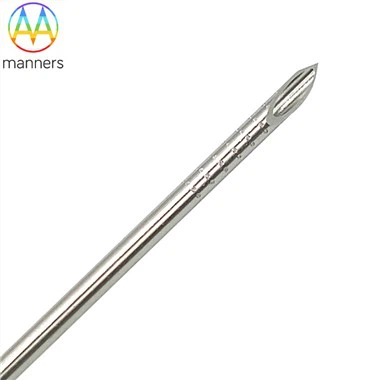
Geometry is an underused lever. A shorter needle holds less aged material; a smoother internal finish leaves less film behind; a tapered bore avoids the step where material stalls. Standard stainless needles are available from 0.1 mm to 0.8 mm inner diameter, with custom inner diameters quoted from a 2D or 3D drawing or from a sample when the exit needs a specific profile. At micro-volume deposits, that geometric choice decides whether the shot repeats at all. High precision stainless steel epoxy adhesive glue dispensing needles are frequently specified with a taper for exactly this reason: the continuous transition reduces the stagnant region where the clock runs fastest.
Long thin-wall parts also need packaging that protects them in transit, since a bent tip is a scrapped tip; standard cartons suit short lengths, while custom packaging protects long or fragile geometries. Documentation supporting a quality system, in the sense of ISO13485, belongs in the same conversation when the assemblies end up in regulated products.
FAQ
Does a longer needle shorten the working window? Yes, in two ways: it holds more material that ages between shots, and it adds pressure drop, which encourages operators to raise pressure and shear the material harder.
Can pot life be extended by cooling the needle? The reaction slows, but viscosity rises and filler settling does not stop. Cooling buys minutes for a pause, not hours for a shift, and it must be measured rather than assumed.
Why does the first shot after lunch always look different? Material in the tip has had time to skin, settle or partially advance. A short purge, a cap, or a warm-up cycle returns the path to the state the recipe assumes.
Is a wide bore more forgiving of long pauses? Generally yes, because the surface-to-volume ratio is lower and the film at the wall is a smaller share of the cross-section. The trade is a larger deposit footprint and a bigger dead volume.
Key Takeaways
Quoted pot life describes a pot, not a tip; the two differ by a large factor.
Wall area to volume ratio, not bulk chemistry alone, sets how fast the exit changes.
Weigh ten shots, pause, weigh ten more: the trend identifies ageing in minutes.
Capping between short pauses is usually cheaper than purging through them.
Geometry is a control variable: shorter, smoother and tapered paths hold less aged material.