Clinical Pains And Technical Breakthroughs Of Oncology Brachytherapy Particle Implant Needles
Aug 08, 2026
1. Industry and Clinical Pain Points
Oncology brachytherapy has become a core minimally invasive treatment for localized malignant tumors, including prostate cancer, lung cancer, breast cancer and abdominal solid tumors. However, the clinical application of traditional particle implant needles has long been restricted by multiple technical and operational pain points, which limit the precision and safety of brachytherapy. First, dimensional mismatching is the most prominent problem. Traditional fixed-size needles cannot adapt to different tumor depths, tissue densities and lesion locations. Thick needles easily cause large vascular and tissue damage, while ultra-thin needles lack structural stability and are prone to bending and deviation during implantation, leading to inaccurate particle placement and uneven radiation dose distribution. Second, poor surface processing quality of ordinary needles often causes intraoperative tissue scratching and excessive bleeding. Many low-end implant needles have rough inner and outer walls, which increase friction during needle insertion and particle pushing, easily trigger tissue tearing, and prolong patient recovery time. Third, the lack of personalized customization function makes it difficult to meet complex clinical scenarios. Special tumors such as superficial subcutaneous tumors and deep visceral tumors require differentiated needle specifications, but traditional standardized needles cannot achieve targeted matching, resulting in compromised treatment effects. In addition, poor imaging compatibility of partial needles leads to unclear positioning under CT or B-ultrasound guidance, increasing the risk of puncture deviation and accidental injury to normal tissues and blood vessels. These pain points have always restricted the popularization and clinical promotion of high-precision brachytherapy.
2. Working Principle of Particle Implant Needles
Oncology brachytherapy particle implant needles are professional injection and puncture medical devices based on minimally invasive interventional therapy principles, cooperating with CT or B-ultrasound real-time imaging guidance to complete accurate tumor particle implantation. The core working principle is to use the hollow stainless steel needle body as a delivery channel to accurately deliver radioactive particles into the interior or periphery of tumor lesions, realizing localized low-dose continuous radiation therapy. Under the real-time monitoring of imaging equipment, the medical staff inserts the needle body through the physiological gap of human tissues, bypasses large blood vessels and important nerve tissues, and reaches the predetermined tumor target area. The high-precision machined hollow lumen ensures the smooth delivery of radioactive particles without particle jamming or displacement. After the needle body reaches the designated position, the particles are released stably, and the needle is withdrawn gently. The radioactive particles continuously release low-energy rays to kill tumor cells, while the localized radiation characteristics avoid excessive radiation damage to surrounding healthy tissues. The overall working logic takes "minimal invasion, precise positioning, targeted treatment" as the core, relying on excellent needle body rigidity and smoothness to balance puncture safety and implantation accuracy, which is the key carrier to realize minimally invasive brachytherapy.
3. Equipment Classification Based on Clinical Needle Sizes
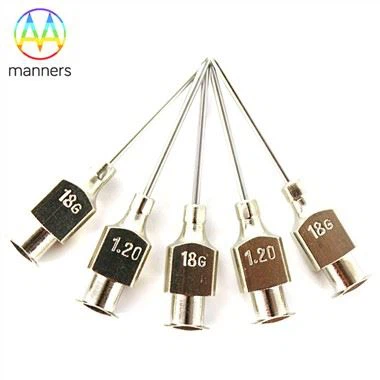
Oncology brachytherapy particle implant needles are mainly classified by needle gauge size, covering 8G, 11G, 13G, 14G, 15G, 16G, 18G, 20G and customized sizes, with different specifications corresponding to exclusive clinical application scenarios. 8G and 11G thick-gauge needles have large needle body diameter and strong structural stability, suitable for superficial solid tumors such as subcutaneous tumors and breast superficial lesions. The thick needle body is not easy to bend during puncture, which can improve the implantation efficiency of large-dose particles and adapt to thick subcutaneous tissue penetration. 13G to 16G medium-gauge needles are the most widely used general-purpose models, with moderate diameter (0.9mm-1.6mm), balancing puncture trauma and structural stability, suitable for conventional visceral tumors such as lung cancer and abdominal tumors. They can effectively reduce intraoperative bleeding while ensuring smooth particle delivery. 18G and 20G ultra-thin needles are mainly used for high-risk deep visceral tumors such as liver and kidney lesions. The ultra-fine needle body greatly reduces vascular puncture damage, and the self-coagulation of human blood can quickly stop minor bleeding, ensuring intraoperative safety. In addition, customized size needles are tailored according to patients' 2D/3D lesion drawings and actual sample conditions, realizing one-to-one matching for special complex lesions and filling the gap of standardized needles in special clinical scenarios.
4. Standard Operational Guidelines for Clinical Implantation
The clinical operation of particle implant needles follows standardized minimally invasive interventional procedures, divided into preoperative preparation, intraoperative positioning and puncture, particle implantation and postoperative needle withdrawal. Preoperatively, medical staff select matching needle specifications according to tumor location, depth and volume, and inspect the needle body for smoothness, lumen patency and surface integrity to avoid particle jamming and tissue scratching. Intraoperatively, patients are placed in a fixed treatment position, and CT or B-ultrasound is used to scan the lesion to delineate the tumor boundary, plan the puncture path, and mark the optimal needle insertion point to avoid large blood vessels and nerve trunks. During puncture, the needle body is inserted slowly along the planned path, and the needle position is adjusted in real time under imaging guidance to ensure the needle tip accurately reaches the target area. After confirming the position, radioactive particles are pushed steadily through the hollow lumen, and the particle spacing and distribution are adjusted according to the treatment plan. After the completion of implantation, the needle body is withdrawn slowly and uniformly to prevent particle displacement and tissue secondary damage. Postoperatively, the puncture site is pressed for hemostasis and bandaged, and imaging recheck is performed to verify particle distribution accuracy and rule out bleeding and other complications.
5. Practical Clinical Experience Summary
Years of clinical application practice have formed mature operational experience for particle implant needle treatment. First, the principle of "thick needle for superficiality, thin needle for depth" must be strictly followed. Superficial tumors with thick tissue layers prioritize 8G-13G needles to ensure puncture stability, while deep high-risk visceral tumors must use 16G-20G ultra-thin needles to minimize vascular damage and bleeding risk. Clinical data shows that the bleeding volume of ultra-thin needle puncture is less than 5ml in most cases, and self-coagulation can be completed within 3-5 minutes without additional hemostatic treatment. Second, real-time imaging guidance is the core guarantee of accurate operation. Blind puncture is strictly prohibited, and dynamic adjustment of needle insertion angle and depth according to CT/B-ultrasound images can effectively reduce the incidence of vascular injury and particle deviation to less than 1%. Third, the surface processing technology of the needle body directly affects patient comfort and recovery speed. Needles processed by electropolishing and laser cutting have smooth outer walls, which can reduce intraoperative tissue friction and postoperative pain, and shorten wound healing time by 30% compared with ordinary needles. In addition, customized needles for special lesions can improve the one-time success rate of puncture and avoid repeated needle insertion caused by specification mismatch.
6. Comprehensive Summary and Technical Sublimation
Oncology brachytherapy particle implant needles are indispensable core consumables for modern minimally invasive tumor brachytherapy, integrating material science, precision machining and clinical interventional technology. Its core value lies in solving the contradiction between "treatment accuracy and minimally invasive safety" in traditional tumor radiotherapy. Through diversified size classification and personalized customization, it covers all clinical tumor treatment scenarios, and relies on high-precision processing technology to achieve low-trauma, high-precision and high-safety particle implantation. Compared with traditional external radiotherapy, particle implantation guided by professional needles has the advantages of localized treatment, small side effects and quick patient recovery, which effectively makes up for the shortcomings of large radiation damage and poor targeting of traditional radiotherapy. The excellent safety performance of the product, such as minor puncture damage and controllable bleeding, also improves the tolerance of tumor patients to treatment, especially suitable for elderly patients and patients with weak physical functions who cannot tolerate large-scale surgery and radiotherapy.
7. Industry Development Prospects and Optimization Suggestions
With the continuous upgrading of minimally invasive tumor treatment technology and the increasing demand for precise medical treatment, the market demand for high-quality particle implant needles is growing steadily. In the future, the industry will develop towards precision intelligence, personalized customization and minimally invasive upgrading. First, it is suggested to further optimize the precision machining process, promote the popularization of laser marking and micro-grinding technology, improve the uniformity of needle body diameter and the smoothness of inner and outer walls, and further reduce intraoperative trauma. Second, strengthen the research and development of intelligent adjustable needles, realize adjustable needle body curvature and diameter, and adapt to more complex irregular tumor lesions. Third, standardize the product classification and clinical matching system, formulate unified operational specifications for different gauge needles, and improve the standardized level of clinical application. In addition, enterprises should strengthen upstream and downstream industrial cooperation, match radioactive particle products with implant needles, form an integrated treatment solution, and promote the standardized and high-quality development of the domestic brachytherapy industry.