Clinical Operation Standards And Complication Management For Core Breast Biopsy Needles
Jun 13, 2026
https://www.mayoclinic.org/tests-procedures/breast-biopsy/about/pac-20384812
Abstract:
Although core breast biopsy is a minimally invasive technique, the safety of the procedure and patient comfort remain primary clinical concerns. This article systematically introduces the operational standards for core breast biopsy needles from a clinical practice perspective, covering pathway planning, anesthesia techniques, and sampling maneuvers. It also provides a detailed analysis of the mechanisms, prevention strategies, and management protocols for potential complications-including bleeding, hematoma, pneumothorax, infection, and needle-track seeding-aiming to enhance standardization and ensure patient safety.
Main Text:
Core breast biopsy needles are widely utilized in clinical settings due to their high diagnostic accuracy and minimal trauma. However, as with any invasive procedure, risks exist. How to maximize risk avoidance and improve the patient experience while using core biopsy needles is a mandatory lesson for every interventional radiologist and breast surgeon. This is not merely a technical issue but a test of responsibility and humanistic care.
Standardized Operation: The First Line of Defense
A successful biopsy begins with meticulous preoperative planning. Real-time ultrasound guidance is currently the mainstream method. Physicians must select an appropriate needle path based on the principle of "shortest distance, avoidance of major vessels, and ease of compression hemostasis." For deep lesions or those adjacent to the chest wall, special attention must be paid to the intercostal spaces and the pleura. For local anesthesia, infiltration should extend from the skin to the lesion capsule to provide analgesia and expand tissue planes, facilitating needle advancement. When using spring-loaded biopsy guns, operators must ensure the safety lock is disengaged and reconfirm the target location immediately before firing. After each sampling pass, firm manual pressure should be applied to the puncture site with gauze for at least 5–10 minutes; this remains the simplest and most effective method to prevent postoperative hematomas.
Identification and Management of Common Complications
- Bleeding and Hematoma: This is the most frequent complication. Minor ecchymosis requires no specific treatment and resolves spontaneously. If a large hematoma forms, presenting as localized swelling and pain, immediate compression should be reinforced. Ultrasound exploration may be necessary to assess the hematoma's extent. Most hematomas resolve with conservative management, and surgical drainage is rarely required. The keys to prevention are avoiding visible vessels and ensuring adequate post-procedure compression.
- Pain and Vasovagal Reactions: Some patients may experience vasovagal reflex symptoms-such as dizziness, diaphoresis, and bradycardia-due to anxiety or pain. Preoperative psychological counseling, gentle intraoperative manipulation, and adequate anesthesia are critical. Should a reaction occur, the procedure must cease immediately. Placing the patient in a supine position with legs elevated usually leads to rapid resolution.
- Pneumothorax: This occurs mainly during biopsies of lesions near the axillary tail or clavicular region, specifically involving the lung apex. Under ultrasound guidance, the pleural line is clearly visible. Maintaining the needle tip strictly outside the pleural line completely avoids this complication. For asymptomatic minor pneumothorax, observation is sufficient; symptomatic large pneumothorax with dyspnea requires closed thoracic drainage.
- Infection: Strict aseptic technique is fundamental to preventing infection. Extra vigilance is required for patients with breast implants to avoid implant rupture and severe infection. Postoperative signs of redness, swelling, heat, or pain warrant immediate medical attention.
- Needle-Track Seeding: This is the theoretical risk that most concerns patients-the dissemination of cancer cells along the needle tract. Extensive evidence-based medicine data indicate that under modern operational standards (such as using trocar systems or coaxial techniques), the incidence of needle-track seeding is extremely low (<0.1%). Even if it occurs, it is typically resected en bloc during subsequent surgery and does not affect the overall prognosis. This risk is negligible compared to the substantial benefits provided by the biopsy.
Innovative Designs for Enhanced Comfort
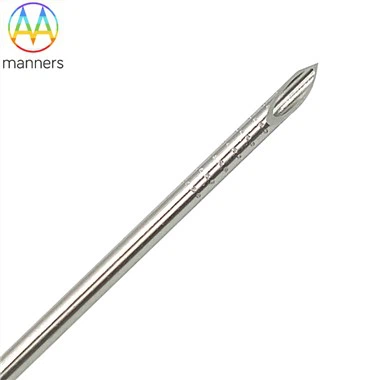
To further improve the patient experience, modern core breast biopsy needles are continuously optimized in design. For instance, Vacuum-Assisted Breast Biopsy (VABB) systems allow for multiple samples via a single insertion, reducing repeated needle passes. Coaxial sleeve designs permit the exchange of inner stylets without withdrawing the outer cannula, protecting the tract and improving efficiency. Sharper tips and smoother surface coatings also significantly reduce the sensation of "give" during penetration and the pain associated with tissue tearing.
Conclusion
The core breast biopsy needle is a mature and safe minimally invasive technology. Its successful implementation relies not only on advanced instrumentation but also on the operator's solid anatomical knowledge, proficient ultrasound skills, rigorous aseptic concepts, and keen insight into the patient's physical and mental state. Through standardized operation and meticulous management, we are fully capable of minimizing complication risks, ensuring this technology remains safe, efficient, and imbued with humanistic warmth.