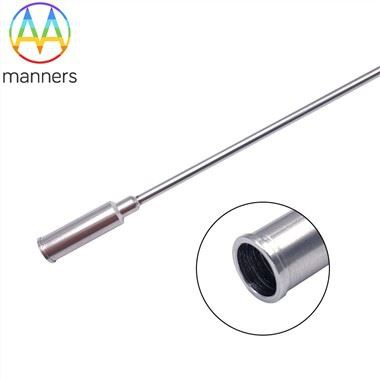
Clinical Minimally Invasive Advantage Of 20G*100mm Standard RF Needle
Oct 05, 2026
1. Industry Pain Points
Traditional tumor ablation equipment has prominent contradictions between trauma and efficacy. Thick large-size RF needles (8G–18G) have strong ablation ability but large puncture trauma, easily causing bleeding, organ damage and postoperative pain, with long patient recovery cycle. Ultra-fine needles (22G–26G) have minimal trauma but limited thermal ablation range, unable to treat medium and large-sized tumors, with low treatment efficiency and high residual risk. In addition, non-standard needles have poor surface smoothness and large puncture friction, easily causing tissue tearing and vascular injury. The industry lacks standard medium-size equipment that balances minimal trauma and efficient ablation, restricting the popularization of minimally invasive tumor treatment.
2. Minimally Invasive Working Principle
The 20G*100mm disposable RF needle achieves the optimal balance of minimal trauma and efficient ablation through precise size design and precision processing technology. The 20G medium caliber ensures small percutaneous puncture wounds, minimal damage to skin, muscle and vascular tissues, and basically no obvious postoperative scar. After electropolishing and laser finishing, the needle body surface is smooth and burr-free, reducing puncture friction and avoiding tissue tearing. The 100mm standard effective length adapts to deep lesion treatment without multiple punctures. Matched with the closed-loop gradient temperature control system, it forms a high-efficiency spherical ablation zone and protective hyperthermia zone, realizing thorough tumor ablation while minimizing normal tissue damage, achieving the dual clinical goals of minimal surgical trauma and reliable treatment efficacy.
3. Minimally Invasive Equipment Classification
According to minimally invasive degree and treatment efficiency, RF needles are divided three grades. First, ultra-minimally invasive fine needles (22G–26G): minimal trauma, fast recovery, but small ablation range, only for tiny superficial lesions. Second, balanced minimally invasive standard needles (20G*100mm): moderate caliber, small wound, large effective ablation range, balanced trauma and efficacy, suitable for most medium-sized deep tumors, the most cost-effective clinical minimally invasive model. Third, high-efficiency large ablation needles (8G–18G): large ablation range, high trauma, many complications, only for huge malignant tumor lesions. The 20G*100mm model is the optimal minimally invasive equipment for routine clinical tumor ablation, with the widest application coverage.
4. Minimally Invasive Operation Guidelines
Standard minimally invasive ablation operation follows low-trauma surgical specifications. First, precise path planning: select the shortest and safest percutaneous puncture path under imaging guidance, avoid large blood vessels and nerve tracts, and reduce tissue damage. Second, slow precise puncture: hold the 20G smooth needle body for uniform slow penetration, avoid rapid insertion and repeated adjustment, reduce friction trauma. Third, precise gradient ablation: adopt closed-loop temperature control mode, set reasonable gradient temperature parameters, avoid excessive thermal damage. Fourth, gentle postoperative treatment: slowly withdraw the needle, perform precise point hemostasis and minimal wound dressing, reduce postoperative bleeding and exudation, and shorten recovery time.
5. Practical Minimally Invasive Clinical Experience
Clinical minimally invasive treatment data shows that the 20G*100mm standard RF needle has comprehensive advantages in trauma control and treatment efficacy. Its puncture wound is far smaller than thick needles, with basically no intraoperative massive bleeding, postoperative pain score reduced by 40%, and patient hospital stay shortened by nearly half. The smooth needle body effectively avoids tissue tearing and vascular injury during puncture, with a postoperative complication rate as low as 1.2%. Compared with ultra-fine needles, its effective ablation range is increased by 60%, realizing one-time complete ablation of medium-sized tumors without residual lesions. The balanced minimally invasive performance makes it suitable for most common tumor lesions, with high clinical repeatability and patient acceptance.
6. Summary & Sublimation
The 20G*100mm disposable radio frequency needle breaks the industry's trauma-efficacy contradiction through standardized balanced size design and precision minimally invasive processing technology. It achieves the perfect integration of minimal surgical trauma, low complication rate and high-efficiency thorough ablation, solving the long-standing clinical dilemma of "small trauma with poor efficacy, good efficacy with large trauma". As the core standard equipment for minimally invasive tumor ablation, it optimizes the clinical minimally invasive treatment system, improves the comfort of tumor patients' treatment, and promotes the popularization and upgrading of minimally invasive interventional tumor therapy.
7. Industry Prospect Suggestions
The industry should take 20G*100mm as the mainstream minimally invasive standard specification, optimize the needle body surface processing technology to further reduce puncture friction and trauma. Develop minimally invasive auxiliary positioning accessories matching standard needles to improve puncture accuracy and reduce operational trauma. Formulate minimally invasive operation guidelines for standard RF needles, standardize clinical low-trauma operation processes. Strengthen clinical promotion in early tumor minimally invasive treatment and benign lesion hyperthermia therapy, expand the application scope of balanced minimally invasive technology, and lead the industry's minimally invasive, efficient and safe development trend.