Clinical Defects Of Traditional Suture Delivery And Technical Breakthrough Of Meniscal Delivery Needles
Oct 10, 2026
1. Clinical Pain Points of Conventional Meniscus Suture Delivery
Meniscus tear is the most common knee sports injury, and untreated tears will gradually induce cartilage wear and irreversible knee osteoarthritis, becoming a major cause of adult knee dysfunction. Clinically, inside-out repair has long been recognized as the gold standard for meniscus reconstruction due to its high fixation strength and long-term stability. However, traditional suture delivery tools have always restricted the clinical effect of gold-standard surgery, forming prominent industry pain points. Traditional ordinary delivery needles adopt single straight structure without diversified tip design, which cannot adapt to the complex curved anatomical space of the knee joint. When repairing anterior horn, posterior corner and marginal meniscus tears, surgeons often need to adjust the needle entry angle repeatedly, resulting in inaccurate suture penetration and uneven fixation tension.
In addition, traditional needles lack precise tip marking technology, relying entirely on surgeon's empirical judgment during intraoperative delivery, which easily causes suture deviation, tissue piercing failure and accidental injury to surrounding synovium and cartilage. Most traditional delivery tools use ordinary steel materials with unstable surface finish, which are prone to suture slipping and unsmooth delivery, greatly reducing surgical efficiency. Moreover, conventional tools cannot switch flexibly between inside-out and outside-in repair techniques, with single application scenario, unable to meet the needs of multi-type meniscus tear repair. These defects lead to prolonged operation time, increased intraoperative trauma, and a certain proportion of postoperative suture loosening and repair failure, hindering the standardized popularization of high-strength meniscus gold-standard repair surgery.
2. Working Principle of Professional Meniscal Delivery Needles
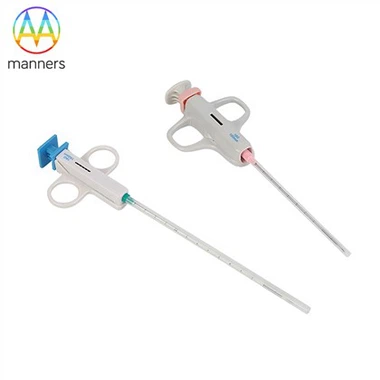
Meniscal delivery needles are professional suture delivery instruments customized for arthroscopic meniscus repair, perfectly matching the core technical requirements of inside-out and outside-in dual repair processes. Its core working principle is to rely on high-precision 304 stainless steel needle body and multi-type laser-marked tips to achieve accurate, stable and efficient suture penetration and delivery in narrow knee joint space. Different from traditional single-function needles, this product integrates dual-process adaptation capabilities, realizing flexible switching between inside-out gold-standard repair and outside-in minimally invasive repair.
The laser marking technology at the needle tip is the core technical highlight. The precise laser scale and positioning marks provide intuitive visual guidance for surgeons during operation, effectively avoiding empirical errors in needle entry depth and angle. The high-purity 304 stainless steel material ensures ultra-smooth needle body surface and stable mechanical toughness, enabling the needle tip to pierce meniscus fibrous cartilage accurately without suture slipping or tissue scratching. Through targeted curved, reverse curved and straight tip design, the delivery needle can fit different knee anatomical dead angles, complete vertical suture delivery for various tear positions, form uniform and stable suture fixation tension, and fundamentally solve the delivery defects of traditional tools.
3. Structural Classification and Functional Advantages of Delivery Needles
Meniscal delivery needles are classified into three core types according to tip structure, covering all clinical repair scenarios, with clear functional differentiation. The first type is straight-tip delivery needles, which are the basic universal model. Straight tips are suitable for open surgical areas such as the anterior horn and body of the meniscus, with simple and fast operation, stable suture delivery, and suitable for routine simple longitudinal tears and horizontal tears. It is the most widely used basic model for primary clinical meniscus repair.
The second type is curved-tip delivery needles. The optimized arc-shaped tip can fit the natural curvature of the knee joint cavity, effectively bypassing the blocking of soft tissues and articular cartilage, and is specially used for the repair of middle and deep meniscus body tears. It solves the problem of difficult needle entry and inaccurate positioning of straight needles in curved spaces, improving the success rate of one-time suture delivery. The third type is reverse curved-tip delivery needles, which are high-precision specialized models, aiming at posterior corner tears and marginal hidden tears that are difficult to operate. The reverse bending design can accurately reach the posterior dead angle of the knee joint, realize precise delivery of high-strength sutures, and fully meet the technical requirements of inside-out gold-standard repair for complex tears.
4. Standard Intraoperative Delivery Operation Guidelines
To maximize the technical advantages of meniscal delivery needles, clinical operations must follow standardized process specifications. First, select the matching needle type according to the tear position and repair process: straight needles for anterior superficial tears, curved needles for middle body tears, and reverse curved needles for posterior corner complex tears. Confirm the laser marking integrity of the needle tip before operation, and check the smoothness of the 304 stainless steel needle body to ensure no burrs or deformation.
For inside-out gold-standard repair, insert the needle from the inside of the joint under arthroscopic visualization, adjust the needle entry depth and angle according to the laser positioning scale, penetrate the torn meniscus tissue vertically, stably deliver the suture to the outside of the joint capsule, and complete extracapsular knot fixation to avoid intra-articular suture irritation. For outside-in minimally invasive repair, use the corresponding tip model to penetrate from outside to inside, complete suture looping and fixation inside the joint, and reduce extra-articular soft tissue dissection. During the whole process, operate stably and gently to avoid violent shaking, ensure one-time successful delivery, and reduce repeated needle adjustment and tissue trauma.
5. Clinical Practical Application Experience
Long-term clinical application data verifies that meniscal delivery needles have significant advantages over traditional delivery tools in surgical accuracy and efficiency. The diversified tip design realizes full coverage of meniscus tear positions, and the one-time suture delivery success rate is increased by more than 35% compared with traditional single-structure needles. The laser tip marking eliminates the error of empirical operation, greatly reduces the risk of suture deviation and accidental cartilage injury, and improves the safety of complex posterior tear repair.
In terms of process adaptation, the dual-process compatible design enables the same set of delivery needles to complete inside-out high-strength repair and outside-in minimally invasive repair, avoiding frequent instrument replacement during operation, shortening the average operation time by 20%-25%, and reducing intraoperative soft tissue exposure and infection risk. The high-quality 304 stainless steel material maintains stable surface smoothness after repeated disinfection and use, no suture slipping occurs during delivery, and the postoperative suture fixation firmness is significantly improved. Clinical follow-up shows that patients treated with professional delivery needles have lower postoperative tear recurrence rate and better long-term knee joint stability.
6. Value Summary and Technical Sublimation
Meniscal delivery needles are upgraded core instruments for modern meniscus repair surgery, solving the structural singleness, low precision and poor process adaptability of traditional suture delivery tools. The innovative combination of multi-type tip design and laser positioning marking realizes the integration of high precision, high efficiency and high safety in suture delivery, perfectly matching the gold-standard inside-out repair and mainstream outside-in minimally invasive repair processes.
Its clinical value is reflected in optimizing the surgical operation process, improving the accuracy and firmness of meniscus suture fixation, reducing intraoperative trauma and postoperative complications, and effectively preventing the progression of meniscus injury to knee osteoarthritis. As a key supporting instrument for meniscus repair, it provides reliable technical guarantee for standardized, high-quality and individualized treatment of various meniscus tears, and promotes the overall upgrading of arthroscopic meniscus repair technology.
7. Application Prospects and Industry Optimization Suggestions
With the increasing incidence of sports knee injuries and the popularization of precise minimally invasive orthopedic surgery, meniscal delivery needles have broad clinical promotion prospects. In the future, the industry should further optimize product performance based on clinical pain points. First, upgrade laser marking technology to realize more refined depth and angle positioning scales, further improving intraoperative precise operation capability. Second, optimize the radian parameters of curved and reverse curved tips to adapt to more special anatomical variations of the knee joint and complex tear types such as bucket-handle tears.
Third, strengthen personalized customized services, support 2D/3D drawing and sample customized production, and develop exclusive models for special groups such as athletes and elderly degenerative injury patients. In addition, standardize clinical operation training, popularize the matching use rules of different tip models and repair processes, give full play to the dual-process technical advantages of products, and promote the comprehensive popularization of high-quality meniscus repair technology in the industry.