Climbing The Smile Curve: Value Chain Upgrading Strategy For EBUS-TBNA Biopsy Needle Manufacturers
May 31, 2026
Within the global medical device industrial smile curve, midstream standardized machining and assembly deliver the lowest added value, while high-profit margins concentrate on upstream R&D & proprietary design as well as downstream clinical after-sales and technical services. For EBUS-TBNA biopsy needles featuring technology intensiveness, high unit value and niche specialized market scale, blind expansion-driven price competition on mass production is not a sustainable development route. Outstanding specialized manufacturers secure irreplicable core competitiveness within high-end segmented markets by strategically moving toward both high-value ends of the smile curve.
I. Upgrading toward the Left End: Deepen R&D & Customization to Evolve into Professional Technical Solution Providers
This strategic shift is essential to escape homogeneous price competition and secure premium technical profit margins.
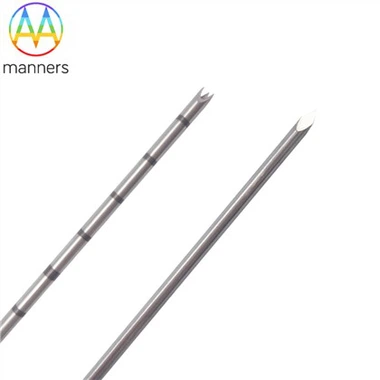
- Core Technology R&D and Patent Portfolio Layout: Continuous technical breakthroughs center on five-axis laser echo-mark engraving, geometric profiling of rear cutting tips, and hybrid fabrication of Nitinol–316L stainless steel composite tubing, accompanied by systematic patent filing. Sound intellectual property assets erect solid technical barriers and serve as strategic bargaining chips against industrial competitors.
- Business Upgrade from Basic OEM to JDM & ODM: Moving beyond blueprint-only OEM subcontracting, manufacturers leverage accumulated process know-how to launch joint design manufacturing alongside global leading bronchoscope brands including Olympus, Fujifilm and Pentax. Early-stage participation in clients' new product planning delivers structural optimization, manufacturability assessment and rapid prototype trial production, evolving into indispensable outsourced R&D partners, which is exactly the core competence behind the documented customized drawing-based development capability (Custom feature).
- Agile R&D for Unmet Specialized Clinical Demands: In response to customized requirements from top-tier medical institutions, such as extended-length cannulas for deep-site puncture or special anti-adhesion surface coatings to reduce cellular tissue sticking, manufacturers complete design revision, sample fabrication and regulatory verification in short cycles. The clinical co-development mechanism locks long-term cooperation with high-value core hospital customers.
II. Upgrading toward the Right End: Expand Value-Added Services to Become Clinical Value Enablers
Downstream diversified technical services effectively improve customer stickiness and build proprietary brand moat.
- Full-set Specimen Quality Total Solution: Rooted in the core logic that needle performance ultimately determines pathological specimen quality, manufacturers extend service scope beyond standalone needle supply. Supporting accessories including specimen preservation reagent, standardized cytology smear tools and standardized pre-processing operation guidelines are bundled; joint training programs with pathologists help clinicians standardize puncture manipulation to maximize intact tissue harvest, lifting overall clinical success rate and professional brand reputation.
- Regulatory & Global Registration Support System: Global market access requires stringent certification including US FDA 510(k) and EU CE MDR. In-house regulatory teams not only finish internal product certification but also supply complete technical documentation, biocompatibility test dossiers and preclinical animal trial data for brand clients, drastically cutting partners' registration cost and time-to-market cycle.
- Specialized Clinical Education & Academic Platform Construction: Constrained by the steep learning curve of EBUS-TBNA interventional techniques, manufacturers organize hands-on skill workshops, live surgical demonstrations and domestic & international expert academic tours. Systematic clinical education cultivates incremental market demand while enabling physicians to build product recognition and usage inertia, raising end-user switching cost substantially.
III. Consolidate Midstream Links: Premium Precision Manufacturing & Strict QC as Foundational Pillars
Moving up the two ends of the smile curve never means abandoning production; instead, traditional production lines are upgraded into a robust precision engineering platform backing upstream customized innovation.
- Capital investment in ultra-precision equipment: Deployment of five-axis laser engraving systems and high-precision tip grinding machines lays indispensable hardware foundation for small-batch customized development and rapid prototype sampling.
- ISO13485-aligned quality governance for market credibility: Full implementation of ISO13485 quality management, with complete raw material certification and full-process test reports archived for every production batch. Reliable quantified quality data builds a trustworthy safety-oriented brand image, a prerequisite for winning high-end JDM cooperation and clinical institution recognition.
IV. Strategic Layout Under Volume-Based Procurement and Domestic Substitution Trend in China's Market
Facing national centralized volume-based procurement (VBP) policies, premium specialized manufacturers adopt differentiated market avoidance tactics:
Refrain from brutal price competition on low-end, universal-spec conventional needle products.
Focus on innovative, functionally complex high-end alternatives competing directly against imported flagship products. Such items feature high technical added value and strong clinical dependency, resisting simple price benchmarking and preserving healthy profit margin and high-end brand positioning.
Conclusion
Forward-thinking EBUS-TBNA needle operators adopt a dumbbell-shaped business model: the left side consists of an innovation-driven core anchored by proprietary R&D and customized development; the right side forms a value realization platform relying on clinical training and after-market technical services; world-class precision manufacturing and ISO-standardized quality control serve as the solid middle connecting hinge. By advancing toward the upstream left end, enterprises capture technical premium and deepen long-term order cooperation; by developing downstream right-end value services, brands consolidate customer loyalty and market influence. This dual-end expansion helps manufacturers occupy high-profit, stable ecological niche along the medical device smile curve and complete the transformation from pure component fabricators to value-driven manufacturers capable of defining product specifications and shaping industry clinical standards within niche interventional pathology markets.