Clean Cut: Chamfered And Blunt Tips For Contamination-Safe, Satellite-Free Dispensing
Oct 14, 2026
The Pain Point Cleanliness is the silent killer of dispensing quality. Every drop that lands where it should not-a satellite speck, a wetted fiber, a micro-droplet dragged off the tip-is a contamination event that can compromise an electrical contact, weaken a seal, or render a medical joint non-conforming. Stringing is the most visible symptom: the fluid follows the needle as it retracts, drawing a fine filament that breaks and leaves debris. Operators compensate by lifting faster, which causes splatter, or by pulling further, which reduces dot placement accuracy. Behind these symptoms is a surface-physics problem the operator cannot see: the fluid's wetting of the tip wall determines whether it snaps cleanly or trails. A needle whose tip geometry and surface finish invite wetting will never produce clean cuts, no matter how careful the operator is.
How It Works The chamfered and blunt tip designs manage the wetting line to achieve a clean cutoff. On a blunt tip, the flat end face presents a wide, stable contact line; fluid exits as a broad, predictable dot, and the abrupt edge gives the strand a defined point where it can separate. On a chamfered tip, the angled face directs the last fluid film to a single sharp edge, concentrating the surface-tension pinch point so the material snaps off cleanly and predictably. The electrically polished exterior also matters: a mirror-smooth outer wall resists the creeping "wicking" of low-viscosity fluids up the cannula, which is the true source of satellite drops and fiber drag. Combined with the burr-free interior and one-piece stainless construction, these tips make the material break where you want it to-at the tip face-rather than somewhere uncontrolled along the shaft. The result is dot placement without satellites, and a workspace that stays clean.
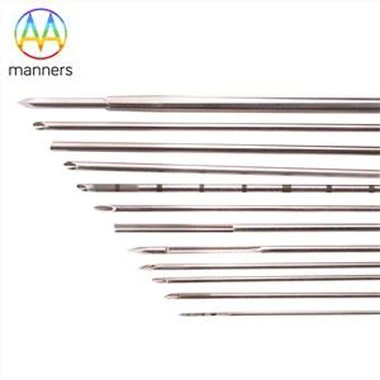
Device Classification Within the nozzle type family, tip geometry is the organizing principle. Blunt tips are the default for most dot dispensing and broad deposits; they give the largest contact area and the most forgiving cutoff for medium-viscosity materials. Chamfered tips add a controlled edge for cleaner snapping and are favored for low-viscosity fluids that want to wick and string. Tapered (conical) tips narrow the stream for fine work while retaining a controlled cutoff at the small end. Bent and angled variants apply the same tip treatments to constrained access. Inside diameter ranges from 0.1 to 0.8 mm, with larger bores for beads and smaller ones for precision dots. Every variant shares the same polish and burr-free one-piece construction, so the classification is purely functional: which tip controls the wetting line best for your material and joint.
Practical Guide Match the tip to the fluid's surface tension. Low-viscosity, low-surface-tension solvents and fluxes need a chamfered or sharp-edged tip to snap cleanly; higher-viscosity pastes are forgiving enough for blunt tips. Set retract distance just above the wetting height of the dot-too high causes splatter, too low causes wicking-and tune lift speed to the material: slower for runny fluids, faster for thick ones. Use a "spit" cycle before each run: a short pressure pulse with the tip over a waste target clears residual film and pre-loads the bore. Watch for the failure signatures: a persistent tail means the tip edge is too smooth or the fluid is wetting the exterior-check for exterior contamination and polish degradation; random satellites mean exterior wicking, usually fixed by cleaning the outer wall or choosing a sharper edge. After use, wipe the exterior and flush the interior so no film hardens on the face-a dried film destroys the clean-cut property.
Field Experience Real production lines confirm that tip geometry is a first-order yield factor. A medical device assembler bonding a cannula to a hub switched from a plain straight tip to a chamfered one and eliminated a stringing defect that had been failing 4% of assemblies in leak testing-the difference was purely the clean break. An electronics board line reduced satellite-drop rejects on a conformal-coat masking step by selecting a blunt tip matched to the coating's viscosity, cutting the rework queue noticeably. The recurring theme is that operators often blame the material or the robot, when the real culprit is a tip that lets the fluid trail. Once the tip manages the wetting line, the operator's compensation techniques become unnecessary, and the process becomes stable.
Reflection A clean cut is the quiet signature of precision. Satellite-free, string-free dispensing is not achieved by clever retract programming but by controlling where the fluid is allowed to break-and that control lives in tip geometry and surface finish. The chamfered and blunt tips of the nozzle type family are proof that the smallest design detail carries the largest process consequence. In contamination-sensitive industries, a needle that wicks or trails is not merely inefficient; it is a source of non-conformances and hidden field failures. Engineering the wetting line is engineering quality at the point of contact.
Outlook As conformal coating, medical bonding, and fine-pitch electronics demand ever-cleaner deposition, tip geometry will become more application-specific. Expect chamfer angles optimized per material class, exterior coatings that resist wicking for low-surface-tension fluids, and tips designed with documented wetting behavior so engineers can select by data rather than trial. Vision systems will verify dot integrity in real time and flag the first satellite before it becomes a defect population. For buyers, the forward-looking advice is to demand spec'd tip geometry and surface finish, and to validate clean-cut behavior on your own fluid before committing to volume. The clean-cut needle is not a nicety; it is the difference between a joint you trust and a joint you hope.