Cannula Craft: Stainless Steel And NiTi In Spinal Needles
Nov 23, 2026
1 The Shaft Is the Instrument
A spinal needle is judged by its tip and its hub, but it succeeds or fails because of its shaft. The cannula must be straight to within a tolerance that is invisible at arm's length, concentric enough that the stylet slides without drag, stiff enough to reach the dura without bowing, and smooth enough that it does not drag tissue or shed particles into the subarachnoid space. At 27G, the wall is a fraction of a millimetre thick and the lumen is smaller than a human hair. Every one of those properties is a manufacturing decision, and every one of them can degrade in a way that no final inspection will catch. The commercial temptation is to treat the shaft as commodity tubing, purchased to an outside diameter and cut to length. That approach produces a needle that looks correct and behaves inconsistently: some units feel crisp, others drag, some bend at the first resistance, and a few produce a particulate load that shows up in a sterility or cleanliness investigation. The difference is not a mystery. It is wall thickness, grain structure, surface finish and the way the tip was formed.
2 Metallurgy and Mechanics at Needle Scale
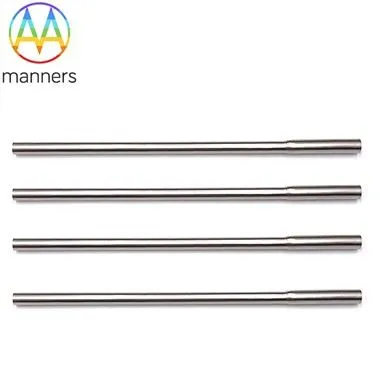
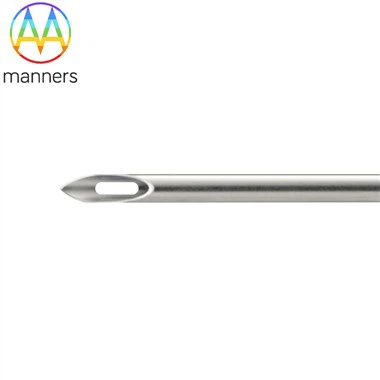
Stainless steel, typically in the 304 or 316L families, is the default material for spinal needle tubing. It offers a favourable combination of stiffness, corrosion resistance, formability and cost, and it is well understood by tube drawers and needle manufacturers. The relevant properties are not merely "stainless" but specific: yield strength in the drawn and annealed condition, elongation, and the uniformity of wall thickness around the circumference. A tube with eccentric wall thickness will bend preferentially in one plane, which is exactly the behaviour that makes a needle track off axis in a deep paravertebral approach. Nitinol changes the mechanics. Its superelastic behaviour allows a fine shaft to recover from bending that would permanently deform steel, which is valuable at 26G and 27G and in long, angulated trajectories. It also has a lower elastic modulus, so it feels softer at the same diameter, and it is more expensive and harder to machine. A nitinol shaft with a steel tip, or a composite construction with a nitinol distal segment, attempts to buy kink resistance where it is needed without paying for it along the whole length. Forming the tip is where mechanics become craft. Rotary swaging reduces the outside and inside diameter of the tube at the tip by cold working, producing the closed, tapered point of a pencil-point needle; grinding produces a bevel; laser cutting produces side openings and specialised geometries. Each process leaves a surface and a residual stress pattern. Swaging can leave a slight eccentricity at the transition, grinding can leave burrs at the bevel edge, and laser cutting can leave a recast layer inside a side hole. Electropolishing and passivation remove the worst of these, improving corrosion resistance and reducing the particle load, but they also remove material, so the process must be controlled rather than applied as a cosmetic finish.
3 Materials, Forming and Assembly
Material selection follows the gauge and the application. Stainless steel for 16G to 24G covers the great majority of demand, where stiffness and flow are the priorities. Nitinol for 25G to 27G addresses kink resistance at the finest sizes, and hybrid shafts are used where a long needle must remain steerable. Coatings, usually silicone-based, reduce friction and improve the feel of the advance, but a coating that is unevenly applied changes the insertion force along the shaft, which the operator perceives as inconsistency. Tip forming divides into the families described earlier: swaged closed tips for pencil-point designs, ground bevels for Quincke designs, and cut side holes for both. The critical tolerances are at the tip: the concentricity of the side hole with the lumen, the absence of a lip that could core tissue, and the sharpness of the transition from taper to shaft. These are not cosmetic; a side hole that is partly blocked by a swaging fold reduces flow unpredictably, and a bevel with a burr cores a plug of dura into the lumen. Assembly is the third variable. The hub may be insert-moulded onto the cannula or bonded with adhesive, and the stylet must be matched to the lumen so that it seats without bottoming and without leaving a gap. A stylet that is too loose allows tissue to enter the tip during advancement; one that is too tight can be difficult to withdraw and may dislodge the needle. The hub-to-cannula joint is a stress concentration, and a poorly controlled insert moulding can leave a step that catches on the skin or leaks under pressure.
4 Specifications That Hold
A useful purchase specification for the shaft is short and specific: material grade, outside diameter and tolerance, wall thickness or a flow requirement, straightness, surface finish, and the forming process for the tip. Dimensional standards for needle tubing, such as ISO 9626, give the vocabulary for wall thickness and tolerance, and they should be cited rather than paraphrased. Where cleanliness matters, a particulate limit and a validated cleaning process should be stated, because a "visually clean" needle can still carry debris from grinding. Verification should follow the failure modes rather than the drawing. Concentricity and wall uniformity are checked by sectioning or by non-destructive gauging. Stiffness and kink resistance are checked by a three-point bend or a simulated insertion into a tissue phantom, at the actual gauge and length. Flow is checked with water or a surrogate fluid at a defined pressure, because a nominal lumen is not a flow rate. Tip integrity is checked by microscopy for burrs, lips and recast layers, and by pushing the needle through a membrane to confirm that it neither cores nor blocks. Stylet fit is checked by insertion and withdrawal force, and hub integrity by leak and pull-off testing.
5 What Shows Up in the Field
Three field failures recur. The first is the needle that bends at the hub rather than at the tip: a joint with insufficient engagement, or a cannula that has been over-annealed at the tip end, concentrates the load where the shaft meets the moulding. The second is the "coring" needle, which pushes a plug of tissue into the lumen and produces a dry tap that no rotation will resolve; the cause is usually a burr or a blunt bevel, and it is invisible until the needle is used. The third is the fine needle that kinks on withdrawal in a patient who has moved, which is a materials problem at 27G and a technique problem at every gauge. There is also a quality signal that buyers can read without a laboratory. A supplier that can state the wall thickness of its 27G tubing, describe the swaging and polishing sequence, and provide a flow rate at a defined pressure is a supplier that knows its process. A supplier that answers every technical question with "standard" is not.
6 Summary
The shaft determines whether the needle reaches the dura cleanly, whether the stylet moves freely, and whether the tip performs as designed. Stainless steel grades, wall thickness and concentricity govern stiffness and tracking; nitinol buys kink resistance at fine gauges; swaging, grinding and laser cutting define the tip, and electropolishing and passivation determine its surface. Assembly of hub and stylet turns a tube into an instrument. A specification that names the material, the dimensions, the forming route and the verification method is the only way to keep those properties stable across lots.
7 Thinner Walls, Better Behaviour
The direction of development is toward thinner walls at finer gauges, which improves flow without enlarging the dural defect, and toward graded shafts that are stiff proximally and flexible distally. Both depend on tighter tube drawing and better control of the tip-forming process. Additive manufacturing is beginning to offer tip geometries that cannot be swaged, though at a cost and with a surface finish that still requires polishing. The clinical prize is a needle that behaves like a 22G and leaves a defect like a 27G, and the manufacturing prize belongs to whoever can hold that tolerance across a million units.