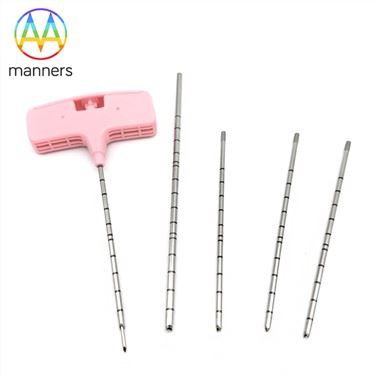
Buying With Confidence: A Checklist For The Medical Stainless Steel Spinal Needle
Nov 23, 2026
1. The Problem: Identical Specifications, Unequal Products
Two suppliers submit samples of a 25G pencil-point device, 90mm long, packed in a sterile blister, priced differently. On paper the products are the same. In use they are not. One advances with even resistance and returns fluid within a few seconds; the other flexes at the hub, drags slightly as it crosses the ligament, and requires a quarter turn and a long pause before anything appears.
Purchasing systems are poorly equipped to capture that difference. Tender documents list gauge, length, tip type, and price. They rarely define shaft straightness, tip symmetry, stylet clearance, hub leak pressure, or color consistency. Clinical complaints, when they arrive, are anecdotal and difficult to turn into a specification.
The result is a slow drift. A unit replaces a good product with a cheaper one, tolerates a slightly worse experience for a year, then discovers that the headache consultation rate has risen and cannot prove why. A structured acceptance process prevents that drift, and it begins with knowing what to ask for.
The stakes are higher than they look. In departments performing several thousand neuraxial procedures a year, a two-percentage-point increase in failed first attempts translates into dozens of extra punctures, extra recovery time, and a measurable increase in headache referrals. Those are the numbers that make an apparently trivial purchasing decision into a clinical one.
2. What Actually Determines Performance
Performance reduces to a handful of design and manufacturing variables.
Alloy and tube quality come first. A medical-grade austenitic stainless steel, cold-drawn into a seamless cannula with controlled wall thickness, provides the stiffness-to-diameter ratio that makes a fine device usable. Welded or imperfectly drawn tube fails at the point of bending, usually deep in the tissue where it is least convenient.
Tip grinding comes next. The bevel angle, the edge radius, and the surface finish determine penetration force for a Quincke point; the cone angle and lateral orifice position do the same for a pencil point. A tip that is off-center will deflect the needle as it crosses the dura, and deflection in a 90mm shaft is a deviation the operator cannot correct.
The stylet and hub assembly completes the system. The stylet must run without play yet withdraw smoothly, and the hub must seal under pressure. A hub that leaks produces a false negative - the tip is in the space, fluid does not appear, and the operator redirects.
Sterilization and packaging determine whether any of this survives to the bedside. Ethylene oxide or gamma processes must be validated for the materials, and the sheath must resist puncture during transport.
Every one of these variables can be specified and, with modest effort, tested. A Medical Stainless Steel Spinal Needle purchased without a written specification is purchased on trust, and trust is not a documented requirement in a tender. Writing the requirements down shifts the burden of proof onto the supplier, which is where it belongs.
3. Defining the Specification Matrix
A useful order specification describes the full range rather than a single item, so that the department can standardize on one family.
Gauge and color should be listed together: 16G white, 17G light purple, 18G pink, 19G light gray, 20G yellow, 21G green, 22G black, 23G dark blue, 24G purple, 25G orange, 26G brown, 27G gray. Requiring the conventional hue for each gauge prevents the supplier from substituting an internally consistent but unfamiliar scheme.
Tip type should be split by intended use. Cutting needles are typically required at 20G to 22G for diagnostic work; pencil-point devices at 24G to 27G for obstetric and ambulatory anesthesia. Some units also stock 22G and 23G pencil points as a compromise for trainees.
Length should specify a 90mm standard plus a defined custom range for obesity and higher approaches, with the extended items separately labeled. Where the volume of bariatric work is significant, the extended products should carry a distinct secondary marking.
Finally, the tender should state the quality system expected of the manufacturer: a certified medical device quality management system, a declaration of conformity, sterilization validation reports, and access to batch records on request.
4. Accepting a Batch: A Practical Sequence
Acceptance happens at three levels.
Documentary review comes first. Confirm the certificate of conformity, the sterilization method and dose, the expiry dating convention, and the labeling content. Check that the instructions for use state single-use status, contraindications, and the gauge-to-color mapping actually printed on the product.
Physical inspection follows. Sample across gauges rather than from a single size. Roll the shaft on a flat surface to check straightness. Examine the tip under magnification or, if unavailable, draw it across sterile gauze and look for snagged fibers. Advance and withdraw the stylet several times and note any grinding. Fit a syringe and apply gentle pressure with the tip occluded to check the hub seal. Compare hub colors against a reference set under both bright and dim light.
Clinical evaluation completes the process. Run a defined number of cases, for example fifty punctures across two or three gauges, and record attempts to success, patient-reported discomfort, and headache follow-up. A product that passes inspection but feels wrong in the hand will fail in service, and the only way to know is to measure.
Two practical tools make that measurement feasible. A simple log kept at the anesthesia cart records gauge, attempts, and any paresthesia; over a month it produces a baseline that can be compared against the same metric after a product change. A short structured questionnaire given to ten or twenty clinicians after two weeks of use captures the tactile impressions that numeric data miss, provided the questions are specific - penetration force, hub stability, stylet drag - rather than general satisfaction.
5. Lessons from Switching Suppliers
Three lessons recur. First, batch consistency matters more than a single good sample; a supplier who cannot reproduce a tip geometry across lots will deliver variation disguised as quality. Second, color drift is a common and under-reported problem, and it should be treated as a non-conformity rather than a cosmetic issue. Third, the cheapest device is rarely the cheapest case: a product that adds two minutes to a list and one extra recovery hour is expensive at any unit price.
Departments that document their experience - attempts, complications, staff feedback - negotiate from a stronger position at the next tender, because they can specify what went wrong rather than merely expressing dissatisfaction.
Contract terms should also include a route for reporting non-conformity. A defined contact, a required response interval, and an agreement on replacement or credit for defective lots turn a complaint into a process. Suppliers who resist such clauses are telling the buyer something useful about how they expect to be treated after the sale.
6. Summary
Procurement of a medical stainless steel spinal needle should be treated as a clinical specification exercise. Define alloy and tube quality, tip geometry, stylet and hub performance, gauge range from 16G to 27G with conventional color coding, and a length program built around 90mm with defined extended options. Verify documents, inspect samples physically, and evaluate clinically before committing to a volume contract.
7. Outlook
Tenders are becoming more quantitative. Suppliers are increasingly asked to provide penetration force data, hub leak test results, and color consistency limits, and buyers are beginning to collect their own outcome data to match. Digital traceability will make batch-level performance visible, which should reward manufacturers who invest in process control and penalize those who rely on price alone. For the anesthesia department, the practical consequence is straightforward: the tender document is now a clinical document, and it should be written by clinicians with procurement support rather than the other way round.