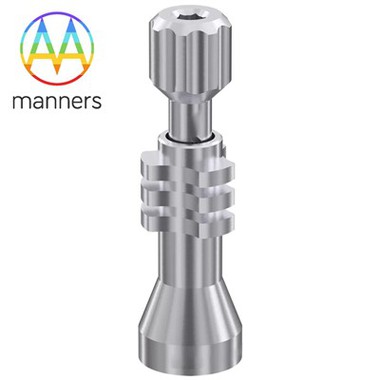
Bone Control Design Saves Aesthetics
Oct 21, 2026
The Pain Point: Implant Survives, Smile Doesn't
Radiographs show osseointegration, but the gum recedes, the buccal tissue flattens, and a black triangle appears. The patient says, "It's not infected-it just looks dead." Traditional success metrics miss this because they count survival, not beauty. The implant is "successful" by every radiographic criterion, but the patient is unhappy.
This is the quiet failure mode of implant dentistry. It does not show up in survival statistics. It does not trigger a revision surgery. It just sits there, a daily reminder that the implant was placed for function, not for the smile. The patient stops smiling in photos. They chew on the other side. They avoid laughing in social situations.
The root cause is not the crown. It is the bone. Crestal bone loss-even 1 mm-can flatten the buccal contour, reduce the papilla, and create an unnatural emergence profile. The implant may be perfectly osseointegrated, but the soft tissue tells a different story.
The Principle: Crestal Bone Decides Long-Term Beauty
Bone Control Design optimizes alveolar ridge preservation and soft-tissue stability. A consistent subgingival contour streamlines tissue shaping. Precise machining supports a soft-tissue seal that isolates bacteria. The rounded apex reduces trauma; the tapered body engages bone without over-compressing the crest.
Aesthetics is not added at the crown stage. It is engineered at placement depth, platform choice, buccal plate thickness, and provisional contour. The implant design supports the biology, but the clinician must still execute the plan.
Device Classification
- Apical rounded design: less apical trauma. The rounded apex reduces the risk of perforating the sinus floor or the nasal floor during placement.
- Subgingival contour: predictable tissue shaping. The implant body is designed to support a natural emergence profile without over-contouring the crown.
- Machined collar zone: soft-tissue attachment management. The machined surface at the collar allows the soft tissue to attach more predictably, reducing the risk of peri-implant inflammation.
- Rough-to-crest surfaces: potentially more bone contact, but demand disciplined depth control. The rough surface promotes bone contact, but if the implant is placed too deep, the rough surface can cause bone loss.
- Provisional-driven sculpting: temp tooth as a tissue former, not just a placeholder. The provisional crown shapes the soft tissue during healing, creating a natural emergence profile before the final crown is placed.
Hands-on Guide
Keep 2 mm of buccal bone whenever possible. Place the implant 3D-correct: appropriate apico-coronal depth, palatal/lingual to the ideal tooth center, and not too close to the neighbor. Provisionalize gently. Never over-torque a temporary into inflamed tissue.
Use the provisional to train tissue, not to test strength. Non-functional esthetic provisionals are underrated; heavy-function temporaries are overused. The provisional should be concave at the gingival margin, not convex. It should support the papilla, not compress it.
Real-world Experience
The most disappointing BLT cases are not infected-they are flat. A 4.1 mm implant at 35 Ncm can still collapse the papilla if placed 1.5 mm too facial. Conversely, a 3.5 mm small-hex implant placed perfectly can look better than a 5.3 mm implant placed carelessly.
Aesthetic failure is usually a planning failure hidden by a "successful" X-ray. The clinician who blames the implant is missing the point. The implant is a tool; the plan is the art.
Summary
Implant success is not only BIC-bone-implant contact. It is PST: papilla, soft tissue, and emergence. Bone Control Design gives the clinician tools, but the clinician must still respect biology. The implant can preserve bone, but it cannot create it. The clinician must place the implant in the right position, at the right depth, with the right angulation, and then manage the soft tissue through the provisional phase.
Outlook
Esthetic scoring will become standard: pink aesthetic score, midfacial level, papilla fill, tissue color, and contour symmetry. Clinics will market "tissue-preservation implants," not just titanium screws. Photography and 3D tissue mapping will be part of every premium BLT case. The patient will choose the clinic that can show esthetic outcomes, not just survival rates.