Between Millimeters And Microns: Precision Manufacturing Challenges And Reliability Philosophy Of Breast Biopsy Needles
May 08, 2026
Breast biopsy needles, particularly vacuum-assisted biopsy (VAB) needles, are miniature masterpieces in the field of precision manufacturing. They must perform a series of complex actions-positioning, suction, rotational cutting, and specimen retrieval-inside the patient's body in a single procedure. Their reliability directly determines diagnostic accuracy and patient safety. For manufacturers of minimally invasive surgical devices, mastering VAB needle manufacturing means elevating their quality control systems and precision engineering capabilities to the highest standards of surgical instruments. This is an extreme challenge to achieve "zero failure" between the overall millimeter-scale dimensions and micron-level feature precision.
Manufacturing Precision of Core Components Directly Determines Clinical Performance
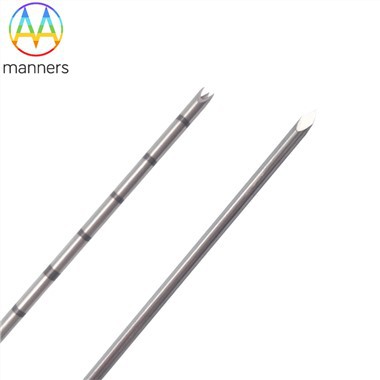
Cutting Cannula and Inner Needle: The "heart" of the biopsy needle. The edge of the cutting window at the cannula's tip must be as sharp as a scalpel, and its geometry (e.g., bevel angle, window size) must be optimized via fluid dynamics to ensure high cutting efficiency and minimal tissue damage. The inner needle (cutting blade) rotates at high speed inside the cannula, with the clearance between it and the cannula's inner wall controlled at the micron level-balancing smooth rotation and prevention of tissue entrapment and jamming. This demands multi-axis precision grinding and polishing of exceptional quality.
Vacuum Tubing and Sealing System: Negative pressure is the power source of VAB technology. The entire vacuum channel, from the needle tip suction port to the rear connector, must be perfectly smooth and leak-free. Even minor burrs or poor sealing can cause vacuum loss, leading to failed specimen suction or dislodgement. This involves complex microchannel machining, high-precision O-ring seal groove fabrication, and ultrasonic or laser welding processes.
Specimen Collection Chamber: Excised tissue strips must be delivered to the collection chamber intact and undamaged. The chamber design must prevent tissue accumulation, folding, or adhesion, and its transparent window must allow surgeons to visualize specimen volume. This requires high-finish medical-grade plastic injection molding and seamless, robust assembly with metal components.
"Functional Reliability" Validation Beyond Dimensional Precision
Manufacturing VAB needles requires more than just meeting dimensional tolerances on drawings-it demands a functional testing system that simulates real clinical conditions:
Cutting Force and Torque Testing: Simulates cutting blade drive torque and cutting completeness in synthetic materials of varying densities (mimicking normal glandular tissue, fat, and dense tissue) to ensure consistent performance across different patient tissues.
Vacuum Holding and Specimen Transport Testing: Evaluates the system's vacuum build-up speed, maintenance capability, and specimen transport success rate from the needle tip to the collection chamber in simulated human tissue fluid.
Fatigue and Durability Testing: Despite being single-use, design validation involves repeated firing tests far exceeding single-use intensity to verify design margins and identify the weakest links.
Quality Philosophy: From "Inspection" to "Prevention"
For top-tier manufacturers, quality control spans the entire supply chain. From the purity of medical-grade stainless steel bars and biocompatibility certificates of polymer pellets, to cleanroom environment control and statistical process control (SPC) for every production step-the goal is to prevent defects before they occur. Production data for each biopsy needle must be traceable, enabling root-cause analysis of any clinical adverse event back to raw material batches and production processes.
Manufacturing a reliable breast biopsy needle is thus a fusion of materials science, precision mechanics, microfluidics, and rigorous quality management. It tests not just the possession of five-axis machine tools, but an entire manufacturing culture and system oriented toward zero clinical risk. Manufacturers that clear this hurdle gain not only orders but also a passport to the manufacturing of more advanced, complex interventional devices.