Back Eye Needles In Arterial Puncture And Monitoring
Nov 16, 2026
The problem: a small vessel, a high-pressure jet and a waveform that will not settle
Arterial access is technically less forgiving than venous access. The vessel is smaller, deeper and more muscular, and it is under systemic pressure, so a puncture that is slightly misdirected produces a haematoma quickly. Once access is established, the requirements change: the sample must be gas-tight and free of bubbles for blood gas analysis, and where a line is left in place for pressure monitoring, the waveform must be faithful enough to be trusted.
Two failure modes keep appearing in both settings. The first is a tip that lies against the arterial wall, which produces a damped trace, a poor blood return or an aspiration that stops partway through the syringe. The second is a jet effect at the outlet, which is unhelpful in arterial sampling because a high-velocity stream against the intima is precisely what causes local damage and, in a small vessel, spasm.
How a side aperture helps at arterial pressures
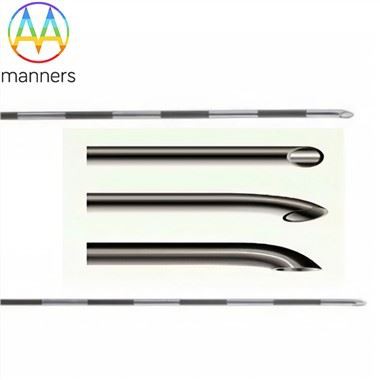
A back eye needle divides the opening into an end aperture and a side aperture. In an artery, where the driving pressure is high and the vessel is relatively small, the redundancy is valuable: if the end opening comes to rest against the wall, the side aperture continues to admit blood, so the sample can be completed without withdrawing and redirecting the needle.
The second effect concerns the exit path. When blood enters the needle through two openings, the velocity at each is lower, and the aspiration is less likely to draw the wall into the aperture. This is the phenomenon that produces the classic intermittent arterial return.
For indwelling arterial cannulae, side-hole geometry at the tip serves the pressure measurement as much as the flow.
The distinction between the two uses matters when a device is specified. For a single arterial puncture the needle sits in the vessel for a minute or two, and the dominant concerns are first-attempt success, sample integrity and haemostasis afterwards. For an indwelling cannula the device remains for hours or days, and the dominant concerns are tip stability, waveform fidelity and the risk of distal ischaemia. A back eye needle belongs to the first category and a side-aperture cannula to the second. Confusing them leads either to an over-specified sampling needle or to an under-specified monitoring line, and neither error becomes visible until something fails. A tip pressed against the wall produces a damped or flattened waveform that is easily mistaken for a technical fault in the transducer or the tubing, and the usual response - flushing, repositioning, replacing the set - costs time and, in a monitoring-dependent patient, clinical confidence.
Equipment types and configurations
Arterial sampling uses dedicated syringes with pre-heparinised barrels and vented or capped tips, and the needle is part of that assembly. Side-hole versions are used where the vessel is small or where the artery is likely to spasm, as in radial access in a patient with low blood pressure.
Arterial cannulae for continuous monitoring are a different product: a plastic cannula with a side aperture near the tip, connected through low-compliance tubing to a transducer. Here the geometry interacts with the fidelity of the pressure signal, and unapproved substitutions should be avoided because tubing compliance and cannula geometry both affect the waveform.
For repeat sampling from an indwelling line, a side-hole configuration reduces the number of occasions on which the line must be manipulated to obtain a sample, and every manipulation is an opportunity for contamination, air entry or displacement.
Consumable quality deserves its share of attention. Arterial syringes are often drawn from a stock shelf where several manufacturers' products sit side by side, and the differences that matter - plunger resistance, heparin distribution, cap sealing and venting - are not apparent from the packaging. A syringe whose plunger sticks will be pulled by hand, which defeats the purpose of arterial filling and introduces bubbles. Where a back eye needle forms part of a pre-assembled arterial kit, the performance of the whole assembly should be evaluated, because the tip is only one of several components deciding whether the sample reaches the analyser fit to be reported.
Practical guide for arterial puncture and sampling
Assess collateral circulation before radial puncture according to local protocol. Select the site, position the wrist in slight extension, and palpate the artery along its course rather than at a single point.
Insert at an angle appropriate to the vessel depth, advancing until pulsatile flash appears, then reduce the angle slightly and advance a further millimetre or two so that the side aperture enters the lumen. This step is what makes the geometry work; a needle that is only just through the anterior wall will not benefit from a side aperture.
Allow the syringe to fill under arterial pressure where the device is designed for it, rather than pulling forcefully on the plunger, which can produce bubble entrainment and haemolysis. Haemostasis after puncture is part of the technique, not an afterthought. Apply firm pressure over the puncture point for at least the period specified in local protocol, and longer where the patient is anticoagulated or the artery is small. A back eye needle leaves a slightly longer track than a single-aperture needle, and although the difference is small, it is a reason to hold pressure deliberately rather than briefly. Inspect the site before the patient leaves and record the outcome.
Remove air immediately, cap the syringe, mix the heparin as specified and analyse without delay.
For an indwelling cannula, secure it so that the tip lies free in the lumen, connect the pressure tubing without trapping air, and zero the transducer as the protocol requires. If the waveform is damped, check the tubing and connections first - the fault is more often external than at the tip.
What users report in practice
Clinicians working in critical care and in blood gas services describe fewer partial arterial samples and less repeat puncture after adopting side-aperture needles, particularly in patients with low mean arterial pressure where the margin for repositioning is small. In monitoring, users report fewer unexplained damped traces.
Two limits are worth stating. A side aperture does not prevent spasm, which is a physiological response to vessel irritation, and it does not make a deeply placed artery easier to find. In both cases the answer lies in technique and, where available, ultrasound guidance.
Ischaemia risk is the consideration that should not be lost in a discussion of tip geometry. A larger cannula in a small artery reduces flow around it, and a side aperture does not change that. Distal perfusion should be assessed before, during and after cannulation according to protocol, and a cannula no longer required should be removed rather than left in place for convenience. Units that audit arterial line duration frequently find a tail of lines left in situ well beyond clinical need, which is a greater source of harm than any needle specification decision.
Summary: fidelity under pressure
Arterial access is judged by two things: whether the sample is complete and analysable, and whether the signal is faithful. Both depend on the tip remaining open, and the second opening is what keeps it open when the vessel wall moves against it. In a vessel this small, the difference between a sample and a repeat puncture is measured in millimetres.
Outlook and recommendations
Ultrasound guidance and protocol-driven sampling are raising the standard for arterial access, and as first-attempt success improves, attention shifts to the quality of the second step - obtaining a clean, bubble-free sample and a reliable trace. Units should audit arterial sampling by indication, site and device type, tracking repeat punctures and rejected samples. Where waveform damping is a recurring complaint, the review should begin with the cannula tip position and the tubing system before any component is condemned.