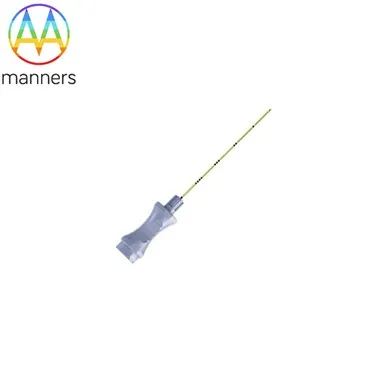
Atraumatic Pencil Point Spinal Needle Material Selection & Biocompatibility Testing
Nov 25, 2026
Introduction
Material selection stands as the foundational pillar for the safety profile of an atraumatic pencil point spinal needle, preceding machining, assembly and sterilisation. Unlike many non-invasive medical consumables, spinal needles directly penetrate living tissue and enter the cerebrospinal fluid compartment, meaning every constituent material must satisfy strict biocompatibility, mechanical and corrosion-resistance benchmarks. Even trace impurities, incompatible additives or unsuitable alloy grades may trigger local inflammation, allergic reactions, corrosion debris release or interference with nerve tissue. This article breaks down the material screening workflow, mandatory biocompatibility test battery, common failure risks and how manufacturers align material choices with ISO 10993 and ISO 13485 requirements for both pencil-point and Quincke-type spinal needles across the full 16G–27G portfolio.
Medical-Grade Cannula Stainless Steel Selection
The needle cannula is almost universally fabricated from precision-drawn austenitic stainless steel, most commonly 304 or 316L medical tubing. 316L is widely preferred for spinal access devices due to its reduced carbon content and enhanced resistance to pitting corrosion after passivation and repeated exposure to bodily fluids. The manufacturer's material engineering team reviews mill certificates to verify alloy composition, grain structure, tensile strength and ductility. Rigidity must be calibrated carefully: overly stiff tubing raises the risk of accidental neural trauma during insertion, while excessively soft thin-walled tubing for 25G–27G fine gauges is prone to buckling, bending or tip deformation under normal penetration force.
The drawing process for fine-bore tubing is tightly controlled to maintain uniform wall thickness, consistent inner lumen geometry and a smooth internal surface. Surface roughness is not merely cosmetic; irregular inner surfaces can disrupt cerebrospinal fluid flow, retain machining residues and complicate effective cleaning. Once tubing arrives, incoming material is sampled for chemical composition verification before release to production.
Hub, Stylet and Adhesive Material Screening
Beyond the steel cannula, additional components require equally rigorous assessment. Needle hubs are typically injection-molded from medical-grade polycarbonate or other biocompatible engineering polymers, formulated with approved colour pigments to maintain the standard gauge colour-coding system. Pigments must be non-bleeding and chemically stable through sterilisation cycles, avoiding leaching of harmful compounds into tissue or CSF.
Stylets match the cannula's material specification and precision ground to fit flush within the pencil-point orifice. Adhesives used to bond the cannula to the plastic hub represent another high-risk material interface. Only medical-grade, biocompatible, low-outgassing structural adhesives are permitted. The manufacturer validates bond integrity after sterilisation and accelerated ageing, ensuring the adhesive does not degrade, crack or release extractables over the product's shelf life.
Biocompatibility Test Matrix Aligned with Clinical Exposure
Spinal needles fall into a high-priority biocompatibility category because of their short-term but direct contact with cerebrospinal fluid, nerve root tissue and the dura mater. Following ISO 10993, manufacturers build a tailored test package rather than relying on generic material certificates. Core evaluations include cytotoxicity testing to detect leachables that damage living cells, skin sensitisation and irritation tests to rule out allergic or inflammatory responses, and intracutaneous reactivity assessment.
Because the device contacts the intrathecal space, testing for systemic toxicity and residual extractables is especially critical. Extractable and leachable studies simulate exposure conditions during sterilisation, storage and clinical use, identifying any substances that could migrate from polymer, adhesive or metal surfaces into the cerebrospinal fluid. Any positive finding triggers material reformulation or supplier replacement before the product is cleared for market release.
Passivation as a Surface Safety Step
Stainless steel tubing, grinding debris and machining processes can leave free iron particles on the cannula surface. These particles are vulnerable to corrosion once exposed to bodily fluids. Passivation is a controlled chemical treatment that removes free iron and forms a stable chromium-rich oxide passive layer on the needle surface. This step is validated for each gauge and tip geometry. Improper passivation can lead to rust spots, microscopic corrosion pits and particle shedding in the intrathecal space, with inflammatory consequences for the patient.
Material Change Control and Re-evaluation
Material substitution is one of the most frequent sources of hidden device risk. If a supplier switches steel melt batches, polymer resin grades, pigment formulations or adhesive lots, the manufacturer must initiate a formal change control review. The team assesses whether the new material could alter mechanical performance, biocompatibility, sterilisation compatibility or long-term stability. Depending on the magnitude of change, supplementary biocompatibility testing, bench performance validation and regulatory notification may be mandatory. No material swap is allowed to proceed through production without documented approval.
Distinction Between Material Safety and Clinical Outcome
It is essential to clarify that passing all biocompatibility and material testing does not eliminate procedural risks. A spinal needle made from fully compliant materials can still be associated with post-dural puncture headache, transient paraesthesia or rare cauda equina injury. These risks stem from anatomical variation, operator technique, needle gauge and insertion path rather than material toxicity. The material programme's purpose is to remove avoidable, device-originating hazards from the clinical equation.
Conclusion
Material selection and biocompatibility validation form the silent safety foundation of every atraumatic pencil point spinal needle. From the precision stainless steel cannula and coloured polymer hub to stylets and bonding adhesives, every component must be traceable, stable and biologically safe. For procurement teams, reviewing material certificates and biocompatibility test summaries is just as important as inspecting tip geometry and packaging quality when qualifying a spinal needle supplier.