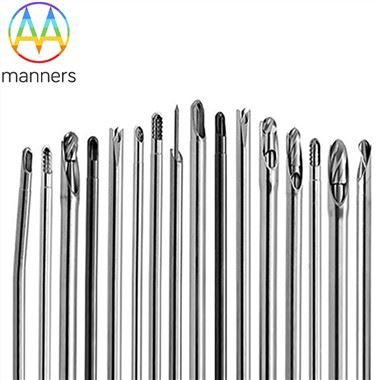
Application And Technical Adaptation Of Crimped Hypotube In Neurovascular And Peripheral Vascular Interventional Surgery
Sep 06, 2026
1. Industry Pain Points
Neurovascular and peripheral vascular interventional surgery has the most stringent technical requirements for medical hypotube components. The human neurovascular system is tortuous, narrow and complex, and peripheral vascular lesions are mostly distributed in limb curved blood vessels, requiring catheter delivery systems to have ultra-high flexibility, stable torque transmission, excellent kink resistance and ultra-small outer diameter size. Traditional welded hypotube assemblies have obvious defects in this scenario: the thermal welding process produces heat-affected zones, which weaken the structural strength of thin-walled tubes, and joint cracking and torque loss are easy to occur during repeated bending and vascular navigation. In addition, the ultra-fine specification hypotubes (Ø0.20mm–2mm) used for neuro-intervention have extremely thin tube walls, and traditional connection processes are prone to lumen blockage and outer diameter overrun. Although laser cut hypotubes can realize gradient flexibility through spiral and radial cutting patterns (minimum 0.012mm kerf width), they lack reliable mechanical connection structures. Medical device manufacturers have long faced the dilemma of balancing flexible performance, connection stability, ultra-small size and clinical safety, and it is difficult for traditional processes to meet the customized needs of complex neurovascular and peripheral vascular interventional devices.
2. Core Working Principle
Crimped hypotube solves the industry pain points of traditional connection processes through precise cold plastic deformation mechanical interlocking technology. Different from thermal welding, crimping molding does not melt the base material of the hypotube and does not produce thermal damage and residual welding stress, which completely retains the original mechanical properties of stainless steel, Nitinol and L605 alloy substrates. For neurovascular and peripheral vascular special scenarios, designers can set local crimp segments on the proximal or distal end of laser cut hypotubes. The laser cut area undertakes the flexible bending and torque adjustment function required for vascular navigation, while the crimping area realizes high-strength mechanical locking with catheter hubs, guide wire tubes and other accessories. By adjusting the crimp compression ratio, indent depth and circumferential distribution, the crimp joint can maintain stable pull-out strength and torque resistance under ultra-small outer diameter constraints. Nitinol crimped hypotubes rely on superelastic alloy characteristics to adapt to extreme bending of narrow neurovascular vessels, while 316L stainless steel and 17-7PH high-strength crimped hypotubes provide high load-bearing capacity for peripheral vascular recanalization and lesion dilation surgery.
3. Equipment Classification and Scenario Matching
According to the application scenarios of neurovascular and peripheral vascular devices, crimped hypotube processing and testing equipment is professionally classified to meet differentiated precision requirements. The first category is ultra-fine precision servo crimping equipment, specially used for Ø0.20mm–5mm micro hypotubes for neuro-intervention, with micron-level pressure and displacement control accuracy to ensure no deformation of ultra-thin-walled tubes. The second category is high-load precision crimping equipment, suitable for 5mm–20mm large-size hypotubes for peripheral vascular intervention, meeting high torque and high push force working conditions. The third category is professional simulation test equipment, including tortuous vascular simulation test benches and dynamic bending fatigue testers, which simulate the repeated bending state of human blood vessels to verify the long-term stability of crimp joints. In terms of product classification, it is divided into neuro-microcatheter crimped hypotube, peripheral vascular recanalization crimped hypotube, aneurysm imaging guidance crimped hypotube and laser cut composite crimped hypotube. All products support customized processing according to customer 2D/3D drawings and samples, and pass ISO9001:2015 and ISO13485 medical certification.
4. Standard Practical Operation Guidelines
In the production and customization of neurovascular and peripheral vascular grade crimped hypotubes, scenario-oriented parameter design and processing standards must be followed. First, clarify the surgical scenario parameters, including the minimum bending radius of the target blood vessel, the number of repeated bending cycles, the limit outer diameter of the catheter and the required joint tensile strength. Second, select matching raw materials: Nitinol is preferred for neurovascular devices requiring ultra-high flexibility and fatigue resistance; 316L medical stainless steel is used for conventional peripheral vascular devices; 17-7PH alloy is selected for high-strength load-bearing scenarios. Third, optimize crimping process parameters, strictly control the compression ratio of ultra-fine tubes to avoid lumen shrinkage, and reserve a safe spacing between crimp indentations and laser cutting areas to protect the flexible structure. Fourth, carry out special simulation tests, use vascular simulation equipment to verify the navigation performance and joint stability of the finished product, and screen out products with fatigue failure risks. Finally, complete full-process traceability filing and adopt dust-proof customized medical packaging to ensure product biocompatibility and cleanliness.
5. On-Site Practical Experience
Clinical verified production experience shows that neurovascular crimped hypotubes have the highest requirements for process precision. Excessively deep crimp indentation will cause invisible residual stress on the ultra-thin tube wall, which will not fail in static tests but break instantly during intracranial vascular navigation. Therefore, micro-pressure slow forming and stress relief treatment must be adopted for all Nitinol micro-crimped hypotubes. In peripheral vascular intervention scenarios, the catheter needs to bear greater push force and torque, so the circumferential uniform multi-indent crimping structure is more reliable than single-point crimping, which can effectively avoid local stress concentration. In addition, the hybrid structure of laser cutting and crimping is the best solution for current vascular interventional devices, but many manufacturers have unreasonable process sequences; the correct process is laser cutting first and then crimping, which can avoid laser kerf deformation caused by crimping extrusion and ensure the consistency of product flexibility and connection strength.
6. Summary and sublimation
Crimped hypotube makes up for the structural defects of traditional welded and single laser cut hypotubes, and becomes the core precision component of modern neurovascular and peripheral vascular minimally invasive interventional devices. Its cold forming mechanical interlocking mechanism perfectly adapts to the extreme working conditions of complex vascular bending and long-term dynamic load, realizing the organic unity of ultra-small size, high flexibility and high connection stability. Differentiated material selection and process parameter design are the key to ensure the adaptive performance of crimped hypotubes in different vascular intervention scenarios. Standardized processing and testing procedures effectively avoid clinical safety risks caused by component failure, providing a solid technical foundation for precise minimally invasive surgery.
7. Industry Prospect and Optimization Suggestions
In the future, vascular interventional surgery will develop towards ultra-miniaturization, intelligent guidance and minimally invasive precision treatment, and the market demand for high-precision crimped hypotubes will continue to grow. It is suggested that manufacturers focus on the research and development of composite process technology, integrate laser gradient cutting and intelligent crimping molding to develop multi-functional integrated hypotube components. At the same time, establish a special parameter database for neurovascular and peripheral vascular scenarios, realize one-click matching of materials, structures and processes, and shorten the product customization cycle. In addition, strengthen in-depth cooperation with medical device R&D institutions, continuously optimize the fatigue resistance and biocompatibility of products, and promote the wide application of crimped hypotube technology in aneurysm treatment, cerebral vascular recanalization and peripheral vascular lesion interventional therapy.