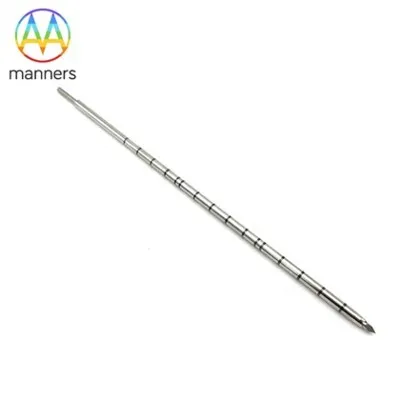
304 Stainless in The OR
Oct 10, 2026
The Pain Point
In the high‑stakes environment of the operating room, the last thing a surgeon should worry about is whether the instrument in their hand will survive the procedure. Yet, for meniscus repair needles made from sub‑standard materials, failure is not a matter of "if" but "when." Procurement teams often write "stainless steel" on purchase orders, assuming it is a universal, fail‑safe specification. What arrives are mystery‑metal tubes-sometimes 201 grade passed off as 304, sometimes 304 that has been improperly processed, sometimes even recycled scrap steel. The consequences unfold in slow motion: a 150 mm delivery needle that kinks under gentle pressure because the alloy lacks ductility; a curved tip that springs back straight after the first autoclave cycle because the bend was work‑hardened without stress‑relief; a laser mark that corrodes into a black pit, harboring bio‑film and turning the depth indicator into a infection risk. In one documented case, a hospital purchased "304‑equivalent" meniscus needles from a non‑certified overseas shop at 60 % of market price. After five reprocessing cycles, three needles developed visible rust spots at the bend, one snapped at the hub during a routine repair, and the laser marks faded to invisibility. The hospital's sterile processing department flagged them as "recall risk," and the entire batch was quarantined. The replacement cost, including expedited shipping of ISO‑13485‑certified needles, OR delays, and additional sterilization, was 4.8× the original "savings." The pain is that commodity stainless is not a medical material-it is a gamble with patient safety and hospital finances.
How It Works
Stainless steel is not a single substance; it is a family of iron‑based alloys with a minimum chromium content of 10.5 % that forms a passive, self‑healing oxide layer. For meniscus repair needles, 304 stainless steel (UNS S30400) is the workhorse. Its nominal composition-18 % chromium, 8 % nickel, ≤0.08 % carbon-delivers a balance of corrosion resistance, formability, and strength. In the annealed condition, 304 has a tensile strength of 500–700 MPa and elongation of 40–50 %, meaning a 1.5 mm OD shaft can be bent to a 24° curve without cracking, yet still transmit the pushing force needed to span 150 mm from skin to contralateral portal. The passive layer reforms instantly if scratched, protecting against the saline irrigation, blood, and bodily fluids of arthroscopy. However, this protection is only as good as the surface finish and post‑processing. Electropolishing removes micro‑burrs and reduces surface roughness to Ra ≤ 0.25 µm, eliminating crevices where corrosion starts. Passivation per ASTM A967 or ISO 16048 dissolves free iron from manufacturing, enriching the chromium oxide layer. Without these steps, even genuine 304 can rust. 316L adds 2–3 % molybdenum for superior pitting resistance in chloride‑rich environments, making it the premium choice for reusable instruments. Nitinol (nickel‑titanium) offers shape memory and kink recovery but requires specialized thermal processing and costs 8–10× more. For most delivery needles, 304 hits the sweet spot-if the entire process chain, from tube drawing to final cleaning, is controlled under a medical‑device quality system.
Device Classification
By Alloy and Condition:
304 SS, annealed – Standard delivery needle; cost‑effective, reliable for single‑use or limited reuse.
304 SS, spring‑tempered – Higher stiffness for long shafts; requires careful bending to avoid fracture.
316L SS, annealed – Premium reusable; superior corrosion resistance; preferred for facilities with aggressive reprocessing.
Nitinol, superelastic – Advanced curved/reverse‑curved tips that return to shape after deformation; used in pediatric or complex‑anatomy needles.
Titanium‑coated 304 – Niche; reduces friction but coating may wear after repeated sterilization.
PTFE‑coated shaft – Suture glide improvement; not durable for reprocessing cycles.
By Surface Treatment:
As‑drawn – Rough, not for medical contact.
Bright annealed – Smooth, basic medical finish.
Electropolished – Ra ≤ 0.25 µm; reduces tissue drag and improves cleanability.
Passivated – Citric or nitric acid treatment; enhances corrosion resistance.
Combined EP + passivation – Gold standard for reusable meniscus needles.
Practical Guide
For Buyers Specifying Material:
Demand a Mill Test Certificate (MTC) with heat number, chemical analysis, and mechanical properties. Reject "commercially available grade" without traceability.
Specify alloy explicitly: "304 stainless steel per ASTM A276/A313" or "316L per ASTM A276." Avoid vague "stainless."
Define condition: Annealed for formability; specify hardness range (e.g., HRC 22–25 for delivery needles).
Surface finish: Electropolish to Ra ≤ 0.25 µm shaft, ≤ 0.15 µm tip; passivation mandatory.
Cleaning validation: Ultrasonic cleaning with particulate count verification; residue‑free per ISO 10993‑17.
Sterility: EO or gamma if pre‑sterilized; if non‑sterile, ensure packaging prevents contamination during transit.
Reprocessing limits: If reusable, request validated cycle count (e.g., "minimum 25 autoclave cycles without corrosion or deformation").
Quality system: ISO 13485 and ISO 9001 certification; audit reports available.
Custom material requests: Nitinol for shape‑memory curves; 316L for high‑humidity ORs; hybrid coatings for special procedures.
For Manufacturers Controlling Quality:
Incoming tube inspection: dimensional, chemical, mechanical.
Process validation: bending, laser marking, electropolish, passivation.
In‑process control: SPC on bend angle, mark position, surface roughness.
Final inspection: 100 % visual for cracks; sample CMM for critical dimensions.
Traceability: Heat number → process lot → finished device serial number.
Real‑World Experience
A regional orthopedic center bought "304" meniscus needles from a discount supplier. After 8 reprocessing cycles, 3 needles lost their curve, 1 showed pitting at the bend, and the laser marks were barely visible. Switching to an ISO 13485‑certified 304 needle with validated electropolish and passivation eliminated failures. A 25‑cycle audit showed zero curve drift, zero pitting, and legible marks throughout. Although the certified needles cost 2.3× more per unit, the cost per case dropped by 40 % because no needles were lost to corrosion or deformation, and no OR delays occurred.
An OEM attempted to cut costs by using 316L for all needles. While corrosion resistance was excellent, the bend spring‑back was excessive on a sliding‑headstock lathe, making the tip angle unstable. Process engineers introduced a partial anneal followed by a final stress‑relief bake; the curve then held within ±1°. The lesson: even a superior alloy can fail if the process is not adapted to its specific metallurgy.
Summary
Material is not a line item; it is the behavior of the needle in the surgeon's hand after 20 repetitions and 20 sterilizations. 304 stainless steel is the standard for meniscus repair needles because it offers the right mix of stiffness, formability, and corrosion resistance-but only when sourced from certified mills, processed under ISO 13485, and finished with electropolish and passivation. Commodity "stainless" is a false economy that risks instrument failure, patient safety, and hospital reputation.
Outlook
By 2030, material traceability will be digital. Each needle lot will carry a blockchain‑linked passport containing the heat number, mill certificate, processing parameters, and cleaning validation data. Buyers will scan a QR code to verify that the 304 in their hand is genuine and properly processed. Reusable needles will embed micro‑chips that count sterilization cycles and alert when the instrument should be retired. Single‑use needles will dominate in outpatient settings, but for hospitals that reuse, the future belongs to 316L and Nitinol instruments with documented life‑cycle management. Material science will merge with data science, and the humble stainless tube will become a smart, connected component of the orthopedic supply chain.