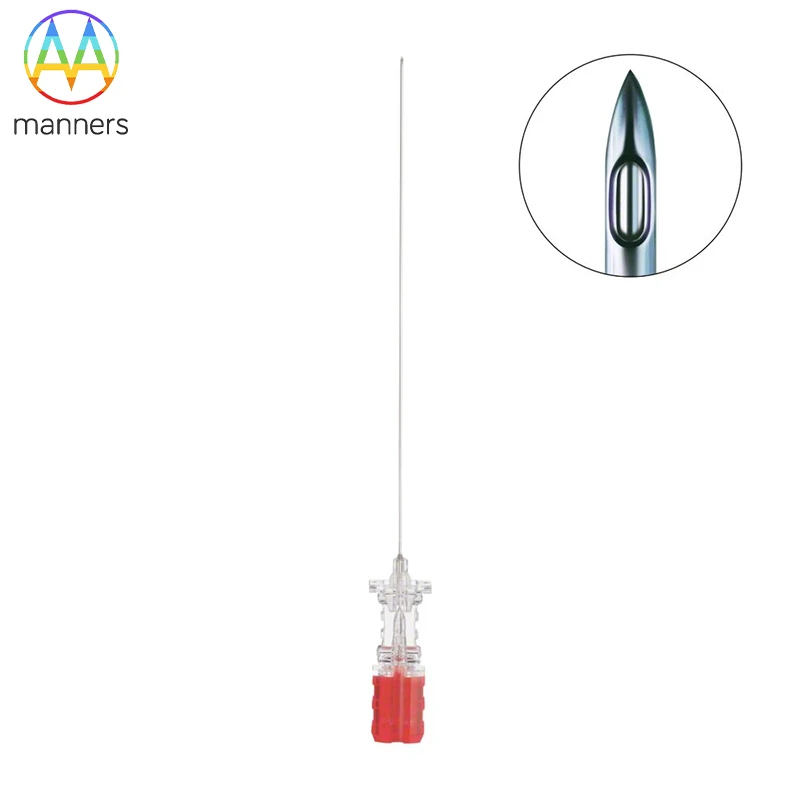
What is the process of doing lumbar puncture needle?
Jun 16, 2022
The patient should be in lateral decubitus or sitting position. Lateral decubitus is preferred for accurate open pressure and to reduce the risk of headache after puncture. Not all patients can receive a lumbar puncture in any position, so the physician should learn to perform the procedure in the patient's left, right, and upright positions. Once the patient's basic position is established, the physician should instruct the patient to adopt fetal position or arch the waist "like a cat" to increase the space between spinous processes. The lumbar spine should be perpendicular to the table when the patient is sitting and parallel to the table when the patient is lateral. A line is drawn between the upper edges of the two iliac ridges, intersecting the midline through the L4 spinous process. The needle is inserted in the space between L3 and L4 or L4 and L5, as these sites are located below the terminal segment of the spinal cord. Physicians should make clear the boundary markers before disinfecting the skin and administering local anesthetics, as these procedures may obscure the boundary markers. Use a skin marker to mark the correct location. Preparation before puncture The physician, after wearing sterile gloves, disinfect the skin with an appropriate disinfectant (povidone-iodine or chlorhexidine containing solution), starting at the center and expanding outward in a circle. Then cover with a disinfectant towel. Analgesia and sedation Lumbar puncture can make the patient feel pain and upset, and a minimal dose of local anesthetic is appropriate. If time permits, the physician may apply a topical anesthetic cream to the patient before disinfecting the skin. Local anesthetics can be injected subcutaneously, as well as systemic sedatives and painkillers after the skin has been disinfected and covered with a disinfecting towel. The lumbar puncture physician once again identifies the boundary marker and inserts a needle with a needle core in the midline, at the upper edge of the next spinous process. The needle is facing the head at about 15 degrees, seemingly in the direction of the patient's umbilical cord. Recent data suggest that the use of "pencil-tip" needles may reduce the risk of post-puncture headache caused by leakage of CSF because they disperse the fibers of the dural sac rather than cutting them. If the more commonly used bevel needle is used, the bevel of the needle should be located in the sagittal plane, which also allows the fibers parallel to the spinal axis to be scattered without cutting them. If inserted correctly, the needle should pass through the skin, subcutaneous tissue, the supraspinal ligament, the interspinous ligament between spinous processes, the ligamentum flavum, the epidural space (which includes the internal vertebral plexus, the dura mater, and the arachnoid membrane), into the subarachnoid space, and between the cauda equina nerve roots. When the needle passes through the ligamentum flavum, the physician may feel a sense of breakthrough. At this point, the needle core should be pulled out 2 mm to observe whether there is cerebrospinal fluid outflow. If the puncture is unsuccessful and touches bone, withdraw the needle to the subcutaneous tissue, but do not withdraw from the skin. Adjust the direction and insert the needle again. Once the needle enters the subarachnoid space, CSF exits. If there is trauma from the puncture, the CSF may be slightly sanguine. The CSF should be clear and bloodless at the time of collection, unless subarachnoid hemorrhage is present. If cerebrospinal fluid is not flowing freely, rotate the needle 90 degrees as the opening of the needle may become blocked by nerve roots. Open pressure can only be measured in patients in lateral decubitus position. Use a hose to connect the manometer to the needle holder of the puncture needle. This should be done before any samples are collected. When the liquid column is no longer rising, read the measurement. You may see fluid level pulsation due to cardiac or respiratory movement. Samples should be collected with CSF dripping into the collection tube and should not be aspirated as even small negative pressure can easily lead to bleeding. The amount of liquid collected should be limited to the minimum required, usually 3 to 4 ml. If the patient is undergoing open pressure measurement, the physician should turn the rotary valve to the patient to allow the CSF in the manometer to flow into the collection tube for CSF sample collection. After collecting enough samples, insert the needle core and pull out the needle.
If you have any questions, please contact us. Our company can produce various customized needles, medical needles, puncture needles, hypodermic needles, biopsy needles, vaccine needles, injection needles, syringe needles, veterinary needles, pencil point needle, ovum pick up needles, spinal needles, etc. If you need customized needle products, please contact us. We look forward to your inquiry! The quality of the products manufactured in our factory will surely satisfy you!
Please contact us if you need: zhang@sz-manners.com