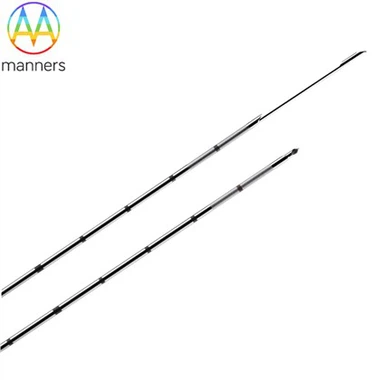
Treatment of severe humeral supracondylar fractures in children with open reduction and cross Kirschner wire internal fixation with different approaches
Dec 15, 2021
To explore the necessity of surgical treatment of supracondylar fractures of the humerus, and to compare the therapeutic effects of different surgical approaches. Methods: From August 2004 to January 2009, 32 children with supracondylar fractures of the humerus were treated with open reduction and cross Kirschner wires Internal fixation was performed in 20 cases, anterolateral approach was used in 12 cases, posterior elbow median approach was used in 12 cases, 24 males and 8 females; ages 3-12 years old, with an average of 8 years. 28 cases of extension type, 4 cases of flexion type Among them, 2 cases had median nerve injury, and 1 case had radial nerve injury. Among them, the extension type was based on Gartland's classification method, with 9 cases of type Ⅱ and 23 cases of type Ⅲ. The Kirschner wire was removed 3 to 4 weeks after the operation. , Started functional exercise. The elbow joint function was evaluated by Cassebaum and other elbow joint scoring system. Results: 28 cases were followed up for 30 weeks to 16 months, with an average of 4113 weeks. During the follow-up period, there was no elbow valgus or elbow joint. Functional evaluation: 18 cases were excellent, 8 cases were good, and 2 cases were fair. The average range of joint motion was 115°. Conclusion: For patients with type II and III humeral supracondylar fractures and obvious swelling of the elbow joint, surgical treatment is the same A reliable treatment method, and the anterolateral surgical approach of the elbow is better than the posterior median approach.
Please contact us if you need: zhang@sz-manners.com