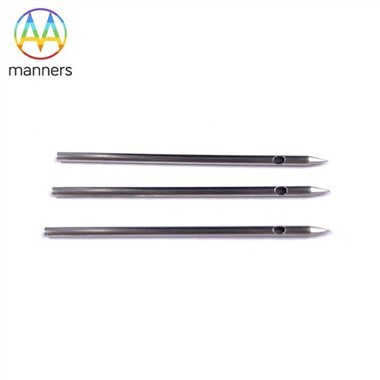
The approach of anesthetic needle for medical dural puncture
Dec 20, 2022
(1) Transsacral hiatus puncture method: The patient was placed in prone position, and the skin was routinely disinfected. After local anesthesia, the sacrocaudal ligament was punctured with the No.16 epidural puncture needle at 45 degrees with the trunk, and then the sacrocaudal canal was slowly penetrated at 25 degrees. Since the subarachnoid space terminates at the second sacral vertebral plane, the puncture needle should not exceed this plane to ensure that it does not penetrate into the subarachnoid space. The needle core should be removed to observe whether there is cerebrospinal fluid overflow. The epidural anesthesia catheter should be inserted into the lumbosacral epidural space, and then the puncture needle should be withdrawn. Before the contrast agent is injected, 80 ~ 120ml of 0.5% procaine can be injected first to observe the presence of spinal anesthesia, so as to rule out the perforated dural injury. Only after confirming that there is no dural damage can the contrast agent be injected. (2) Posterior dural angiography by lumbar puncture: the patient was placed in lateral decubitus position, with the affected side lower and the head slightly elevated. Methods With epidural anesthesia, puncture was performed from the space of lumbar 3 and 4. After confirming that the needle tip was located in the epidural space, the contrast medium was slowly injected, the puncture needle was removed and an X-ray film was taken. (3) Translumbar puncture predural angiography: The patient was placed in lateral decubitus position, and the 22-gauge puncture needle was inserted through the fourth and fifth spines of the waist. When the needle tip broke through the posterior wall of the arachnoid and entered the subarachnoid space, cerebrospinal fluid flowed out. When the needle tip penetrated into the predural space, no cerebrospinal fluid flowed out. An X-ray is taken to confirm that the needle tip is at the posterior edge of the vertebral body, and 2ml of 0.5% procainine is injected. If there is no resistance, 2ml of contrast agent can be injected. Another X-ray is taken to confirm that no contrast agent spills into the subarachnoid space, and 4ml of contrast agent is injected. An epidural scan can show the size of the spinal canal and the extent of the disc herniation beyond the dural sac. It has a high diagnostic accuracy for lumbar disc herniation, but it affects the display of spinal canal contour image due to the unstable amount of fat, loose connective tissue and venous plexus in the epidural space of the spinal canal. When reading a film, it is necessary to combine positive and lateral analysis.