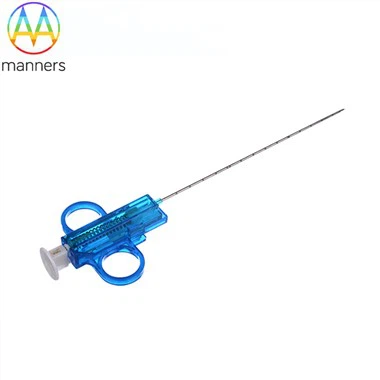
Nerve block puncture needle for chronic pain
Dec 02, 2022
1 Nerve cryotherapy Cryotherapy nerve block is to use the cryotherapy probe to produce extremely low temperature (-80℃ ~ -100℃). The biological effect of low temperature makes the myelin sheath of the nerve endings in the corresponding parts denature and lose conduction function to achieve the purpose of analgesia. Advantages: Recurrent lesions, less neuritis, less equipment costs than radiofrequency neurolysis. Disadvantages: Produces temporary nerve block and requires repeated cold damage; The cold probe is large, the process of the skin will be uncomfortable; The success of the block depends largely on how close the puck is to the nerve. Chen Jianwen et al. believed that lumbar muscle strain and small joint disorder had the best curative effect in the treatment of low back pain by posterior branch of spinal nerve freezing.
2 Radiofrequency thermocoagulation injury Radiofrequency thermocoagulation therapy uses controlled temperature to act on ganglion, stem, root and other parts, and uses the difference of temperature tolerance of different nerve fibers to selectively block the Aδ and C fibers that transmit pain, so as to achieve the purpose of both pain relief and local touch retention. The unmyelinated fine fibers (Aδ, C) that transmit pain are denatured at 70℃ ~ 75℃, while the myelinated coarse fibers (Aβ) that transmit touch can tolerate higher temperatures. Compared with chemical nerve destruction therapy, it has the following characteristics: ① the size of the lesion can be accurately controlled; (2) can accurately monitor the damage temperature; ③ The puncture needle can be accurately placed by means of electrical stimulation test and impedance monitoring; (4) Most procedures can be done under mild sedation or local anesthesia. (5) Most of the thermocoagulation lesions can recover quickly, with fewer residual symptoms; ⑥ Under correct operation, the incidence of complications and side effects is low; ⑦ If the pain symptoms recrudescence, radiofrequency thermocoagulation therapy can be repeated. Disadvantages: Expensive equipment; Operators need to be trained and have certain work experience. Radiofrequency thermocoagulation semilunar ganglion, posterior branch of cervical lumbar spinal nerve and intercostal nerve can treat trigeminal neuralgia, cervical headache, low back pain and intercostal neuralgia respectively. Radiofrequency thermocoagulation facet joint neurotomy has also achieved good results in the treatment of neck and back pain.