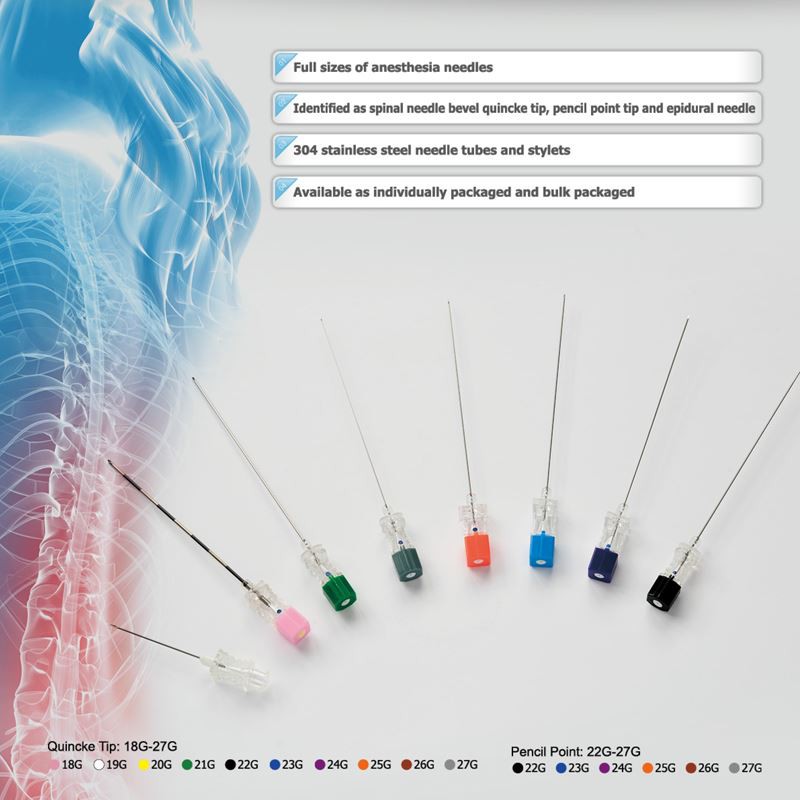
Introduction of the lumbar puncture needle
Nov 16, 2021
Introduction of the lumbar puncture needle
The insertion is made with a lumbar puncture needle equipped with a stylet. In order to be manœuvred easily into the sacral canal, the needle must have some flexibility and therefore should be long: a 9 cm needle is perfect for this purpose (21 G × 9 cm). The stylet precludes the risk of introducing a piece of skin, which later could lead to the development of an inclusion dermoid cyst.
The needle is thrust in between the two cornua just distal to the palpating thumb. After piercing the thick intercornual ligament, it passes freely through the hiatus before it hits the bone of the sacral base. The needle is then partly withdrawn and angled slightly in order to conform with the obliquity of the sacral canal; this can be done by applying slight pressure with the palpating thumb on the skin above the needle.
The needle is then moved further upwards over a distance of 3–5 cm. Normally, the tip remains well distal to the lower end of the dural sac, which is represented by the line between the two lower iliac processes.
Usually, the needle slips intrasacrally without any problem. However, the tip may meet bone, which indicates that the angle must be altered. Judging the angle of insertion of the needle is the most difficult part of the whole procedure. Important guides are previous palpation of the lower sacral spinous processes and the angle of the fine needle used for surface anaesthesia when it was pushed through the intercornual ligament. A very curved sacrum is difficult to approach, demanding puncture well distal to the bony ridge connecting the cornua. The needle is then aimed almost horizontally, in the direction of the patient's head. A patient with hyperlordosis usually has a flat, horizontal sacrum, which calls for an almost vertical insertion. A particular problem is posed by an overcurved bifid sacrum, where the sacral arches are not bony but consist of fibrous tissue. If the insertion is made too low down, the tip of the needle may slip through the ligamentous roof of the sacrum and come to lie in the fibrous tissue closing the defect. A sacrum with an intrasacral bony projection is an occasionally encountered difficulty. If the needle catches such a bony obstacle on its way up, it must be withdrawn a short distance and thrust in again at a slightly different angle. If this proves to be impossible, the tip of the needle should be left there and the injection made from this position, providing no palpable swelling at the hiatus appears as the fluid is administered.
When the needle is far enough into the sacral canal, the stylet is withdrawn. Care is taken to see that neither cerebrospinal fluid nor blood escapes.
The needle pierces the theca in only the occasional case in which the dural sac ends at an abnormally low level. In most, the dural sac terminates at the level of S2, which is considerably more proximal than the tip of the needle. If cerebrospinal fluid escapes, the needle should be removed immediately. It is a serious mistake to withdraw the needle only a little until it lies extradurally and then to continue with the injection, as enough of the procaine solution can pass through the hole to cause a spinal block. Hence, if the theca has been pierced, the whole procedure should be postponed until some days later, when the needle is not inserted so far proximally.
Often blood escapes when the stylet is withdrawn, which is not surprising, considering the number of epidural veins in the sacral canal. It is enough to move the tip of the needle into a position where it no longer penetrates the vein, and the injection can then be given without any danger. If the needle cannot be manœuvred into a position where blood ceases to escape, the injection should be postponed for 2 days.
If you have any questions, please contact us. Our company can produce various customized needles, medical needles, puncture needles, hypodermic needles, biopsy needles, vaccine needles, injection needles, syringe needles, veterinary needles, pencil point needle, ovum pick up needles, spinal needles, etc. If you need customized needle products, please contact us. We look forward to your inquiry! The quality of the products manufactured in our factory will surely satisfy you!
Please contact us if you need: zhang@sz-manners.com