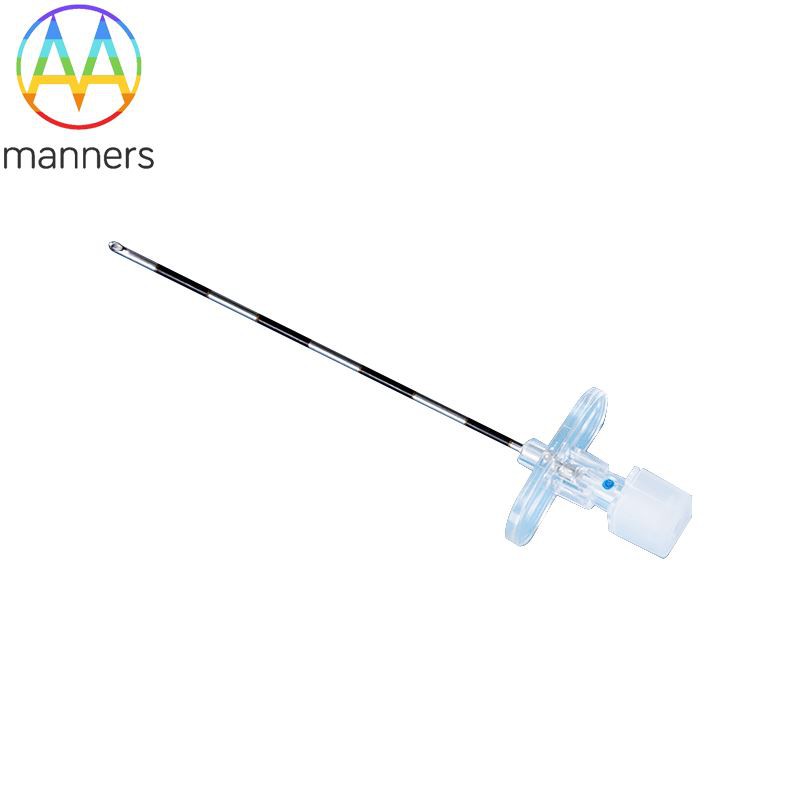
Epidural needle puncture method
Jan 04, 2022
1. Blind puncture method Epidural puncture can use straight approach and side approach. The spinous processes of the cervical spine, the upper thoracic spine and the lumbar spine are parallel to each other, and the straight approach is mostly advocated; the middle and lower spinous processes of the thoracic spine are shingled, with narrow gaps, and the side approach can be used when puncture is difficult. For the elderly with calcification of the supraspinous ligament and restricted curvature of the spine, the lateral approach is generally appropriate.
Straight-in method Make skin hills at the selected spinous process space near the upper edge of the inferior spinous process, and then infiltrate layer by layer. A 15 G sharp needle can be used to puncture the skin and ligaments, and then the epidural puncture needle can be pierced along the needle hole. The position of the needle must be on the mid-sagittal line of the spine. The needle tip penetrates the subcutaneous superspinous ligament, interspinous ligament, ligamentum flavum and other tissue levels, and the resistance to penetrating the ligamentum flavum suddenly disappears, prompting to enter the epidural space (Figure 4).
Lateral entry method The side entry method is to insert the needle 1.5 cm beside the spinous process space. The puncture needle is aligned with the interspinous process hole at a 75° angle with the skin, avoiding the supraspinous ligament and interspinous ligament, and enters through the ligamentum flavum. The epidural space (Figure 5).
Catheter placement method for continuous epidural anesthesia: When it is determined that the epidural needle enters the epidural space, turn the bevel of the needle toward the cephalic or caudal side, and insert a graduated needle through the lumen of the epidural needle 20 G catheter. The catheter should exceed the tip of the puncture needle and enter the epidural space by 3 to 4 cm. Secure the catheter with a sterile dressing. Place the catheter to inject drugs multiple times or continuously.
Drugs and dosage: First, inject a test amount of local anesthetic, usually 1.6% to 2% lidocaine 3 to 5 ml. Before injecting the medicine, it must be sucked back to confirm that there is no blood and cerebrospinal fluid.
2. Ultrasound positioning guided puncture technology has been widely used in minimally invasive surgical anesthesia, regional block and vascular puncture. It also provides a new method for epidural puncture and catheterization. High-quality ultrasound imaging can help the operator quickly and accurately locate the epidural space, and guide the puncture needle and catheter into the epidural space to complete the epidural positioning tube, which can reduce the number of tries and reduce the discomfort of the patient. Improve patient satisfaction.
The operation steps are to scan and mark the highest point of the iliac crest first, and then move the probe to the head to scan the lumbar intervertebral spaces and spinous processes, and locate the third spinous process at the measured intersection. Determine the epidural related structures and show the clearest gap, which is about 1.0 cm away from the midline as the puncture point. Routine disinfection of the puncture site was performed. After 1% lidocaine local anesthesia, the puncture point was used as the center of the probe to scan the paramedian longitudinal section.
Ultrasound imaging shows (from shallow to deep) the most superficial layer is skin, the fascia is linear and strong echo, the adjacent spinous process is "wall-like", the bone surface is arc linear and strong echo, and the back is covered by sound shadow. At the top of the two spinous processes, due to the different directions of the ligament fibers in each group, the ultrasound beam produces anisotropy. The supraspinous ligament, the interspinous ligament and the interarch ligament are medium to low uneven echo images. The dura mater and the ligamentum flavum have a dense tissue structure. The sonogram shows a moderate to strong echogenic zone, mainly the ligamentum flavum. The epidural space between the dura mater and the ligamentum flavum is an epidural space with moderately hypoechoic in the cavity. Ultrasonography of epidural fat (Figure 6). The operator inserts the epidural puncture needle through the ligamentum flavum into the epidural space according to the collected images of the intervertebral space. When the puncture needle reaches the ligamentum flavum, the resistance increases, withdraw the puncture needle core, connect a low-resistance syringe, and slowly inject saline containing bubbles; when the puncture needle breaks through the ligamentum flavum, there is no cerebrospinal fluid and blood drawn back, and the bubbles are not compressed. The saline bolus injection has no resistance, which confirms the success of the puncture.
3. Puncture under C-arm positioning. Under C-arm fluoroscopy, the spinous process of the vertebral body can be clearly identified and the real-time position of the puncture needle can be clearly seen, which can improve the success rate of puncture.
If you have any questions, please contact us. Our company can produce various customized needles, medical needles, puncture needles, hypodermic needles, biopsy needles, vaccine needles, injection needles, syringe needles, veterinary needles, pencil point needle, ovum pick up needles, spinal needles, etc. If you need customized needle products, please contact us. We look forward to your inquiry! The quality of the products manufactured in our factory will surely satisfy you!
Please contact us if you need: zhang@sz-manners.com