Why Vascular Access Needles Manufacturers Are Championing The 45mm IO Needle
Jul 28, 2026
In the realm of global emergency and critical care medicine, the escalating prevalence of obesity is fundamentally reshaping clinical pathways for establishing vascular access. The "golden ten minutes" of resuscitation demand immediate vascular access, yet in patients with excessive BMI and abnormally thickened subcutaneous adipose layers, traditional 25mm intraosseous (IO) needles often prove inadequate. It is against this backdrop that the 45 mm intraosseous vascular access needle has emerged as a new focal point in the emergency consumables market. Manufacturers have identified through product development and market education that in obese populations-where the tibial trochanter is often impalpable-the 25mm needle frequently fails to traverse deep tissue, delaying the delivery of life-saving medications. This article delves into the medical logic and industrial responsibility behind the strategic pivot of Vascular Access Needles Manufacturers toward the 45mm specification.
During resuscitation, vascular access is the gateway to survival. Intraosseous access is the gold standard when peripheral IV attempts fail due to collapsed veins. However, altered anatomy presents a challenge manufacturers must address. Excessive adipose tissue not only obscures critical bony landmarks like the tibial tubercle and greater trochanter but also drastically increases the skin-to-cortex distance. Clinical studies indicate that in severely obese individuals, soft tissue depth over the proximal tibia often exceeds 25mm, sometimes reaching 30mm to 40mm. Attempting IO access with a 25mm Vascular Access Needle in such scenarios risks the needle failing to reach the cortex or, worse, "burying the needle"-a scenario where the needle is lodged insecurely or incompletely within the soft tissue.
Manufacturers emphasize in technical manuals: "As long as the provider does not 'bury the needle,' the 45 mm intravascular access needle tip can be used anywhere regardless of depth." The core of this statement lies in the redundancy offered by the 45 mm length. Unlike the 25mm variant, the 45mm design ensures that after penetrating potentially dense soft tissue, sufficient length remains to breach the cortical bone and reside securely within the medullary cavity. In some cases, parts of the needle may even protrude from the skin to facilitate visualization and stabilization. This "over-penetration without burial" safety profile is the engineering answer manufacturers provide to the physiological realities of obesity. When the needle pierces the cortex (possibly allowing parts of the needle to protrude), it guarantees access at all three common sites: proximal tibia, distal tibia, and proximal humerus.
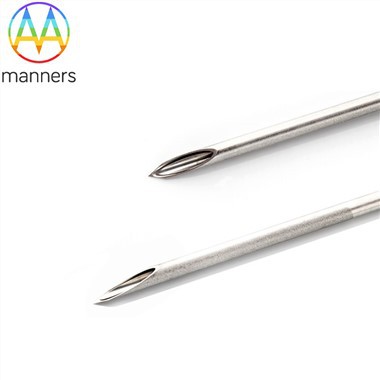
For Vascular Access Needles Manufacturers, producing a 45mm规格 is not merely about extending the cannula; it involves a comprehensive upgrade in materials science and precision manufacturing. Medical-grade stainless steel must exhibit enhanced buckling resistance when extended to 45mm. A longer needle is prone to bending (buckling) when axial force is applied through dense fat and fascia. Leading manufacturers optimize the hardness of the stainless steel, employ tapered wall thickness designs, and utilize diamond-grade tip grinding to ensure that axial force translates efficiently to the needle tip rather than being lost to deflection. Furthermore, ergonomic hub design is adjusted to accommodate the potential need for securing a partially exposed needle shaft.
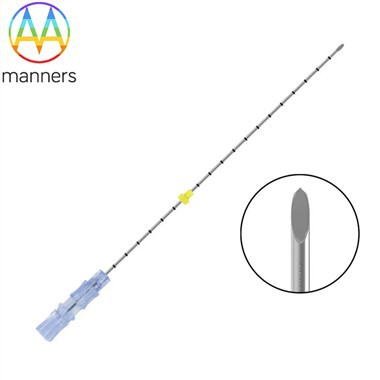
Market feedback indicates that EMS agencies and hospital ICUs are moving away from "one-size-fits-all" inventory practices. Manufacturers explicitly state: "The bottom line: The 25 mm vascular access needle may not provide the appropriate length of vascular access for obese patients. For these patients, consider reaching for the 45 mm vascular access needle, especially if palpation of the tibial trochanter is not possible." This evidence-based guidance is driving manufacturers to establish more granular product matrices-ranging from 15mm (pediatric), 25mm (standard adult), to 45mm (obese/adult with large muscle mass). In OEM/ODM services, manufacturers customize depth calibration markings on the 45mm shaft based on client-provided 2D/3D Drawings, aiding clinicians in visually estimating insertion depth when palpation fails.
Beyond physical specifications, manufacturers' responsiveness in packaging and supply chain logistics is critical. The 45mm Vascular Access Needles require robust packaging-often within a Standard carton or according to customer's requirement-to protect the needle tip during transit. Blister packaging must be redesigned to accommodate the longer length while ensuring effective ethylene oxide (EO) sterilization penetration and residue control. Amidst global supply chain restructuring, Vascular Access Needles Manufacturers capable of providing stable, compliant, and Custom Size options are solving the global challenge of "difficult access" in obese patients through this specialized niche.
In conclusion, the obesity crisis is not a transient epidemic but a long-term public health challenge. By championing the 45mm IO needle, Vascular Access Needles Manufacturers are not merely selling an Injection & Puncture Instrument; they are contributing to a more resilient emergency medical system. From material selection to clinical guidance, every step reinforces the industry consensus: when soft tissue depth is uncertain, the 45mm needle provides not just length, but a critical safety margin for saving lives. Moving forward, manufacturers must collaborate with clinical researchers to gather more real-world data on the reliability of 45mm needles across diverse ethnicities and extreme BMI ranges, ensuring every stainless steel shaft reaches the medullary cavity precisely when seconds count.