Unique Structural Design Principles And Clinical Advantages Of Tuohy Needles
Jul 20, 2026
https://en.wikipedia.org/wiki/Tuohy_needle
The core competitiveness distinguishing Tuohy needles from ordinary puncture needles originates from their exclusive precision structural design. The combined structure of curved blunt tip, rear eye, gradient pipe diameter and transparent hub perfectly matches the clinical demands of minimally invasive spinal canal puncture, effectively solving industrial pain points of traditional puncture needles such as easy tissue damage, catheter deviation and drug solution leakage. As special core instruments for epidural anesthesia, every structural design of Tuohy needles is developed based on human spinal anatomy and minimally invasive medical operation logic, representing an integrated product of clinical medicine and precision machinery manufacturing.
The curved blunt needle tip is the most iconic core design of Tuohy needles and the key to its far superior clinical safety over sharp conventional needles. Traditional puncture needles adopt sharp bevel tips, which tend to pierce the dura mater, blood vessels and soft tissues during puncture, triggering complications including cerebrospinal fluid leakage, hemorrhage and post-dural puncture headache. In contrast, Tuohy needles feature slightly upward curved blunt tips that gently push ligaments, soft tissues and blood vessels aside instead of cutting them during puncture, minimizing risks of spinal canal tissue injury. Meanwhile, the curved tip delivers natural guiding performance. After penetrating into the epidural space, it can accurately guide the subsequently placed catheter to run parallel to the spinal canal, avoiding catheter bending, deviation or penetration out of the epidural space and greatly improving the stability of indwelling catheters. This accounts for Tuohy needles being the preferred instrument for labor analgesia and postoperative continuous analgesia.
The rear eye design is an exclusive process highlight of Tuohy needles, differing from the front eye of ordinary puncture needles by placing the drug delivery hole behind the needle tip. This structure effectively prevents the eye from closely fitting tissues and blocking the drug outlet during puncture, ensuring uniform and stable output of anesthetic and analgesic drugs. Moreover, the combination of rear eye and curved tip enables directional diffusion of drug solutions to precisely target the designated area in the epidural space, boosting anesthesia and analgesia effects while reducing drug waste and adverse reactions caused by excessive local drug concentration. In terms of cerebrospinal fluid backflow observation, the rear eye can rapidly drain intracavity fluid. Matched with the transparent hub structure, medical staff can intuitively judge whether the puncture position is accurate, drastically lowering the rate of puncture errors.
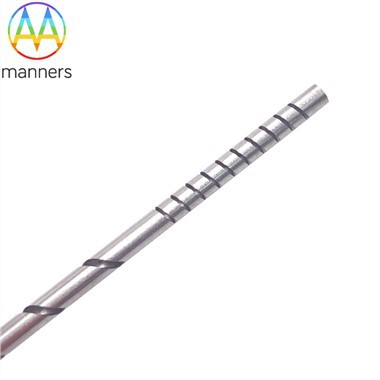
Gradient pipe diameter and precision tube wall design further optimize the operation experience and clinical performance of Tuohy needles. Industrial standard Tuohy needles cover a full specification range of 0.25 mm to 30 mm in diameter. Different pipe diameters correspond to varying puncture depths and surgical scenarios: ultra-fine diameters suit minimally invasive puncture for children and lean patients, while thick diameters match adult complex surgeries and high-volume drug infusion scenarios. All pipe diameters adopt seamless precision tube wall technology with uniform and smooth surfaces free of burrs or protrusions, guaranteeing smooth puncture, preventing scratches on human tissues and facilitating rapid needle withdrawal after operation to reduce patient discomfort. Additionally, centimeter scale lines are marked on the needle shaft to accurately identify puncture depth, helping medical staff track puncture progress in real time and avoid medical risks from over-penetration.
The integrated transparent hub embodies humanized design of Tuohy needles. Made of high-transmittance medical plastic, it enables direct observation of blood and cerebrospinal fluid backflow to quickly confirm successful puncture and rule out accidental vascular or subarachnoid penetration, providing accurate visual basis for clinical operations. Furthermore, the hub adopts a standard Luer connector compatible with mainstream medical catheters and syringes, supporting rapid drug injection and catheter indwelling operations. The integral structure has no dead corners for easy cleaning, complying with multiple sterilization and reuse standards while balancing practicality and cost efficiency.
Overall, the structural design of Tuohy needles centers on four core principles: safety, precision, minimal invasiveness and high efficiency, targeting numerous defects of traditional spinal puncture instruments. After decades of clinical iteration, this exclusive structural design has become a universal industrial standard, widely applied in obstetric analgesia, surgical anesthesia, chronic pain treatment, cerebrospinal fluid leak repair and other scenarios, serving as an indispensable core instrument in minimally invasive anesthesiology.