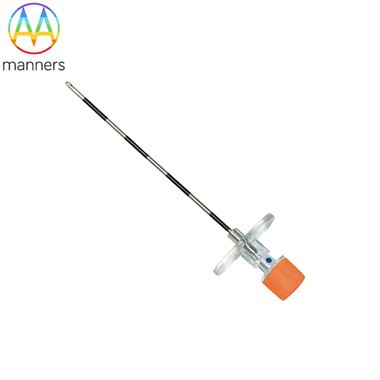
Uncovering The Full Precision Production Flow Of Echogenic Ultrasound Needle Tips
Jun 10, 2026
https://www.nature.com/articles/s41598-024-72620-8
Core Perspective: From an industrial manufacturing standpoint, this article breaks down the complete production journey of a qualified echogenic ultrasound needle tip from raw material to finished product, highlighting rigorous precision control and underlying technical challenges.
Though an echogenic ultrasound needle appears deceptively simple, fabricating its tip constitutes a sophisticated precision manufacturing symphony spanning materials engineering, mechanical processing, chemical technology, optoelectronic inspection and other disciplines. Even micron-scale deviations can compromise ultrasound image visibility and smooth penetration tactility. This walkthrough unveils the behind-the-scenes production workflow of needle tips.
Step 1: Tubing Forming – From Raw Capillary to Blank Tip
Production commences with precision medical-grade stainless steel or Nitinol alloy capillary tubing.
- Cutting and Length CalibrationAutomated machinery cuts raw tubing to exact pre-set lengths. This stage demands exceptional end-face flatness and burr suppression; minuscule defects will disrupt subsequent processing steps.
- Tip GrindingThis core stage shapes the geometric profile of the needle tip. High-speed rotating diamond grinding wheels perform multi-angle, multi-layer precision grinding on one end of the tubing per programmed parameters. Custom programs yield standard single bevels, composite bevels, or complex tip configurations with barbs and side ports. The entire process is governed by high-precision CNC machine tools paired with inline vision inspection systems that real-time monitor tip angle, symmetry and surface finish post-grinding.
Step 2: Surface Modification – Preparing the Substrate for Echogenic Coating
Bare metallic tips possess overly smooth surfaces incapable of reliable ultrasound visualization, necessitating specialized surface alteration.
- Multi-Stage Degreasing and CleaningSequential ultrasonic cleaning and organic solvent baths thoroughly eliminate metal swarf and grinding lubricant residues, delivering a perfectly contaminant-free tip surface.
- Roughening and EtchingPhysical or chemical texturing boosts adhesive bonding between the polymer coating and metal substrate. Common techniques include sandblasting (impacting the surface with fine hard particles), chemical acid etching (creating micro uneven topography), and femtosecond laser engraving (ablating precise arrays of micro-pits or grooves). This phase is critical to preventing coating delamination during clinical use.
Step 3: Coating Deposition – Endowing the Tip with "Ultrasound Vision"
This stage represents the steepest technical barrier in the entire production line.
- Coating Slurry FormulationInside a cleanroom environment, specialty polymer resin is blended at calibrated ratios with prefabricated microbubbles or high-reflective microparticles. Stabilized coating slurry is prepared via specialized mixing, homogenization and defoaming processes. Microbubble dimension and uniform dispersion form closely guarded proprietary formulation know-how.
- Precision Coating ApplicationTreated tip sections are coated via dip-coating with controlled withdrawal or precision spray coating. Coating thickness and coverage boundary (how far the film extends onto the shaft) are tightly held within design tolerance limits. Tips then undergo staged temperature ramp curing in ovens, triggering polymer crosslinking to form a solid film that securely encapsulates microbubbles and particulate fillers within the polymer matrix.
Step 4: Final Sharpening and Comprehensive Quality Inspection – Pursuit of Perfection
Cured coatings can slightly degrade penetration performance, requiring final fine finishing.
- Secondary Micro SharpeningUltra-fine abrasives deliver micron-level re-sharpening to the coated apex, restoring and optimizing cutting sharpness for smooth penetration.
- Rigorous Batch Quality VerificationEvery production batch undergoes a full suite of stringent qualification tests:
Dimensional inspection: High-magnification microscopy measures tip bevel angle, inner/outer diameter and coating thickness.
Penetration force testing: Phantom tissue simulant gauges insertion resistance against established specification benchmarks.
Echogenic performance testing: Tips are inserted into ultrasound tissue phantoms; trained technicians assess echo brightness, uniformity and angular dependence using standardized ultrasound systems.
Coating adhesion testing: Bending cycling and ultrasonic agitation challenge coating resistance to peeling or flaking.
Transformed from plain metallic capillary tubing into a precision cutting instrument equipped with ultrasound visibility, the echogenic needle tip embodies the pinnacle of modern precision manufacturing. Relentless meticulous control over every microscopic detail underpins its dependable, consistent performance in clinical minimally invasive interventions.