Ultimate EBUS-TBNA Needle Purchasing Guide | Price, Quality & Certification Checklist 2026
Aug 12, 2026
https://www.olympus-europa.com/medical/en/Products-and-Solutions/Products/Product/EBUS-TBNA.html
With the continuous expansion of the global EBUS-TBNA needle market and the increasingly complex product pricing system, many procurement teams lack systematic purchasing judgment standards, resulting in problems such as inappropriate product selection, excessive procurement costs, or unqualified consumable admission. In 2026, with the continuous upgrading of medical device industry standards and market supervision, the procurement of EBUS-TBNA needles needs to establish a standardized evaluation system covering price, quality, craftsmanship, certification, and after-sales service. This ultimate purchasing guide sorts out core selection and pricing judgment standards, helping global buyers quickly screen high-quality and cost-effective EBUS-TBNA needle products and complete standardized and safe procurement.
First, clarify the price positioning matching clinical scenarios to avoid blind high-price or low-price selection. Routine general pulmonary biopsy scenarios can choose cost-effective medical stainless steel EBUS-TBNA needles, with moderate pricing and stable performance, fully meeting conventional diagnostic needs. For complex scenarios such as curved airway, narrow lesion space, and high-precision sampling, it is recommended to select high-performance Nitinol alloy EBUS-TBNA needles. Although the price is slightly higher, the super flexibility and positioning stability of Nitinol can effectively improve the success rate of complex surgery and avoid diagnostic errors caused by needle body deformation. Imported high-priced products are only suitable for individual high-end scientific research and special clinical scenarios, and most conventional scenarios can be replaced by high-quality domestic products to save costs.
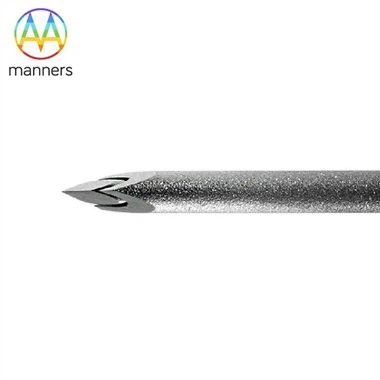
Second, take material and process standards as the core quality evaluation basis to verify product value behind the price. Qualified EBUS-TBNA needles must use medical-grade 316L stainless steel or Nitinol materials with 200-250 HV standard hardness, and provide complete BOM lists and material certification reports. In terms of craftsmanship, four core processes must be fully equipped: precise back-cut point grinding to ensure cutting sharpness, 5-axis laser etching spiral texture to enhance ultrasound visibility, standardized electropolishing to optimize surface smoothness and corrosion resistance, and high-frequency ultrasonic cleaning to ensure sterile cleanliness. Any missing core process means reduced product performance and hidden clinical risks, even if the price is extremely low, it should be eliminated directly.
Third, strictly check international certification qualifications to ensure product compliance and admission pass rate. Formal EBUS-TBNA needles must have dual certification of ISO 9001:2015 quality management system and ISO 13485 medical device quality system, and their production and processing processes need to comply with ASTM F899 (stainless steel material standard), ASTM B912 and ASTM A967 (electropolishing standard). Buyers must verify the authenticity of certification documents before procurement, reject products with fake certificates and incomplete qualifications, and avoid the risk of unqualified consumable admission. Certified products have standardized pricing and transparent cost composition, no excessive premium, and are the safest choice for institutional procurement.
Finally, comprehensively evaluate after-sales service and supply chain stability to lock long-term cost advantages. When selecting suppliers, in addition to price and quality, it is necessary to investigate factory production capacity, delivery cycle, customized service capability, and after-sales guarantee mechanism. Excellent suppliers support batch preferential pricing, free packaging customization, fast delivery, and free after-sales replacement, and can provide long-term stable price locking services. For long-term cooperative procurement, stable supply chain and perfect after-sales service can avoid additional cost losses caused by stock-outs, delayed delivery, and quality problems. In conclusion, scientific EBUS-TBNA needle procurement is not simply pursuing low prices or high prices, but realizing the optimal balance of price, quality, compliance, and service through standardized evaluation standards, so as to maximize clinical value and procurement cost performance.