The Straight Path To Ablation
Oct 02, 2026
There is a particular kind of frustration that builds in an interventional gynecology suite when the tool fights back. A flexible electrode, elegant in the catalog, bends a few degrees as it crosses a thick abdominal wall; the sonographer loses the tip echo for half a second; the operator compensates with a twist, and suddenly the thermal front is no longer where the plan said it would be. For fibroids that sit deep in the posterior wall, or for submucosal lesions approached through the cervical canal, that half-degree of wander becomes a centimeter of uncertainty at the serosa. The pain point is rarely the generator - modern 400 kHz units are stable, with clean impedance roll-off - it is the geometry of the shaft. Curved and expandable electrodes have their place, but they introduce angle correction, prong deployment anxiety, and a learning curve that discourages smaller centers from offering thermal therapy at all. Layered on top is the marketing confusion around "ablation plus cutting" instruments: a device that promises to cut and coagulate sounds impressive, yet the puncture shaft in such hybrids is often a compromise - neither a clean scalpel nor a focused thermal tip. The operator ends up with a tool that does two things moderately instead of one thing precisely.
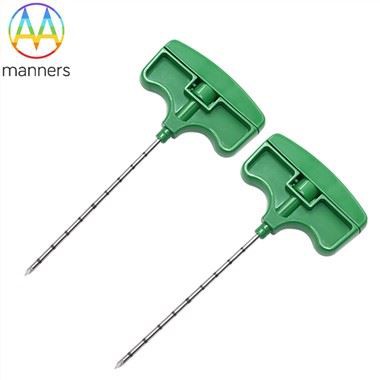
The straight tip returns the conversation to precision. A Straight Tip Radiofrequency Puncture Needle is, by design, the shortest honest line between skin and lesion. Medical radiofrequency occupies the 200 kHz–750 kHz band; the instrument in question works near 400 kHz. When current flows through tissue, the alternating electromagnetic field forces intracellular ions - positive and negative - into rapid oscillation. They collide with neighboring molecules, friction converts to heat, and the lesion warms from within. Around 60°C, intracellular water begins to evaporate; proteins denature; the stroma dries, contracts, and undergoes aseptic necrosis. Crucially, because the tip is straight and the exposed segment is fixed, the thermal ellipse grows axially and symmetrically. There is no fan to open, no prong to deploy - the energy vector is a line, and the operator can predict, in millimeters, where the lethal isotherm sits. This is why "straight" is not a simplification; it is a control strategy.
Classifying straight-tip RF needles is less about brand names and more about the three variables that actually change outcomes. Gauge first: 8G–10G shafts are stiff, suited to deep transabdominal access through adipose tissue; 14G–18G form the interventional workhorse for intramural fibroids; 21G–26G are fine, low-trauma tracks for cervical or superficial nodal work. Tip exposure second: 3 mm for thin submucosal lesions, 5 mm for the common 3–4 cm intramural fibroid, 10 mm for larger deep masses - but only with strict margin monitoring. Process third: necking thins the distal shaft without weakening it; swaging fuses hub to cannula with no leak path; grinding sets a reproducible bevel; laser cutting enables side-window variants; laser marking etches depth rings that survive sterilization; electropolishing drops surface roughness so the shaft does not drag thrombus on withdrawal. A straight tip that skips electropolishing may look straight but behaves sticky; a swage with poor concentricity may look sealed but leaks energy at the hub.
In practice, the straight tip rewards a quiet discipline. The sonographer first maps a direct access corridor - from pubic angle to fibroid core, or through the cervical canal to a submucosal nodule - confirming at least 1 cm of myometrium between the tip path and the serosa. The operator selects gauge and exposure before touching the skin, not mid-procedure. Entry is along the long-axis ultrasound plane so the entire bright needle line is visible from hub to tip. Power ramps from 10–15 W in 10-second steps; the first faint hyperechoic microbubbles signal the thermal front forming. The needle is advanced in 5 mm increments for moving ablation, each track overlapping the previous by half its exposed length. No one chases a "clean" ultrasound appearance; the endpoint is a non-perfused core on contrast scan. The straight shaft is never twisted to redirect - if the line is wrong, it is withdrawn and re-planned. That single rule prevents more complications than any fancy generator preset.
Clinicians who have migrated from claw arrays to straight tips describe a kind of relief. "I stopped guessing where the prongs are," one senior gynecologist put it. In a series of 3–5 cm intramural fibroids, a 17G straight tip with 5 mm exposure, advanced in 5 mm steps, produced overlapping cylindrical necrotic zones with fewer residual peripheral blushes than a three-prong array. The trade-off is honesty: straight tips do not forgive oversizing. A 10 mm exposure in a 2.5 cm fibroid overheats the margin; a 21G fine tip in a firm calcified mass may never build enough thermal front. One training center, after auditing track-burn incidents, banned partially insulated generic shafts and standardized on laser-marked, fully insulated, electropolished straight tips - and track-complaint rates fell close to zero within two quarters. The folklore that travels with these needles is spare: measure twice, energize once, never twist.
Elevating the view, the straight tip is the grammar of predictability in a field seduced by complexity. Curved electrodes negotiate with anatomy; arrays dramatize coverage; the straight tip simply honors a plan drawn on the ultrasound screen. It tells the operator that the shortest line can also be the safest, provided the specification is honest and the hand is restrained. There is a quiet dignity in a tool that does not pretend to be clever.
Looking forward, the recommendations are deliberately unglamorous. Label exposed-tip length in plain language on every peel pouch. Require phantom isotherm maps for every 8G–26G straight line before it enters a clinic. Train operators in axial depth control - reading depth rings, counting 5 mm steps - rather than only in generator menus. The next straight tip should be smart at the very end and dumb everywhere else: a thermocouple at the tip, a straight, uninspired shaft, and a traceability code that follows it from the swaging bench to the bedside. Heat should surprise no one.