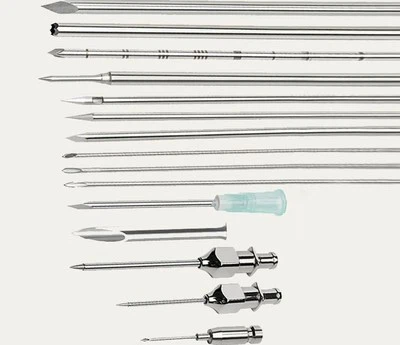
The Significance Of The Needle — Trauma Control And Flow Field Optimization At The Sub-Millimeter Scale
Apr 11, 2026
Micromechanics & Fluid Dynamics Perspective: The Significance of the Needle - "Trauma Control" and "Flow Field Optimization" at the Sub-Millimeter Scale
From an engineering standpoint, a medical puncture needle is a micro-system that synergistically optimizes solid mechanics and fluid mechanics at the sub-millimeter scale. Its core "significance" lies in its ability to simultaneously solve two classic mechanical problems-"how to penetrate tissue with minimal force" and "how to transport fluid with minimal resistance"-within a physically constrained space of extremely small dimensions.
I. Puncture Mechanics: Microscopic Game Between Needle Tip Geometry and Tissue Damage
Puncturing is a high-strain-rate micromechanical interaction between the needle body and biological tissue. The needle tip design directly dictates the physical nature of the resulting trauma.
Puncture Force: The objective is to control the puncture force within 0.5–1.0 N (approximately 50–100 grams-force). This requires a precision grinding process chain (centerless grinding → cylindrical grinding → superfinishing) to form a sharp tip with an edge radius of < 1 micron. Its significance lies in staying below the threshold of most human nociceptors while reducing tissue squeezing and tearing, achieving "minimally invasive" intervention at the physical source.
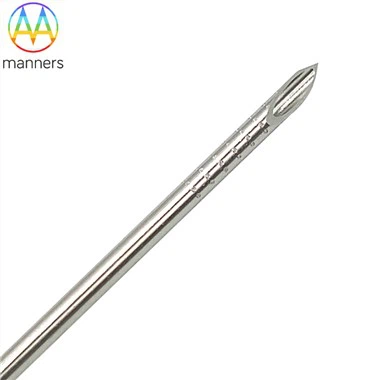
Cutting and Dissection: Multi-bevel designs (such as Tri-bevel) decompose the total puncture force into multiple directional components, effectively "slipping" past tissue rather than "wedging" it apart. This is critically significant for AVF needles traversing tough, fibrotic fistula walls, as it significantly reduces longitudinal cutting injuries to the vessel intima and lowers the risk of postoperative bleeding and aneurysm formation.
II. Fluid Dynamics: The "Minimum Dissipation Principle" for Intra-Luminal Flow
Inside the needle tube, flow adheres to the Hagen-Poiseuille law. Here, the needle's "significance" is to act as a high-energy-efficiency fluid transmission channel.
The "Fourth-Power Law" of Inner Diameter: Flow rate Q ∝ (inner radius r)⁴. Therefore, adopting a thin-walled design for AVF needles to maximize the inner diameter within a given outer diameter is the most effective engineering method to reduce flow resistance and increase dialysis blood flow. This directly determines whether dialysis is "adequate."
Flow Field Reconstruction via Multi-Side Hole Design: Traditional end-hole needles create high shear stress and strong negative pressure zones in front of the tip during high-speed aspiration, easily leading to hemolysis and vessel wall suction. Multi-side holes machined via 5-axis lasers disperse a single, concentrated inflow "point" into multiple "surfaces." The significance lies in reconstructing the flow field near the needle tip:
Reducing local flow velocity and shear stress to protect blood cells.
Eliminating the "wall suction effect" to provide stable high flow.
Analogous to adding multiple entrance ramps to a highway, preventing congestion and accidents at the main entrance.
III. Surface-Fluid Interaction: "No-Slip Boundary" with Nanoscale Smoothness
According to the fluid dynamics "no-slip boundary condition," wall roughness directly affects the state of the boundary layer flow.
Fluid Significance of Electropolishing: Reducing inner wall roughness to the nanoscale holds core significance in eliminating microscopic protrusions that induce turbulent transition, thereby maintaining laminar flow and drastically reducing flow resistance. A process that appears merely aesthetic ("good looks") actually enhances fluid delivery efficiency and reduces the likelihood of platelet activation within microscopic eddies.
IV. Conclusion
From the perspectives of micromechanics and fluid dynamics, the "significance" of a needle is the optimized solution to a series of precisely quantified physical problems. Every successful puncture and smooth fluid exchange serves as proof that physical parameters-puncture force, flow resistance, shear stress-have been precisely controlled. The evolutionary history of modern medical puncture needles is, in essence, a history of engineering design relentlessly pursuing physical limits at the scales of millimeters and millinewtons.