The Fundamental Significance Of Needle Puncture in Medical Diagnosis
Jun 29, 2026
https://www.medicalexpo.com/medical-manufacturer/puncture-needle-3117.html
Core Angle: Exploring the essence of "needle puncture" as a minimally invasive means of obtaining internal information-"exchanging the smallest price for the most critical decision-making basis"-illustrated by the example of lung puncture biopsy.
In the Chinese language, the character "inherently carries a sense of sharpness and penetration. When combined with needle puncture is no longer just a simple verb, but a behavior imbued with profound medical philosophy-it signifies using an extremely fine instrument to actively breach the body's natural barriers (skin, mucous membranes, and even organ capsules), to touch, to acquire, and to intervene in the invisible internal world.
I. The First Meaning of Needle Puncture: Opening a "Window" to the Inside
For doctors, the primary significance of "needle puncture" lies in diagnosis. In an era before CT and MRI, doctors relied on percussion and auscultation to infer internal conditions. In modern precision medicine, needle puncture biopsy is the "gold standard" for obtaining histopathological evidence. Taking a lung puncture as an example: when imaging reveals a suspicious nodule, the doctor faces a choice-either exploratory thoracotomy (which is highly traumatic) or mere observation (which may delay treatment). At this juncture, a slender puncture needle becomes the optimal solution.
The "piercing" of this needle is essentially an act of information acquisition. What it brings out is not air, nor speculation, but tangible cells and tissues. Under the pathologist's microscope, these cells will reveal their identity: is it benign inflammation or malignant cancer? Is it adenocarcinoma, squamous cell carcinoma, or small cell carcinoma? The significance of this "needle puncture" lies in transforming vague images into a definitive diagnosis, thereby providing an unshakable basis for subsequent treatments (surgery, radiotherapy, chemotherapy, targeted therapy).
II. The Second Meaning of Needle Puncture: Balancing Minimal Trauma with Maximum Benefit
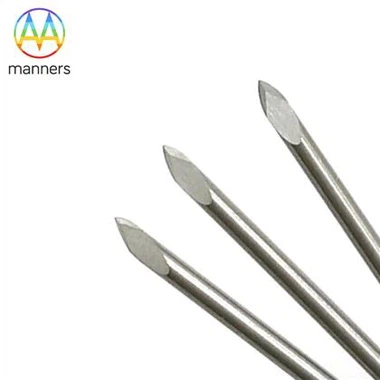
As mentioned in your provided materials, the advantages of microneedles lie in being "minimally invasive," "precisely targeted," and enabling "rapid recovery." This is precisely the ultimate pursuit of modern medicine regarding the act of "needle puncture." Traditionally, "surgery" involves incisional exposure, whereas "needle puncture" is a punctate penetration. A wound caused by an 18G puncture needle (approximately 1.2mm in diameter) is far smaller than that made by a scalpel. The patient only requires local anesthesia, and after applying pressure for a short while post-procedure, can go home, greatly reducing the risk of infection and hospitalization costs.
This philosophy of "using a small stake to win big" runs through the entirety of interventional medicine. Whether it is a biopsy of the liver, kidney, thyroid, or breast, the core logic remains consistent: exchanging the minimal cost of a single needle for vital information concerning life and death. Here, "needle puncture" is synonymous with "precision strike."
III. The Third Meaning of Needle Puncture: A Dual Test of Skill and Courage
Do not mistake "needle puncture" for simply stabbing in. Taking a lung puncture as an example, the operator must calculate the angle and depth of needle insertion under real-time CT guidance, avoiding ribs, blood vessels, and interlobar fissures, while also accounting for the patient's respiratory movements. A slight deviation could puncture a major blood vessel causing massive hemorrhage, or pierce the pleura causing a pneumothorax. Therefore, every successful "needle puncture" is a high degree of synergy between the doctor's hands, eyes, and brain-a perfect combination of anatomical knowledge and spatial imagination.
Conclusion: The fundamental meaning of "needle puncture" in medical diagnosis is using a slender needle to seek certainty amidst uncertainty, and to pursue benefit amidst risk. It is both a technique and an art; both a means and an attitude-a modern medical attitude that respects life and strives for minimal invasiveness.