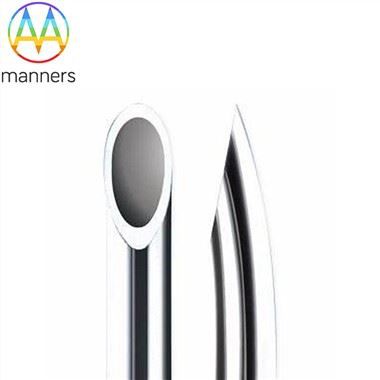
The Framework Of V3 Infusion Needles & Manners’ Expertise In Material Science
May 28, 2026
In the automated industry, especially food, tobacco and other sectors with stringent requirements for precision and hygiene, infusion needles are tiny yet core components that enable accurate volumetric injection. The outstanding performance of Manners Technology's V3 Infusion Needle is built upon an in-depth understanding and scientific application of its key material - AISI 304 stainless steel (SUS304). The material chosen for this needle's structural framework is no random pick, but an optimal solution determined based on harsh operating conditions, long-term reliability verification and feasibility for precision manufacturing.
Operating Challenges: Severe Service Conditions for V3 Infusion Needles
Primarily deployed on automated infusion robots, the V3 infusion needle delivers liquids such as food-grade essential oils, plant extracts and flavors into products including cigarette filters and food fillings with exceptional repeat precision. It has to withstand multiple rigorous challenges:
- Chemical Compatibility: The needle comes into contact with a wide range of liquids containing organic acids, alcohols, esters and other components. The material must deliver superior corrosion resistance to prevent rusting and metal ion leaching that would contaminate end products.
- Mechanical Durability: On high-speed automated production lines, the needle frequently pierces rubber or silicone seals and bears cyclic axial pressure and minor lateral force. A balanced combination of hardness and toughness is essential to maintain sharpness while avoiding brittle fracture.
- Cleanliness and Hygiene: As a component in direct contact with food-grade raw materials, its surface must be ultra-smooth, non-adhesive, easy to clean and sterilize, and compliant with safety regulations for food-contact materials.
- Machinability: To fabricate miniature precision parts with complex geometries - such as fully threaded hexagonal bases and dual-hole needle tips - the material must feature excellent machinability.
Why 304 Stainless Steel? Perfect Match of Material Properties
Among various stainless steel grades, 304 stainless steel stands out as the ideal choice for V3 infusion needles thanks to its well-balanced and superior overall performance.
- Superior Corrosion Resistance (Core Advantage): 304 stainless steel contains approximately 18–20% chromium (Cr) and 8–10.5% nickel (Ni). Chromium forms an ultra-thin, dense and self-healing chromium oxide passive film on the material surface. This film effectively resists corrosion from various organic acids, food media and atmospheric environments, ensuring long-term service free from rust and contamination.
- Adjustable Mechanical Properties: In the solution-annealed state, 304 stainless steel boasts moderate strength and excellent ductility. Its strength and hardness can be remarkably enhanced via cold working. The V3 infusion needle is engineered to a hardness range of HRC 22–25, achieved through precisely controlled cold working processes including cold drawing and swaging. This hardness level delivers sufficient rigidity for needle penetration, while retaining adequate toughness to withstand accidental impact.
- Excellent Formability: Featuring good ductility and machinability, 304 stainless steel is well-suited for high-precision turning on Citizen Cincom L12-1M7 sliding head lathes, as well as two-die rotary swaging to form complex needle tip profiles. Its favorable weldability also facilitates subsequent laser welding for joining bases and needle tips.
- Extensive Regulatory Compliance: Globally recognized as a safe food-contact material, 304 stainless steel complies with FDA and other relevant standards. Its excellent biocompatibility also meets hygiene requirements for high-end application scenarios.
From Raw Material to Finished Part: Process Empowerment by Manners
Selecting the right material is only the first step. Fully unlocking its potential through sophisticated processes lies at the core of Manners' technological strengths.
Choosing 304 stainless steel for the V3 Infusion N
- Precision Forming and Hardness Control: Raw tubes and bars are first processed by cold drawing to meet initial dimensional and hardness requirements. The swaging process then applies radial forging force via dies to compact the material at the needle tip, further boosting local hardness and strength while forming the precise dual-hole structure. Accurate control over work hardening throughout the process is critical to achieving the target hardness of HRC 22–25.
- Reliable Welding for Similar/Dissimilar Materials via Laser Welding: The hexagonal base and needle tip are joined by laser welding to form a metallurgical bond. With concentrated heat input and a minimal heat-affected zone, laser welding largely preserves the original corrosion resistance and mechanical properties of 304 stainless steel. It creates firm, leak-tight welds without hardness degradation or component deformation caused by overheating.
- Ultimate Enhancement via Surface Engineering: Machined parts inevitably have microscopic surface defects. In accordance with ASTM B912, Manners adopts electropolishing to remove material at the micron level, eliminating burrs and microcracks and delivering an ultra-smooth surface with Ra < 0.4 μm. This reduces liquid residue and eases cleaning. More importantly, the polishing process enriches chromium content on the surface, creating ideal conditions for subsequent chemical passivation. The passivation process removes free iron through acid pickling and promotes the formation of a thicker, more stable chromium oxide passive film, maximizing the inherent corrosion resistance of 304 stainless steel.
Conclusion
eedle is a data-driven and application-oriented decision made by Manners Technology. It is far more than a casual adoption of common stainless steel; it reflects a thorough grasp of 304's optimal balance between corrosion resistance, mechanical performance and machinability.
More importantly, Manners fully taps and locks in the material's potential via a complete set of sophisticated cold working, welding and surface treatment processes. This transforms a general-purpose alloy into a specialized material capable of meeting stringent industrial standards. The structural framework of this infusion needle embodies profound respect for material science and relentless pursuit of process perfection - the fundamental reason why it operates stably and durably on high-speed automated production lines for food and tobacco industries.