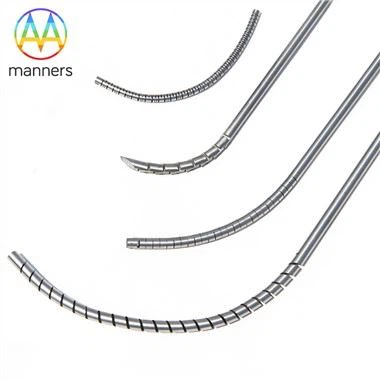
The Blue Ocean Strategy Of Precision Manufacturing - The Evolution Of Competition in The Slot-Type Rigid Pipe Market And The Construction Of Manufacturers' Core Capabilities
May 01, 2026
Driven by the global wave of medical device innovation and the upgrading of the manufacturing industry, the highly specialized and precise component of slot-type rigid laser cutting of tubes is rapidly expanding from the niche market serving a few high-end medical devices to the broader blue ocean market of minimally invasive surgical instruments. Behind this is the clinical pursuit of the ultimate performance of the devices, as well as the continuous breakthroughs in precision manufacturing technology. This article will analyze the core driving forces of the current market, the evolution of the competitive landscape, and explore the core capability system that manufacturers need to build to establish a moat in the future competition.
I. The Deep Driving Forces Behind Market Growth
1. Minimizing complex surgeries and enhancing the performance of equipment: The popularization of complex surgeries such as transcatheter aortic valve replacement (TAVR), neurointerventional thrombectomy, and tumor interventional therapy has placed unprecedentedly high demands on the pushing force, tracking ability, and anti-knotting performance of the delivery system. Traditional designs are no longer sufficient, and the demand for slot-type rigid tubes as a technical solution that can simultaneously address the contradiction of "able to push" and "not bending" has surged.
2. Iteration of endoscopy technology and the wave of domestication: New technologies such as 4K/3D/fluorescence laparoscopes and ultra-thin joint scopes require the mirror body to be lighter, more sturdy, and have higher optical stability. At the same time, the policy of domestication and substitution of medical devices in emerging markets such as China has opened up a huge market space for local precision component manufacturers with R&D capabilities. They are moving from imitation to innovation and have a strong demand for high-performance core components.
3. Surgeon robot industry explosion: Surgeon robots are being popularized from large centers to multiple departments. The end effector of the surgical robot's instrument arm requires a highly compact, reliable, and precise transmission structure. Whether it is a rigid instrument rod or a driving element with a flexible wrist, slot-type rigid or semi-rigid tubes are the key basic components for achieving complex movements. The market has grown simultaneously with the expansion of the robot industry.
4. Spillover of industrial precision transmission demand: In high-end semiconductor equipment, precision optical adjustment mechanisms, and automated inspection equipment, there is an increasing demand for miniature shaft rods that are small in size, highly rigid, have high torque density, and possess certain impact resistance. The technology of slot-type rigid tubes has spilled over from the medical field to these high-value-added industrial fields, opening up a second growth curve.
5. Supply chain security and collaborative R&D trend: Global geopolitical factors and the impact of the pandemic have prompted medical device OEMs to re-examine supply chain security and prefer to establish strategic partnerships with key component suppliers with deep R&D capabilities and rapid response, rather than simple procurement relationships. This has presented opportunities for suppliers that can provide one-stop services from concept design to mass production.
II. Stratification of Competitive Landscape and Value Migration
Market participants are showing a clear hierarchical structure:
* Tier 1: Global Comprehensive Solution Giants: Such as some large multinational medical technology companies or top precision engineering groups, they often vertically integrate, producing from materials to final components and even complete machines internally. Their advantage lies in their strong brand, global supply chain, system integration capabilities, and long-term deep ties with top customers. They set the technical and price benchmarks for the industry.
* Tier 2: Professional Precision Manufacturing Experts: This is a group of enterprises that have深耕ed in the field of precision metal laser processing for many years. They are currently the most dynamic force in the market. They usually do not produce end devices but focus on becoming "experts in precision metal structural components". Their core competitiveness lies in: deep process Know-how (proficient in laser micro-processing, material handling, surface modification), rapid prototyping and customization capabilities, strict quality system (such as ISO 13485, ISO 9001), and design support services based on simulation. They gain advantages in niche markets through technical expertise and agile services, and constantly challenge the status of Tier 1.
* Tier 3: General Metal Processing Factories: They mainly engage in standardized, low-complexity machining operations. They lack in-depth understanding of slot-type structural mechanics, medical material characteristics, as well as medical device regulations and quality systems, making it difficult for them to meet the strict requirements of the high-end market for performance consistency, reliability, and document traceability. They are mostly at the lower end of the value chain.
In the future, competition will be an all-round contest among Tier 2 specialized enterprises and between them and Tier 1 giants in terms of technical depth, service breadth and response speed. Value is shifting from simple "processing and manufacturing" to "design collaboration and solution provision".
III. Building the Future Moat: The Core Competence Pyramid of Manufacturers
To succeed in the future blue ocean, manufacturers need to systematically build the following core capabilities:
1. Top Layer: Forward Design and Simulation Capabilities (Solution Definition Layer)
* Capability Description: From "processing according to the blueprint" to "jointly defining performance and achieving design". Capable of using tools such as finite element analysis (FEA) and computational fluid dynamics (CFD), participating in the early design of customers, predicting the mechanical properties, fatigue life, fluid characteristics, etc. of the products, and optimizing the slot design to achieve the best performance.
* Value: Significantly shortens the product development cycle for customers, reduces the cost of trial and error, moves from the back end of the supply chain to the front end, and becomes an indispensable R&D partner for customers.
2. Middle Layer: Deep Control of Materials and Processes (Core Technology Layer)
* Materials Engineering: Not only processes 304/316 stainless steel, but also proficiently masters the characteristics, processing difficulties, and post-processing techniques of more special materials such as nickel-titanium alloys, cobalt-chromium alloys (such as MP35N), degradable magnesium alloys. Establish a material performance database.
* Laser Micro-Processing Process Library: Establish a verified laser cutting process parameter library (power, speed, frequency, auxiliary gas, etc.) for different materials, different pipe diameters and wall thicknesses, and different slot patterns. Master ultra-fast laser (femtosecond/picosecond) processing technology to meet the extreme requirements of heat-sensitive materials and non-slip cutting.
* Surface Engineering and Post-Processing: Proficient in electrolytic polishing, passivation, sandblasting, various functional coatings (hydrophilic coatings, antibacterial coatings, friction reduction coatings), and be able to recommend the best surface treatment solution based on the final use of the product.
3. Bottom Layer: Data-driven Quality and Operation System (Excellence Operation Layer)
* Full-process Digitalization and Traceability: Achieve full-process data collection (SPC statistical process control) from raw material entry to finished product exit. Establish a "digital twin" for each product, recording all key parameters and test data during the production process. This is not only a quality requirement, but also the basis for process optimization and root cause analysis of problems.
* Automation and Intelligent Production Lines: Introduce automated loading and unloading, online visual inspection, laser parameter adaptive control, etc., to improve production efficiency and consistency, and reduce human error.
* Agile Supply Chain and Rapid Response: Establish flexible production lines, capable of efficiently handling small-batch, multi-variety rapid prototyping requirements. Establish stable strategic relationships with raw material suppliers to ensure supply chain security.
4. Extension Layer: Application Expansion and Ecosystem Construction (Strategic Development Layer)
* Cross-industry Application Expansion: Expand the highly reliable precision manufacturing capabilities verified in the medical field to semiconductor equipment, precision optics, aerospace, high-end consumer goods, etc., which have demands for micro-precision metal structural components, to diversify risks and seek new growth points.
* Technological Integration Innovation: Explore the integration of slot structure with other technologies, such as integrated sensors (optical fiber shape sensing), integrated microchannels, and co-forming with polymers/composite materials, to develop next-generation intelligent structures or multi-functional components.
* Industry Standards and Patent Layout: Participate in the formulation of relevant industry standards and conduct patent layout through core processes and design innovations, building technical barriers.
IV. Selection of Strategic Pathways
Manufacturers can choose different development paths based on their own resources and advantages:
* Technology-leading type: Focuses on the most cutting-edge and complex technical challenges (such as ultra-fine diameters < 0.5mm, complex and irregular structures, intelligent integration), serves top innovative clients, and takes technological premium as the core.
* Large-scale solution type: Selects several core product series with large market capacity (such as standard-sized laparoscopic tubes, delivery sheath tubes), through extreme automation, large-scale production and cost control, becomes the most competitive supplier in this category globally.
* Vertical field deepening type: Deeply focuses on a rapidly growing niche field (such as neuro-interventional devices, surgical robot joints), thoroughly understands all clinical needs, regulatory requirements and supply chain characteristics of this field, provides a complete set of solutions from design to verification, and becomes the preferred expert for customers in this field.
Conclusion: The market for slot-type rigid laser cutting of pipes is moving from the "parts supply" red ocean to the "precision structural solution" blue ocean. The essence of this competition is the upgrading of manufacturing capabilities to a deep integration capability across the entire chain of "design - materials - process - data". The future winners will be those enterprises that can deeply integrate material science, micro mechanics, advanced manufacturing, and clinical insights, and build a stable, efficient, and agile operation system driven by data. What they will provide will no longer be a cold metal pipe part, but a key module carrying performance commitments, reliability data, and innovative potential. This pipe with a precise slot-type thus also becomes a benchmark for measuring the future competitiveness of a precision manufacturing enterprise. In the grand narrative of the continuous evolution of medical technology, enterprises that master its core manufacturing technology will undoubtedly play an increasingly important role.