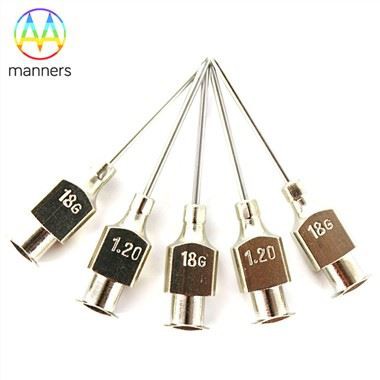
Tapered Nozzles Dispensing Needles: Future Trends Of Piston-Driven Micro Fluid Control
Nov 13, 2026
Meta Description: Future trends of piston-driven micro fluid control using tapered nozzles dispensing needles. Stainless steel tapered tips, 0.1–0.8mm ID, ISO13485, custom by drawing or sample for automated dispensing.
Tapered Nozzles Dispensing Needles: Future Trends of Piston-Driven Micro Fluid Control
Micro fluid control is the foundational technology behind miniaturized electronics, wearable medical devices, optical sensors and diagnostic reagent preparation. As components shrink, the tolerance for dispensing error becomes tighter, and traditional time-pressure dispensing reaches its performance ceiling. Tapered nozzles dispensing needles paired with piston stroke quantitative control represent a mature but evolving solution, combining low-resistance conical flow channels, stainless steel precision machining and software-enabled stroke adjustment. This article reviews the current value of tapered metal dispensing nozzles and explores technology trends, manufacturing upgrades and market changes in micro fluid dispensing.
The core pain point limiting old dispensing technology is poor volume repeatability under variable working conditions. Air compressor fluctuation, temperature-induced viscosity drift, barrel liquid level change and nozzle wear all shift dispense results. Many factories compensate by adding frequent manual calibration, which lowers throughput and increases human error. Medical liquid preparation faces stricter limits: volume deviation directly affects assay accuracy. Plastic tapered tips cannot support long-cycle high-precision automation, while straight metal needles cause high backpressure and stringing. Piston-driven tapered nozzles separate material filling and extrusion, using mechanical stroke to define output volume and reduce sensitivity to air and viscosity variation.
The working principle of tapered nozzles dispensing needles remains the core of this technology. Compressed air transports fluid into the syringe barrel and piston feed pipe. The upward piston stroke fills the piston chamber with liquid or adhesive. On the downward stroke, the piston pushes fluid through the gradually tapered channel and out of the nozzle orifice. The dispensed drop size is determined by piston stroke distance. Operators can adjust stroke manually for simple stations, or integrate stroke parameters into robot dispensing software for dynamic, zone-based control. The smooth taper reduces turbulence, shear stress and backpressure, making the nozzle suitable for delicate substrates, low-viscosity reagents and high-viscosity filled pastes.
Classification of tapered nozzles dispensing needles will continue to expand in the future. The standard portfolio keeps 0.1 mm to 0.8 mm inner diameter as the mainstream for micro dispensing. Custom orders from 2D drawings, 3D models or physical samples will grow faster than standard catalog sales, as manufacturers pursue proprietary dispensing processes. Multi-casing two-casing and three-casing tapered assemblies for high-speed robotic lines will become more standardized, with tighter concentricity tolerance. Stainless steel will remain the primary material, while advanced surface treatment options such as low-friction coating and special passivation will be added to reduce fluid adhesion and residue buildup. ISO13485 certification will be a baseline requirement for all tapered nozzles used in medical and IVD liquid workflows.
Operation guidance for future dispensing systems will shift toward digital parameter management. Instead of manual paper records, factories will store validated piston stroke, air pressure and nozzle model data in MES systems. When a tapered nozzle is replaced, the system automatically calls the matched process recipe. Predictive maintenance will monitor dispensing deviation trend to identify nozzle wear or clogging before scrap occurs. Cleaning workflows will also become standardized: automated ultrasonic cleaning stations for reusable stainless steel tapered nozzles, with cleanliness verification records for medical batches. Packaging will be smarter too, with batch traceability QR codes on both standard cartons and custom clean packaging.
Practical experience from leading dispensing integrators indicates that the biggest upcoming shift is the convergence of industrial adhesive dispensing and medical liquid handling. The same tapered nozzle hardware can be validated for both medical device assembly glue dispensing and clinical reagent aliquoting, as long as it is manufactured under ISO13485 and properly cleaned between applications. This convergence reduces the number of consumable part numbers and simplifies supply chain management. Custom tapered nozzles will be developed together with new fluids, rather than selected after fluid formulation is finalized. Engineers will design nozzle taper geometry and fluid viscosity in parallel for optimal performance.
The industry prospect for tapered nozzles dispensing needles is positive. The global trend of miniaturization across semiconductor, automotive electronics, wearable medical devices and optical packaging continuously raises demand for micro quantitative dispensing. Piston-driven dispensing systems are gradually replacing simple time-pressure valves in high-yield factories. The competitive advantage of suppliers will no longer be only low price, but precision machining capability, custom drawing development speed, ISO13485 compliance and application engineering support.
In summary, tapered nozzles dispensing needles built on piston stroke quantitative control are a foundational component for the future of micro fluid control. The stainless steel tapered channel stabilizes flow and reduces backpressure, while stroke control delivers consistent dispense volume. Standard 0.1–0.8mm inner diameters satisfy mass production, and custom tapered geometry from drawings or samples supports innovative process development. Digital recipe management, advanced surface treatment and cross-industry medical-electronics convergence will drive the next generation of tapered dispensing nozzles. For automated glue machines and clinical liquid preparation systems, piston-controlled tapered metal nozzles will keep serving as a reliable, high-precision consumable that balances performance, compliance and customization.
< img alt="news-1-1" src="/uploads/24240/news/202604241539186d0ff.png " />