Surgical Technique: Choosing Aggression Over Finesse
Oct 21, 2026
The Pain Point
Every arthroscopic surgeon has faced the same dilemma: the blade that trims a meniscus efficiently also cuts too aggressively around the cartilage edge, while the gentle blade stalls on tough tissue, prolonging the procedure and increasing the risk of thermal or mechanical damage. This trade-off frustrates surgeons, lengthens operations, and increases the chance of iatrogenic injury to the articular surface. A deeper problem compounds it: most surgeons buy one type of blade and use it for everything, from meniscal resection to soft-tissue debridement to light bone work. The result is a suboptimal match between instrument and tissue, leading to longer procedures, more debris, and a joint cavity that is harder to clear-the very conditions that predispose to the early post-operative complications of hemarthrosis and swelling. Selecting a blade by tissue type is not a refinement; it is a basic professional responsibility.
The Principle
Shaver blades achieve tissue resection via the interaction of three variables: rotation speed, blade edge geometry, and window design. Aggressive blades feature deeper teeth and larger cutting windows, capturing more tissue per revolution-ideal for bulky meniscal flaps that need to be removed quickly. Fine blades offer shallow, smooth profiles that plane cartilage like a scalpel, removing thin layers with minimal collateral trauma. Operating speed modulates this behavior: high rpm favors soft tissue and cartilage shaving, while low rpm with oscillation mode cuts fibrous tissue more predictably because the alternating direction prevents tissue from grabbing and tearing. Suction rate further controls debris evacuation and tissue capture; higher suction pulls tissue into the window more aggressively, which is useful for bulky tissue but dangerous near the cartilage surface. Understanding this multi-variable interaction is what separates a procedure that flows from one that fights.
Classification of Devices
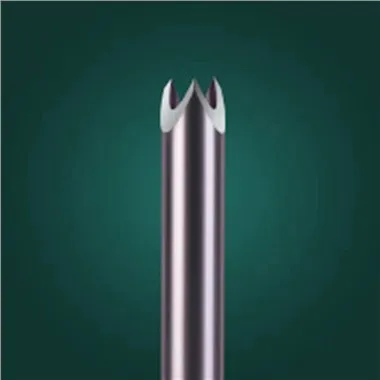
Blades are broadly classified by cutting profile and intended tissue. Full-radius blades combine a curved tip and aggressive teeth for fast debulking while maintaining a modest safety margin; they are the workhorse for meniscal surgery. Serrated multi-tooth blades target meniscal and ligament tissue where a strong bite is required; the teeth act like a rasp across fibrous tissue. Cartilage-shaver blades use smooth, angled edges that contour articular cartilage without gouging; they are essential for chondroplasty and for preserving the intact cartilage layer in young athletes. Bone-resection burrs are burr-tipped rather than windowed, using abrading action on osteophytes, bone tunnels, and calcified tissue; their spherical or cylindrical ends allow access to hard surfaces that tooth-blades cannot address. Suction-assisted designs add flutes and optimized ports that evacuate debris more effectively, keeping the surgical field clear and reducing tissue drag. Finally, synovial-resector blades offer a balance between scraping and burr action, ideal for removing pathological synovium without damaging the joint capsule. Mastery of these categories allows a surgeon to select the instrument that is right for each stage of the procedure.
Practical Guide
Adopt a tissue-based selection protocol at the start of every case. Classify the first target: bulk meniscus demands a full-radius or serrated blade at moderate speed (2,500–4,500 rpm); cartilage contouring requires a smooth cartilage blade at low speed (1,500–2,500 rpm) using oscillation mode; bone work needs a burr at 4,000–6,000 rpm. Always keep the window facing away from neurovascular structures, and use the "sweep-then-suction" maneuver: resect in short passes, then dwell for one to two seconds to clear debris before advancing. When switching tissue types mid-procedure-for example, from meniscus to cartilage or from cartilage to bone-change blades rather than forcing one design to do multiple jobs. This single habit reduces procedure time, tissue trauma, and post-operative debris. Finally, integrate suction management: reduce suction when working near the capsule to avoid collapsing the joint, and increase it when bulky debris clouds the field.
Common Real-world Scenarios
In practice, we have observed sharp contrasts in outcomes driven purely by blade selection. In revision surgeries, knee joints with existing scar tissue respond best to aggressive serrated blades used in burst mode-the teeth break down the thick, fibrous tissue that would otherwise deflect a smooth blade. In contrast, primary cartilage lesions in young athletes demand smooth, contoured blades used in oscillation at low speed, to preserve the intact cartilage layer and minimize iatrogenic damage. Data from three facilities showed that blade-type-triaged cases shortened average meniscal procedures by 11 minutes and cut the incidence of visible cartilage fraying by nearly half. On the financial side, fewer unplanned blade changes and shorter operating times translated into measurable savings per case, reinforcing the argument that informed blade selection is not a luxury but a productivity tool.
Summary
Blade selection is a surgical decision, not an inventory choice. The classification ladder-full-radius, serrated, cartilage-shaver, burr-mirrors the progression of tissue difficulty, from bulky tissue to delicate cartilage to hard bone. Matching the right blade to the right tissue at the right time is the cheapest, most reliable way to protect the joint, shorten procedures, and optimize post-operative recovery. Surgical judgment and instrument intelligence are complementary; the best technique is meaningless without the right tool in hand.
Future Prospects
Smart blades with embedded force or impedance sensors will soon feed real-time tissue feedback to the surgical console, automatically adjusting speed, direction, and suction to match the tissue being cut. Surgeons who master the classification principles today-tissue-based selection, speed modulation, and procedure-tailored instruments-will be the first to harness these adaptive systems when they arrive, turning the blade into a collaborative partner rather than a passive tool.