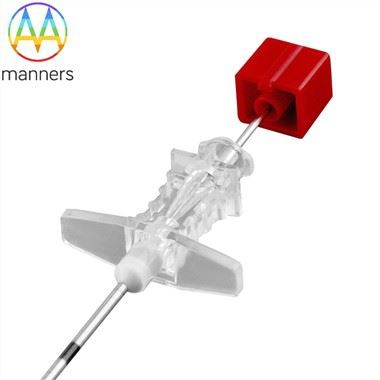
Stainless Steel Vs. NiTi: The Material Decision For Puncture Needles
Oct 18, 2026
The Bend That Ruins the Attempt
Every proceduralist remembers the sinking feeling: the needle that was advancing cleanly suddenly deflects, bending at the tip, refusing to hold its course. The pain point is material. A needle that is too stiff resists the body's curves and may miss the target; a needle that is too flexible wanders off course and makes a clean tap nearly impossible. The choice between stainless steel and nickel-titanium (NiTi) alloy is not a matter of preference-it is a matter of matching the instrument's mechanical personality to the patient's anatomy and the procedure's demands. Understanding the materials is the difference between a needle that cooperates and a needle that fights.
The Mechanical Science of Needle Materials
Stainless steel is the traditional material of the lumbar biopsy puncture needle, and its properties explain its longevity. High-grade stainless steel offers stiffness-the resistance to bending that allows the clinician to transmit force predictably from the hub to the tip. It holds an edge well, is corrosion-resistant, and is inexpensive enough to support single-use economics. Its limitation is exactly that stiffness: through curved or calcified anatomy, a steel needle transmits force rigidly, and deflection at the tip can send it off course. NiTi alloy-nickel-titanium, known for its superelasticity-behaves differently. Within its working range, NiTi bends elastically, returning to its original shape rather than taking a permanent set; a NiTi needle can follow tissue planes and anatomical curves, resisting kinks and recovering from deflections that would permanently bend steel. Its flexibility is its defining clinical asset, but it comes with trade-offs: NiTi needles transmit less push force, demand a lighter touch, and require the clinician to read tissue resistance differently. The material science is not abstract: it is the physics of how force travels from hand to tip, and it determines whether the needle arrives at the target or arrives bent.
Classifying Needles by Material Behaviour
The classification follows clinical behaviour rather than alloy chemistry alone. Stainless steel needles suit the majority of routine procedures: predictable stiffness, crisp tactile feedback, and reliable performance through typical anatomy. They are the rational default for standard lumbar punctures where anatomy is straightforward. NiTi needles earn their place in the difficult cases: obese patients where tissue depth and soft-tissue deflection complicate the path, elderly patients with calcified ligaments, patients with spinal deformity where a flexible needle can follow the available corridor, and repeated attempts where a kink-resistant instrument preserves the chance of success. Within each material, grade matters: medical-grade stainless steel with certified composition and validated processing outperforms unbranded economy steel, and NiTi needles vary in superelasticity, surface finish, and trackability depending on manufacturing quality. The clinician who knows their material grades can predict their needles' behaviour-and the clinician who predicts behaviour can adapt technique before the needle misbehaves.
Practical Material-Selection Guide
Match the material to the case. For a routine diagnostic tap in an average adult, certified stainless steel in an appropriate gauge is efficient, predictable, and cost-effective. For difficult access-obesity, deformity, calcification, or repeated attempts-reach for NiTi and adjust your technique: advance with lighter, more patient pressure, read the tissue through the flexible shaft, and let the needle follow the path rather than forcing it. Verify material certification with every batch, whether steel or NiTi, and reject any product without documented alloy identity-mislabelled material is a clinical hazard, not a bargain. Store needles according to manufacturer guidance, because humidity and temperature affect even premium alloys. And train staff on the different feel: a clinician who treats a NiTi needle like steel will bend it and blame the product; the clinician who adapts touch to the material extracts its full value. The selection guide is short, but it encodes the clinical wisdom that separates the smooth tap from the struggle.
Lessons from Difficult Taps
Clinicians who serve high-difficulty populations report that material selection transforms outcomes. An interventional pain service that added NiTi needles to its arsenal for obese and post-surgical patients saw its failed-tap rate fall and its complication rate follow; the flexible needles reached targets that steel needles could not. A neurology department that standardized on certified steel for routine work kept costs predictable while reserving NiTi for the cases that needed it, achieving both efficiency and excellence. Practitioners describe the NiTi learning curve honestly: the first cases feel strange, the tactile feedback is different, and the temptation to push is strong-but clinicians who persist learn that the flexible needle is not weaker, just different, and its kink resistance is a gift in difficult anatomy. The pattern is consistent: the material is not a marketing choice but a clinical tool, and the practice that matches material to case performs procedures that others cannot.
The Material as Clinical Judgment
The choice between stainless steel and NiTi is clinical judgment made physical. It says that the practitioner saw the patient's body, anticipated the path, and selected an instrument whose mechanical personality matches the challenge. That judgment is invisible to the patient-they see only the needle-but it shapes the entire procedure: the number of attempts, the duration, the trauma, the outcome. The material is the practitioner's silent partner, and the practice that chooses its partner wisely is the practice that performs the difficult cases with the same calm as the routine ones.
The Future of Needle Materials
Materials science is expanding the envelope of what a puncture needle can do. Improved NiTi formulations are combining superelasticity with better pushability, closing the gap with steel. Composite needles-steel cores with NiTi distal sections-are being developed to give clinicians both push and flexibility where each is needed. Bioactive coatings are being added to reduce tissue reaction at the puncture site. Shape-memory alloys are being explored for needles that straighten or curve on command, following paths that fixed geometry cannot. Digital manufacturing is making patient-specific material selection practical, tailoring stiffness and geometry to individual anatomy. Forward-looking departments should build material diversity into their inventory, train clinicians in the feel of each material, and track outcomes by material to build their own evidence base. The future of puncture is not one perfect material-it is the right material for every patient, chosen with knowledge and used with skill.