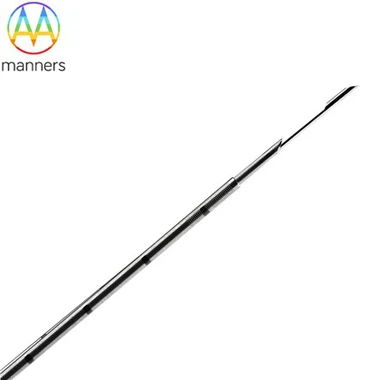
Stainless Steel And Edge Quality In Solid Lancet Manufacture
Nov 15, 2026
The material a lancet is made from is rarely discussed and always felt. Edge retention, penetration force, corrosion behaviour, and even the sterility envelope all depend on the steel specification and on how the edge is finished. This article examines what stainless steel contributes to a solid lancet and why edge quality - not material grade alone - is the decisive variable in products such as the ILancet Needle With Triple Cut Tip.
Why Stainless Steel, and Which Grade
Stainless steel is the default material for solid lancet needles because it offers a combination that is difficult to match: adequate hardness for a fine cutting edge, sufficient corrosion resistance for a sterile single-use device, and consistent formability for high-speed grinding. The material is stated broadly in most specifications, which is both a simplification and a risk.
Different grades trade off hardness against corrosion resistance and machinability. A harder grade holds a sharper edge for longer but is more demanding to grind consistently; a more corrosion-resistant grade is more forgiving in storage but may not hold as fine an edge. For a single-use device the edge only has to survive one use, so the priority is not durability but the quality of the edge as manufactured and its stability through sterilisation and shelf life.
Buyers should treat the material line as a starting point and ask the follow-up question: which grade, and what evidence supports its suitability for the intended sterilisation method and claimed shelf life? A supplier who can answer with grade and validation data is a supplier who has thought about the product rather than the catalogue.
The Edge Is the Product
A lancet tip is a very small piece of geometry asked to do a very precise thing. The relevant characteristics are:
Edge radius. The roundedness of the cutting edge at microscopic scale. A smaller edge radius cuts rather than displaces.
Edge continuity. Absence of burrs, nicks, and rolled sections along the cutting edge.
Surface finish on the facet. Roughness on the ground facet increases friction along the channel wall during insertion.
Apex alignment. Whether the point sits on the mechanical axis of the needle.
Each of these is set during grinding and each can degrade afterwards through handling, cleaning, or sterilisation. A triple cut tip multiplies the requirement: three facets must each meet the quality criteria and must meet each other at a common apex. This is where the ILancet Needle With Triple Cut Tip design places its real manufacturing challenge - not in the number of facets, but in their mutual alignment and the consistency of all three edges.
Grinding as a Controlled Process
Bevel grinding is often described as if it were a single operation. In practice it is a chain of parameters: abrasive type and grit, wheel or belt condition, feed rate, coolant, fixturing, and dressing interval. Variation in any of these changes the edge.
Two disciplines separate consistent production from inconsistent production.
Tooling life managed by measurement. Grinding media wear progressively. A schedule-based replacement policy assumes wear is predictable; a measurement-based policy verifies it. Edge quality inspection at defined intervals, with results recorded, converts tool wear from a hidden variable into a managed one.
First-article and in-process inspection. Each production run should begin with verified parts and continue with sampled inspection. The sampling frequency should be justified by process capability, not by convenience.
For multi-facet tips, add a specific control: facet alignment verification. A tip can pass a silhouette check and still cut poorly if the third facet is offset. Magnified inspection of the apex from more than one orientation is the usual control.
Surface, Friction, and the Patient Experience
Penetration force is the sum of cutting resistance and friction along the needle surface. A clean edge addresses the first; surface finish addresses the second. Two lancets with identical geometry can produce noticeably different patient experiences if one has a rougher ground surface.
For this reason, surface condition should be a specified characteristic rather than an implicit outcome of grinding. Practical specifications include a roughness criterion on the ground facets, a deburring requirement, and a limitation on visible surface defects under magnification. Where coatings or surface treatments are applied, their effect on friction and on biocompatibility should be documented.
Sterilisation, Storage, and Edge Stability
A sharp edge at the end of manufacturing is not the same as a sharp edge at the moment of use. Sterilisation and storage intervene.
Sterilisation methods used for single-use lancets each impose different demands on the assembly: radiation methods are compatible with most polymer and steel combinations but can affect some materials; ethylene oxide requires residue control and aeration; other methods carry their own compatibility profiles. The essential requirement is that the chosen method is validated for the complete configuration, including the hub polymer, the needle, and the packaging, and that the validation supports the claimed shelf life.
Storage is the second factor. Moisture, temperature cycling, and packaging integrity all affect edge condition and sterility. A product validated for a defined shelf life under defined conditions, with packaging that maintains those conditions, is a product whose performance at use is defensible. A product whose shelf life is asserted without evidence is a product whose edge quality at use is unknown.
What Documentation Should Accompany the Product
For the material and edge characteristics discussed here, a professional supplier should be able to provide:
| Item | Content |
|---|
| Material declaration | Steel grade and applicable standard |
| Biocompatibility evidence | Test basis for the intended contact duration and site |
| Edge and profile inspection | Method, magnification, sampling frequency, acceptance criteria |
| Dimensional verification | Diameter, length, and depth where applicable, with tolerances |
| Sterilisation validation | Method, parameters, and shelf life basis |
| Lot traceability | Manufacturing date and inspection records per lot |
Where custom configurations are supplied - for instance a tip geometry derived from a customer drawing or sample - the controlled drawing should be referenced, and the inspection criteria should be tied to it.
Design Choices That Protect Edge Quality
Manufacturers can reduce the risk of edge damage before the product ever reaches a user. Practical measures include protective geometry around the tip where the design permits, hub designs that prevent accidental contact with the needle before use, and packaging that locates the lancet positively rather than allowing movement. For depth-controlled and safety designs, the retraction or shielding mechanism also protects the edge after use, which matters for handling safety as well as for measurement integrity.
Frequently Asked Questions
Does a harder steel always give a sharper lancet? Not necessarily. Hardness supports edge retention, but as-manufactured edge quality depends primarily on grinding control and inspection.
Is edge quality visible to the naked eye? No. Meaningful assessment requires magnification and defined acceptance criteria.
Can sterilisation blunt a lancet? Sterilisation and storage can affect edge condition and surface state. The full configuration should be validated for the claimed shelf life.
Why does a triple cut tip require additional inspection? Because three facets must align to a common apex. Alignment is not fully verifiable from a single silhouette view.
Conclusion
Stainless steel provides the foundation, but the performance of a solid lancet is decided at the edge. Edge radius, edge continuity, surface finish, and apex alignment are the characteristics that determine penetration force, patient comfort, and sample yield. Controlling them requires measurement-based tooling management, disciplined in-process inspection, and validation of the complete sterilised configuration. For a multi-facet product such as the ILancet Needle With Triple Cut Tip, that discipline is precisely what separates a reliable clinical consumable from a low-cost approximation.
< img alt="news-1-1" src="/uploads/24240/news/202604241539186d0ff.png " />