Sourcing Custom Lengths Of Disposable Stainless Steel Spinal Needles
Nov 25, 2026
The Order That Almost Fits
A purchasing officer who has just received a delivery of spinal needles can usually tell within a week whether the order was right. The complaints are rarely dramatic. A clinician mentions that the 90mm shaft is marginal for the bariatric list. A nurse notes that the paediatric tray is short of a shorter length. A theatre manager reports that the cartons are stacked in an awkward count and half a box is opened before anyone notices. None of these is a clinical disaster, but together they describe a supply that was specified from a catalogue rather than from practice.
Sourcing custom lengths is the part of procurement where a small amount of specification work prevents a year of quiet inefficiency. The questions are concrete: what lengths are held, how a non-standard length is defined, what evidence accompanies the batch, and how the delivery is packed and verified.
Why Length Is a Specification, Not a Detail
Length determines whether a needle can reach the subarachnoid space without being pressed into the skin. When the shaft is short, the operator compensates by pushing the hub, which tents the tissue, falsifies the depth reading, and loads the junction where the shaft meets the hub. The clinical consequence is a track that deviates and a needle that fatigues. When the shaft is too long, the opposite problem appears: the operator loses fine depth control because a long column of unsupported shaft flexes under axial load.
Because skin-to-dura distance varies with body habitus, age, and spinal level, no single length serves an entire hospital. A 90mm shaft covers most adults, which is why it is the standard option in most catalogues, but a service that treats bariatric patients, paediatric patients, or both will need lengths on either side of that figure. Treating length as a specification rather than a detail is the difference between a stock item and a working instrument.
Defining the Range Before Ordering
Start by measuring what is actually needed. Audit the previous year's difficult cases and note where length was cited as a limiting factor. Most departments discover two or three lengths that would cover the gap, rather than a long list.
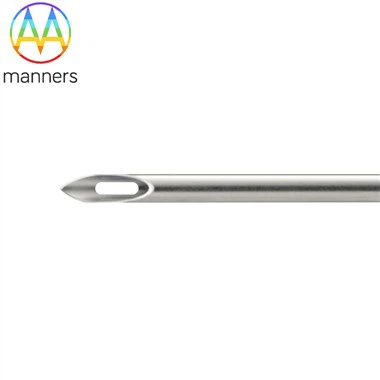
The standard platform is straightforward. Needles are produced in stainless steel, in gauges from 16G to 27G, in both Quincke Point and Pencil Point versions, for anesthesia usage, with a 90mm shaft as the default and custom length available to order. Twelve colour codes identify gauge across the family, running from White at 16G through Light Purple, Pink, Light Grey, Yellow, Green, Black, Dark Blue, Purple, Orange and Brown to Grey at 27G, so a new length does not introduce a new coding problem.
The customization route should then be agreed explicitly. A length can be defined by a 2D drawing, by a 3D model where the geometry is more complex, or by submitting a physical sample for measurement and replication. Each route has a purpose: drawings are precise and archivable, models capture curved or tapered features that a flat drawing cannot express, and samples remove ambiguity when a clinician's requirement is easier to demonstrate than to describe. Whichever is used, the approved document should be signed by both parties and referenced in every subsequent order, because an unrecorded verbal adjustment is the most common source of drift between batches.
A Verification Routine That Catches Problems Early
Check the paperwork before the cartons. Confirm that the delivery note references the approved drawing or sample, states the gauge and length for each line, and matches the quantities ordered. Then check the labels on the cartons themselves, which should carry gauge, colour code, length, and batch number, so that a box can be identified without opening it.
Open one carton per line and verify three things: the hub colour against the stated gauge, the shaft length against the drawing using a simple gauge block, and the tip style by inspection under magnification. Insert the stylet and confirm it seats flush; a stylet that stands proud or sits short is a handling defect that will cause problems at the bedside. Record the batch numbers received against the batches consumed, so that a later complaint can be traced to a specific delivery.
Finally, run a small clinical pilot before the full consignment is released to the wards. Ten needles used on the intended patient group will expose a length that is awkward, a flow that is unexpectedly slow, or a hub that is hard to grip, and it costs almost nothing compared with withdrawing a full order.
Lessons from Real Procurement
The most frequent error is ordering a custom length without ordering a matching colour code convention, which leaves the new length visually indistinguishable from a standard length of the same gauge. The second is allowing the supplier to substitute a standard length when a custom line is delayed, without informing the clinical team.
A third lesson concerns packaging. Standard carton packaging is convenient, but the pack count must be stated and consistent, because a carton that holds a different number than the previous order disrupts stock rotation and shelf capacity. Marker pens and coloured tape on the outside of a carton are not a substitute for printed specification, and in a busy store room they fade within weeks.
A fourth lesson concerns lead time. A custom length is not a catalogue item, and a service that discovers its need during a shortage has no room to negotiate. Ordering the non-standard line alongside the routine one, and holding a modest buffer rather than relying on just-in-time delivery, prevents the substitution problem from arising at all. It also lets the clinical pilot run without pressure, which is when pilots produce useful information.
A fifth concerns internal communication. The specification document should be held by the store room, by the clinical team that uses the needles, and by purchasing, because these three groups fail in different ways: the store room substitutes quietly, the clinical team adapts silently to a wrong length, and purchasing reorders from an old document. A single controlled copy, referenced on the purchase order, removes all three failure modes.
Taken together, these lessons describe a supply of Disposable Stainless Steel Spinal Needles that behaves like an engineered component rather than a consumable. The gauge, the tip style, the shaft length, the hub colour, and the carton count form one agreed configuration, and any change to any of them is a change to the specification that should be recorded. Services that treat a range of Disposable Stainless Steel Spinal Needles that way find that the awkward questions, about which length was used and which batch it came from, have been answered before anyone asks them.
Summary
Custom lengths are a specification exercise rather than a purchasing formality. Audit the clinical need, define the range on a platform of stainless steel needles from 16G to 27G in Quincke and Pencil Point versions with a 90mm default, agree whether the specification is expressed as a 2D drawing, a 3D model, or a physical sample, and verify gauge, length, tip, stylet seating, and packaging on arrival. A pilot of ten needles before full release is cheap insurance.
The Direction of Practice
Supply is moving toward smaller, more frequent deliveries and toward digital specification records in which the approved drawing is attached to the purchase order itself. For buyers, that means the custom length becomes an auditable line item rather than a conversation. For manufacturers, it means the ability to hold a specification stable across repeat runs is becoming as important as the ability to produce a first batch, and consistent packaging and coding are part of that promise rather than an afterthought.
< img alt="news-1-1" src="/uploads/24240/news/202604241539186d0ff.png " />