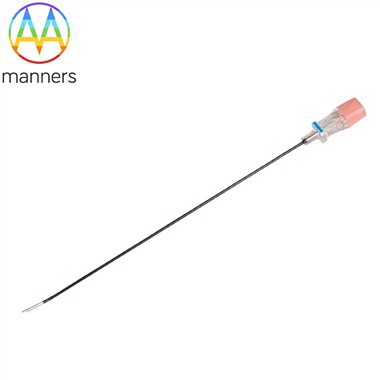
Size Adaptability Of Nerve Block Needles In Diverse Surgeries
Sep 27, 2026
1. Size Mismatch Clinical Pain Points
Unreasonable size matching of nerve block needles is a common hidden danger affecting surgical efficacy and safety. In practical clinical applications, many operators rely on empirical selection rather than standardized scenario matching, resulting in prominent adaptation problems. Using oversized thick needles for pediatric and delicate extremity surgeries will cause excessive tissue trauma, increase postoperative pain and scar formation, and affect functional recovery. Using undersized fine needles for major deep-tissue surgeries leads to slow drug delivery, prolonged operation time, insufficient anesthetic dosage and unstable anesthesia depth, easily causing intraoperative pain rebound. In addition, standard fixed-size needles cannot adapt to special groups such as obese patients and patients with abnormal anatomical structures, resulting in low puncture accuracy and frequent repeated operations, increasing surgical risks and patient discomfort.
2. Size Adaptation Working Principle
The size adaptation of nerve block needles follows the matching logic of "surgical anatomical characteristics + drug delivery demand + patient physical condition". The needle gauge (G value) is inversely proportional to the needle body diameter and inner diameter: the larger the G value, the finer the needle body, the smaller the puncture wound and the slower the drug delivery speed. Different surgical sites have distinct tissue thickness, nerve depth and anesthetic dosage requirements, requiring matched needle sizes to achieve optimal puncture minimal invasion and drug delivery efficiency. Combined with epinephrine adjuvant medication mechanism, matched sizes ensure uniform mixing of drugs, give full play to vasoconstrictive and prolonged anesthesia effects, and avoid local drug accumulation or insufficient diffusion. Custom size design breaks through the limitation of standard sizes, realizing one-to-one adaptation for special anatomical structures and personalized surgical needs.
3. Full-Specification Equipment Classification
The full range of 8G–26G nerve block needles covers all clinical surgical scenarios with clear adaptive classification. 8G–14G heavy-duty large-size needles feature large inner diameter and fast drug delivery speed, suitable for major orthopedic surgery, abdominal surgery and thoracic surgery with deep nerve plexus position and large-dose anesthetic demand, which can quickly complete drug injection and shorten operation duration. 16G–22G universal medium-size needles are the most widely used clinical models, with balanced puncture stability and drug delivery efficiency, adapting to general surgery, obstetrics and gynecology surgery, joint surgery and most adult routine regional anesthesia. 24G–26G ultra-fine small-size needles have minimal puncture trauma, specially applied in pediatric surgery, facial plastic surgery, hand and foot microsurgery and other delicate operations. Meanwhile, non-standard customized sizes can be produced according to customer 2D/3D drawings and physical samples to meet special surgical adaptation needs.
4. Scenario-Based Size Matching Operation Guide
Clinical needle size matching adheres to the core principle of "scenario classification and precise adaptation". Preoperatively, formulate targeted selection schemes based on surgical type, patient age, body shape and surgical site characteristics. Select 8G–14G large-size needles for deep-tissue and long-duration major surgeries to ensure efficient and sufficient drug delivery. Choose 16G–22G universal needles for routine medium-depth surgeries to balance safety and efficacy. Adopt 24G–26G ultra-fine needles for pediatric, facial and extremity delicate surgeries to minimize tissue damage. For obese patients and patients with special anatomical structures, apply customized lengthened or enlarged inner diameter needles to ensure accurate nerve positioning. During operation, adjust injection speed according to needle size to ensure stable drug diffusion and give full play to anesthesia efficacy.
5. Practical Matching Experience
Clinical matching practice proves that standardized size adaptation can effectively solve the problem of poor surgical effect caused by equipment mismatch. In adult lower limb major orthopedic surgery, 18G–20G universal needles achieve the best matching effect, with stable anesthesia duration and low complication rate. In children's upper limb minor surgery, 24G ultra-fine needles reduce postoperative trauma response by more than 30% and speed up recovery. Customized size needles for special patients increase primary puncture success rate from 65% to 98%, completely avoiding repeated puncture damage. Reasonable size matching combined with standard epinephrine medication can maximize the advantages of nerve block anesthesia, reduce postoperative adverse reactions, and significantly improve surgical safety and patient comfort.
6. Summary and Refinement
Full-specification coverage and scenario-based precise matching are the core advantages of modern nerve block needles. The graded size design of 8G–26G realizes the full coverage of routine surgical scenarios, and customized size services make up for the adaptation loopholes of standard products for special surgeries and special crowds. Most clinical size mismatch problems are caused by non-standard manual selection rather than incomplete product specifications. Scientific size matching is the basic premise to give full play to equipment performance and medication advantages, which can effectively reduce surgical trauma, stabilize anesthesia effect and reduce clinical risks.
7. Industry Matching Optimization Suggestions
The industry should establish a complete size-scenario matching database, clarify the optimal needle size corresponding to different surgeries and patient groups, and form unified industry matching standards. Manufacturers need to further enrich customized size product lines, shorten customized production cycles, and improve the response speed to personalized clinical needs. Medical institutions should strengthen operator training on size matching, standardize preoperative needle selection processes, and eliminate empirical blind selection. At the same time, promote the intelligent matching system of needle specifications and surgical schemes to realize digital and precise equipment selection.