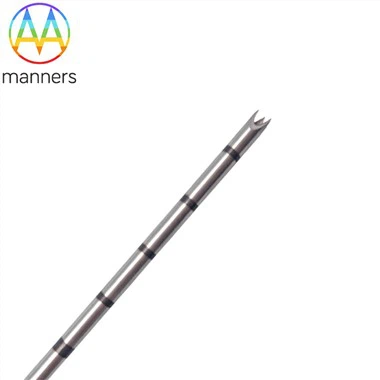
Single-Use Needles: The Real Cost Per Implant
Nov 28, 2026
Target keyword: brachytherapy particle implant puncture needle single use
Needle cost is usually discussed as a line item per unit. In practice the relevant figure is cost per completed implant, and that figure includes track complications, repeat punctures, procedure time, and the documentation burden created by poor traceability. Single-use brachytherapy particle implant puncture needles are inexpensive relative to the procedure that contains them, yet procurement decisions are frequently made on unit price alone. That mismatch produces predictable, measurable downstream cost.
The Hidden Cost of Reuse
Reprocessing a needle that was designed for single use is technically possible and economically attractive on paper. The problems are physical. Steam sterilisation degrades neither the alloy nor the geometry in a single cycle, but repeated cycles accumulate: edges round, bores accumulate residue, and hubs lose the dimensional precision that gives a reproducible datum. The clinical consequence is a needle whose insertion force increases gradually and whose depth seating becomes less certain, which manifests as drift in seed placement rather than an obvious failure.
There is also a documentation problem. A reprocessed device carries a new sterilisation record but the original lot identity is lost or becomes ambiguous. In audit, the link between the implanted device and the batch dimensional data is broken, which undermines any retrospective analysis of placement error. For programmes operating under European or North American quality expectations, that gap is a compliance issue rather than a convenience issue.
The third cost is procedural. A reused needle that sticks adds minutes to a case, and minutes in an interventional suite are expensive. If it sticks at depth and forces a second puncture, the cost includes additional imaging, additional sedation, and a measurable increase in complication risk. Cases where reuse appears to save money are often cases where the savings are offset by a single repeat puncture.
What Drives Needle Unit Cost
Four factors dominate manufacturing cost. Material specification is first: a controlled-alloy stainless tube with certified inclusion content costs more than a commercial tube, and the difference is justified by machinability and consistent mechanical behaviour. Second is the machining route. Necking, swaging, turning, and laser cutting each have different capital and cycle costs; a tapered transition produced by swaging is fast but requires tooling, while a machined taper is flexible but slow.
Third is finishing. Electropolishing, passivation, lumen cleaning, and marking each add steps and yield loss. A needle that fails a push test at final inspection has already consumed most of its cost. Fourth is packaging and sterilisation. A validated sterile barrier, a Tyvek-to-film seal, and ethylene oxide or gamma sterilisation with the associated validation add cost that is invisible in the unit price discussion but real in the invoice.
Understanding this structure explains why quotes vary so widely for apparently identical needles. Two suppliers can offer the same gauge, length, and hub while differing by a factor of two in price, because one is controlling bore concentricity and functional force and the other is controlling only the drawing dimensions.
Product Tiers and Their Trade-offs
A practical way to structure a catalogue is three tiers. The standard tier covers routine percutaneous implantation with defined dimensional tolerances, a general-purpose finish, and basic sterile packaging. The precision tier adds controlled concentricity, straightness, and per-lot functional force testing, at a modest premium. The procedure-specific tier is designed for a named technique: template-compatible hub geometry, calibrated depth datum, instrumented tracking compatibility, or a lumen optimised for a particular seed format.
The tiers are not a marketing hierarchy. A high-volume prostate programme may be best served by the precision tier for its daily work and the procedure-specific tier only where anatomical complexity demands it. A low-volume programme handling heterogeneous referrals may find that a single precision-tier needle across all cases reduces inventory complexity without increasing cost per implant.
The trade-off that deserves scrutiny is between customisation and standardisation. Custom lengths, gauges, and hub forms improve fit to a specific workflow but lengthen lead times and complicate inventory. Most programmes are better served by standardising on two or three configurations and reserving custom designs for techniques that genuinely cannot be served by a catalogue item.
Building a Cost-Effective Kit
A kit should be sized to the case, not to the carton. Overly large kits create waste through unused items expiring on the shelf; overly small kits create intra-operative shortages that force improvisation. The practical approach is to define a standard kit per procedure type and a small supplementary module for complications, containing one extra needle of the next larger gauge, one extra stylet, and a spare depth-reference marker.
Traceability belongs in the kit design as well. Each needle should carry a lot identifier that can be recorded in the procedure note without transcription error, and the kit should include a single sheet on which the operator records gauge, lot, and any deviation from plan. This sheet is the raw material for later dosimetry review and for supplier performance discussions, and it costs almost nothing.
Inventory control is the third element. Needles have shelf lives defined by the sterile barrier, not by the steel. Rotating stock so that older lots are used first prevents expiration write-offs, and keeping lot numbers grouped by receipt allows a supplier quality issue to be traced to a specific delivery rather than to the whole catalogue.
Procurement Experience
Programmes that have moved from unit-price purchasing to cost-per-implant purchasing report a consistent shift in the conversation. Suppliers begin providing functional data because it is now a scored criterion; complaint rates fall because the causes are visible; and the internal cost of repeat punctures becomes measurable rather than anecdotal. The transition requires that the programme record enough data to compute cost per implant, which in turn requires the traceability described above.
A second observation concerns tendering. Specifications written around gauge and material alone attract the widest range of quality at the lowest price. Specifications that include concentricity, straightness, insertion force band, lumen push force, marking durability, and per-lot documentation narrow the field to suppliers who can actually measure those properties, which is the intended effect.
Where the Money Actually Goes
A useful exercise for any procurement committee is to allocate the cost of a complicated implant across its components. The needle is typically a small fraction; the imaging time, the interventional suite occupancy, the sedation, the consumables, and the professional time dominate. A needle that costs twice as much but reduces procedure time by ten minutes, or removes one repeat puncture in fifty cases, is cheaper per implant by a wide margin. The arithmetic is simple once it is performed, and it is rarely performed because unit price is the number that appears on the purchase order.
The same logic applies within a catalogue. Paying a premium for per-lot functional data has value only if the programme uses that data, which means recording lot numbers and reviewing complaints against them. Paying a premium for a sterile barrier that opens reliably has value every single case, because a barrier that is difficult to open under sterile conditions costs seconds and occasionally costs sterility. Paying for a custom hub has value only where the platform requires it. Distinguishing these three kinds of premium prevents both under-buying on the items that matter and over-buying on the items that do not.
A final commercial point is that cost per implant improves fastest through reliability, not through discount. A programme that eliminates repeat punctures sees a larger saving than a programme that negotiates a ten percent price reduction, because the repeat puncture consumes a second set of consumables, additional imaging, and additional professional time. Reliability, in turn, comes from specifying measurable properties and auditing them, which is a purchasing decision as much as a clinical one.
Summary
The cost of a brachytherapy particle implant puncture needle is best assessed per completed implant, not per unit. Reuse carries hidden geometric, documentation, and procedural costs. Unit cost is driven by alloy specification, machining route, finishing, and sterile packaging, which explains why apparently identical products differ in price. A tiered catalogue, a right-sized kit, and a specification built on measurable performance convert procurement from a price comparison into a quality decision.
Outlook
As implantation moves toward template guidance and robotic delivery, the needle's contribution to outcome becomes easier to quantify and therefore easier to price. Programmes that already record lot-level performance data will be positioned to negotiate on measured value; suppliers who can supply that data will be able to defend a premium that unit-price purchasing would have erased. The direction is clear: the needle is becoming a documented instrument, and documentation is what makes cost per implant a meaningful number. It also changes the internal conversation: the argument shifts from which supplier is cheaper per unit to which supplier can show that a case ran once, on plan, without a repeat puncture.