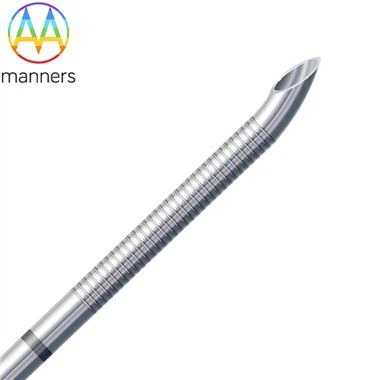
Silicon-Coated Needles: Smoother InsertioN
Nov 27, 2026
Silicon-Coated Brachytherapy Needles
Every brachytherapy case begins with a mechanical event that no treatment plan can model: the needle passing through skin, perineal tissue, fascia and gland. The force required for that passage is transmitted back through the needle to the operator's hand, and from the hand into the target volume as deformation. Silicon-coated needles address the first link in that chain by reducing the friction between the cannula and the tissue it displaces.
This article treats coating as an engineering decision rather than a marketing feature. It explains why friction is a clinical problem, how the coating works, how coated products are classified, how to use them well, what experienced users have learned, and where the technology is heading.
Why Friction Costs Accuracy
The first cost is deflection. A needle pushed through resistant tissue bends, and a bent needle does not follow the planned line. In a template-based procedure the entry point is fixed, so deflection at depth moves the tip off the grid coordinate. The operator cannot see this on the hub, only on the image, and by then the needle must be withdrawn and redirected.
The second cost is target displacement. Force applied at the perineum compresses and shifts the gland. When force is released, the gland springs back, and the needle now sits at a different relative depth than it did under load. This "spring-back" error is one of the classic explanations for seeds found a few millimetres proximal to plan.
The third cost is tract trauma. Each pass creates a tract that bleeds and swells. Oedema changes the acoustic appearance of the gland and increases the distance between seeds, which affects dosimetry. Fewer traumatic passes mean less oedema and a dose distribution closer to the plan.
The fourth cost is operator fatigue. High friction forces a tighter grip and a firmer push, and grip force degrades fine depth control. In a twenty-needle template, the difference between a smooth tract and a dragging tract is the difference between a controlled case and an exhausting one.
The fifth cost is time. A needle that enters easily needs fewer probe adjustments, fewer repositions and fewer confirmations. Room time is the most expensive resource in a brachytherapy programme, and friction is a direct tax on it.
How the Coating Works
Silicon coating is a thin, low-friction film bonded to the outer surface of the stainless cannula. Its function is to lower the coefficient of friction between steel and tissue, so that the same advance requires less axial force. The effect is not lubrication in the sense of oil; it is a surface property that persists along the working length.
Application is a process, not a dip. Surface preparation comes first, because a film bonded to contaminated steel will not last. Cleaning, passivation and controlled drying establish the substrate. The coating is then applied to a specified thickness and cured under controlled conditions. Thickness matters in both directions: too thin and the film wears through at the tip region, too thick and it can blunt the entry feel or shed particles.
Bonding quality decides durability. A coating that survives one pass but degrades over a long case leaves the operator with a needle that behaves differently at needle fifteen than it did at needle one. Adhesion testing, friction testing and visual inspection under magnification are therefore part of the manufacturing specification, not optional extras.
The coating must coexist with the rest of the design. The tip still has to be sharp and, where required, echo-enhanced. The bore still has to be polished and electropolished so that seeds and spacers move smoothly. The hub still has to carry a foil marker for bevel orientation and centimetre graduations for depth. Coating improves the insertion event; it does not substitute for the other functions.
There is also a compatibility question. Some sterilisation cycles and some cleaning agents degrade thin films. The supplier should be able to state which sterilisation methods the coating tolerates and how many cycles it is expected to survive, so the department can plan reprocessing and stock rotation realistically.
Classification and Configuration
Coating specification is the first axis. Products differ in film thickness, in adhesion system and in the surface preparation standard applied before coating. For most departments the practical distinction is between a standard low-friction film and a specification written around a particular insertion force target.
Gauge is the second axis. The family runs from 8G to 20G, including 11G, 13G, 14G, 15G, 16G and 18G, with custom sizes available. Friction scales with contact area, so large-gauge needles benefit most from coating, while small-gauge needles benefit in absolute terms less but still feel the difference in fine tissue.
Tip format is the third axis. Bevel angle, grind quality and echo enhancement are specified independently of the coating. A coated needle with a poor bevel is still a poor needle.
Hub format is the fourth axis. Round and square hubs, both with foil markers for bevel orientation and centimetre markings for depth. Custom colours are available, and colour coding is genuinely useful when several gauges are on the same tray.
Bore finish is the fifth axis. The inside diameter is polished and electropolished for smooth seed deployment, which is a separate requirement from outer-surface friction. A needle can be slippery outside and still drag internally if the bore is not finished correctly.
Customisation closes the list. Lengths, colours and full configurations can be produced from a 2D drawing, a 3D model or a physical sample, with standard carton or customer-specified packaging.
Using Coated Needles in Practice
Before the case, confirm the gauge and length against the plan, inspect the coating along the working length for gaps or blisters, and verify that the stylet moves freely. A coating defect near the tip is the most consequential kind, because that region carries the highest load.
Prepare the tract as the technique requires, and advance the needle steadily. Coating reduces friction but does not eliminate the need for a controlled push. A single smooth advance with consistent force is better than a series of short jabs, which break the film's benefit and shear the tract.
Watch the depth graduations and the hub marker, not only the image. The graduations give the nominal depth, the marker gives the bevel direction, and the image confirms position. When a coated needle feels unexpectedly resistant, stop and investigate rather than pushing harder; resistance usually signals a tip problem, a bent needle or a tract that has been entered at an unfavourable angle.
Deposit in one continuous stylet push with a small coordinated withdrawal. Then withdraw the needle along its own axis without levering, because lateral force is what damages coatings and tracts alike.
Document gauge, length, lot, coating specification and depth. If a case later shows unexpected oedema or a systematic proximal shift, the record allows the department to separate technique from product.
Lessons From Experienced Users
The first lesson is that coating is not a substitute for sharpness. Departments that bought coated needles with mediocre bevels found the insertion force unchanged and concluded, wrongly, that coating does not work. The correct comparison keeps every other variable constant.
The second lesson is that the first centimetre matters most. Entry through skin and fascia loads the tip heavily, so a coating that is intact at the tip and along the first few centimetres is what the operator actually feels.
The third lesson is about wetting. Some operators lubricate the needle before insertion out of habit. With a bonded low-friction film this is usually unnecessary and can even impair performance, so follow the supplier's instruction rather than tradition.
The fourth lesson is that coated and uncoated stock should not be mixed within one tray without clear colour coding. In a busy room, a needle that behaves differently from its neighbours is a source of inconsistency, and inconsistency is an accuracy problem.
The fifth lesson is economic. Coating adds cost per unit, so the case for it rests on measurable gains: fewer redirects, shorter room time, less oedema. Departments that track those metrics can justify the specification; departments that do not tend to revert to the cheapest option and then absorb the cost elsewhere.
Summary
Silicon coating is a controlled surface engineering step that lowers insertion friction on a stainless brachytherapy cannula. It reduces deflection, target displacement, tract trauma, operator fatigue and room time, provided the underlying tip, bore and hub design are sound. Gauges from 8G to 20G, multiple tip and hub formats, polished and electropolished bores, and drawing-based customisation allow the specification to match the procedure. The benefit is real but conditional: it appears only when sharpness, bore finish and technique are controlled alongside it.
Outlook
The next step is quantified friction. Suppliers are beginning to publish insertion-force measurements against tissue-mimicking media, which turns a qualitative claim into a specification number that procurement can compare.
Durability testing is the second trend. Adhesion, abrasion and sterilisation-cycle data are becoming part of the product file, because departments want to know how the film behaves late in a long case and after repeated processing.
The third trend is coating tailored to procedure. Different approaches load the cannula differently, so film thickness and surface preparation are being differentiated by route rather than offered as one universal specification.
The fourth trend is traceability. Laser marking of lot, gauge and coating batch on the hub supports the audit trail that radiotherapy departments increasingly maintain, and it shortens recall investigations when a batch issue appears.
Underneath the trends, the requirement is unchanged. The needle must enter with minimal force, carry its seeds without drag, show its tip and state its depth. Coating is one of the four, not a replacement for the other three.
< img alt="news-1-1" src="/uploads/24240/news/202604241539186d0ff.png " />